

Your Faith Journey with EWTN
As we deepen our relationship with the Eternal Word, Jesus Christ, we grow in grace and are transformed by His love and mercy.
931–December 16, 999
Patron Saint of brides, second marriages, widows, stepparents, abuse victims, people in exile, and members of royalty

St. Adelaide, Empress and wife of Otto the Great, was a political leader and a woman of deep faith and charity. She was dedicated to strengthening the Church’s ties to the Holy Roman Empire.
Born the daughter of King Rudolph II of Burgundy, she was married at age 16 to Lothair, King of Italy. Widowed after just three years, she was imprisoned by political rivals but escaped. In 951, she married Otto I, King of Germany.
Victorious in several key battles against Roman enemies, King Otto and St. Adelaide were named Emperor and Empress of the Holy Roman Empire. As empress, St. Adelaide played an influential role in European politics and in supporting the Church.
St. Adelaide used her position to promote monastic reform, build churches, and assist the poor. Known for her generosity, she founded monasteries and supported the Cluniac monastic movement, which sought to reform the Church through prayer and discipline.
After Otto’s death, she oversaw the kingdom’s affairs until her son, Otto II, was of age to assume his birthright. While she continued to have considerable influence, her daughter-in-law, the princess of the Byzantine Empire, turned her son against her, and she was exiled.
She was eventually reconciled with her son and later functioned as regent for her grandson, Otto III, after her son’s death. Despite political struggles, she never ceased her works of charity and devotion.
In her later years, she retired to the monastery at Selz in Alsace, which she had founded. There she devoted herself to prayer, works of mercy, and supporting the monastic community until her death. St. Adelaide died in 999 and was canonized by Pope Urban II in 1097.
As empress, St. Adelaide supported the Cluniac monasteries. She encouraged their reforms and emphasis on the renewal of prayer and liturgy in monastic life. St. Adelaide played a significant role in strengthening religious reform across Europe. Her close relations with the Abbey of Cluny, a key center of monastic reform, promoted the growth of the Cluniac order in Germanic lands.
Accounts suggest that she died disappointed that she had not seen Jesus’ return. During the Middle Ages, many people believed that Jesus might soon return, particularly in the years leading up to the year 1000. She was possibly influenced by these beliefs, and stories told of her desire to see the beginning of the new millennium. She died just two weeks before the start of the year 1000.
St. Adelaide was a devout Christian, a powerful empress, and a capable leader. Her connections and influence helped her to keep the empire safe and protect her family’s legacy during times of transition. When her daughter-in-law died, St. Adelaide oversaw the kingdom until her grandson, Otto III, was old enough to assume the throne. Under her watch, the kingdom enjoyed peace and stability.
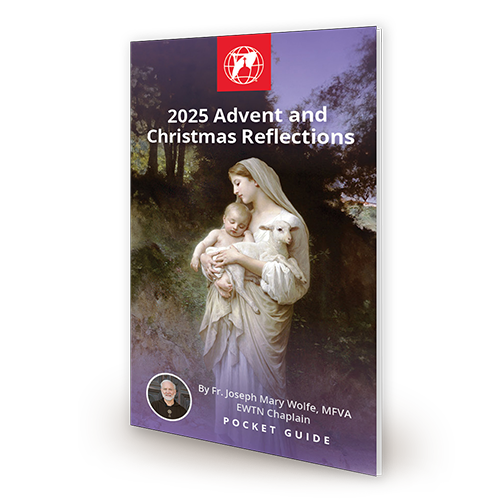
Sign up below for the free 2025 Advent and Christmas Reflections pocket guide, featuring meditations by Fr. Joseph Mary Wolfe, the EWTN Chaplain. His video series will also be sent to your email each Sunday of Advent and throughout the Christmas season. When you request the pocket guide by mail, we’ll also email you the eBook version. Or you may choose to receive just the eBook version and video series.
Send me the Physical Pocket Guide
Only available to homes in the U.S.A., while supplies last.
Send me the eBook
As we deepen our relationship with the Eternal Word, Jesus Christ, we grow in grace and are transformed by His love and mercy.
STEP 1
We’re here to serve you. Let us help you complete your gift with confidence.

Send a message to Mission Advancement.

Guidance for DAFs, stock, IRA, and more.

Manage your gifts and preferences.