

Your Faith Journey with EWTN
As we deepen our relationship with the Eternal Word, Jesus Christ, we grow in grace and are transformed by His love and mercy.
630-637 –709-710
Patron Saint of teachers, scholars, students, arms dealers, guards, soldiers, butchers, against plague and epilepsy, Libya

St. Adrian of Canterbury was a scholar, abbot, and teacher in the 7th century whose legacy shaped the intellectual and spiritual life of Anglo-Saxon England. Born in the region of Cyrenaica, Libya, St. Adrian belonged to a distinct ethnic group indigenous to North Africa. This group used a common language and lived there before the arrival of the Arabs, according to Venerable Bede, a historian.
St. Adrian became abbot of a monastery near Naples, Italy, and was known for his scholarly work in scripture, his knowledge of Greek and Latin, and his piety.
Twice offered the archbishopric of Canterbury by Pope Vitalian, St. Adrian humbly declined, saying he was not worthy of the post. Eventually, he agreed to accompany his friend, Theodore of Tarsus, to England as a trusted adviser. In 668, St. Adrian was appointed abbot of the monastery of Sts. Peter and Paul in Canterbury, later known as St. Augustine’s Abbey.
Under St. Adrian’s leadership, the monastery became a flourishing center of learning in Europe. He established a school that taught future bishops and abbots in Latin, Greek, Scripture, theology, Roman law, and arithmetic.
St. Adrian’s influence helped shape the development of the English Church and produced many saints. He died on January 9, 710 A.D., in Canterbury. Centuries later, his body was discovered incorrupt, a sign of sanctity.
St. Adrian twice declined an offer by Pope Vitalian for the role of Archbishop of Canterbury out of profound humility. Each time, he insisted that he was unworthy of such a highly esteemed position, according to Bede, a 7th-century historian. St. Adrian recommended his friend Theodore for the post. He eventually agreed to serve as an advisor to his friend Theodore of Tarsus. Both St. Adrian and Theodore were highly educated and fluent in Greek and Latin.
Faithful to Pope Vitalian, Theodore placed St. Adrian as head of the Sts. Peter and Paul Monastery. He founded a renowned monastic school where he taught for 39 years. St. Adrian’s leadership in education made the school a prominent center of learning where many bishops and abbots prepared to serve the English Church.
St. Adrian established a monastic school in Canterbury that became a major center of Christian learning. His most significant contribution to the Church in England was introducing an intellectual and scholarly educational model in Anglo-Saxon England. St. Adrian inspired a new generation of scholars who contributed to the development of the Church in the region.
Serving as abbot of the Monastery of Saint Peter and Saint Paul in Canterbury, St. Adrian expanded the curriculum to include Greek and Latin literature, Greek and English poetry, and arithmetic. He prepared a new generation of scholars who, in turn, continued to spread knowledge throughout England and Europe.
During construction at the abbey, centuries after his death, St. Adrian’s remains were found to be incorrupt. News of the incorrupt body spread, and the abbey became a significant pilgrimage site where many miracles were reported. His relics are buried at St. Augustine’s Abbey in Canterbury, England, where he served as abbot. His body was reinterred and honored at St. Augustine’s Abbey. Although the abbey is no longer in use, the remains of St. Adrian, along with other Anglo-Saxon saints, are buried there.
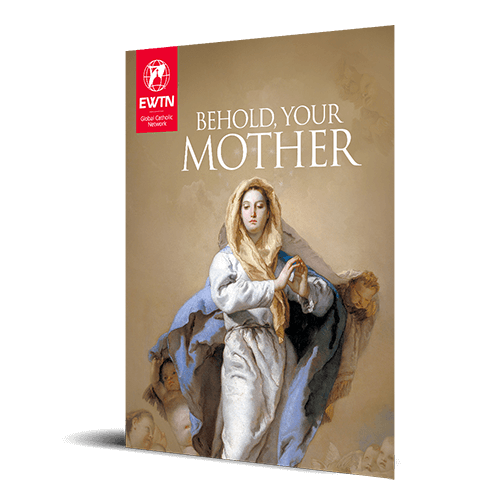
We hope this special eBook will draw you closer to our Blessed Mother and her Son, Jesus Christ. We trust that the following pages will bring your heart under her mantle, as we share a few of the beautiful and befitting names bestowed upon the Blessed Virgin Mary.
As we deepen our relationship with the Eternal Word, Jesus Christ, we grow in grace and are transformed by His love and mercy.
STEP 1
We’re here to serve you. Let us help you complete your gift with confidence.

Send a message to Mission Advancement.

Guidance for DAFs, stock, IRA, and more.

Manage your gifts and preferences.