

Your Faith Journey with EWTN
As we deepen our relationship with the Eternal Word, Jesus Christ, we grow in grace and are transformed by His love and mercy.
December 8, 607–January 23, 667
Patron Saint of theologians; scholars; writers; education; protection against floods; Toledo, Spain; Zamora, Spain

St. Ildefonsus of Toledo is one of the greatest saints from Spain, along with St. Isidore of Seville. He was a bishop, theologian, and ardent devotee of the Blessed Virgin Mary, whose teachings and theological writings helped shape the faith of Spain for centuries.
He was born into a noble family in Toledo, Spain, in the early seventh century. He entered the monastery of Agali near his home, where he devoted himself to prayer and study. Drawn to the monastic life, he later became abbot and was noted for his humility, wisdom, and love of learning.
St. Ildefonsus was ordained a deacon and attended the Councils of Toledo, where he played a key role in collaborative decision-making with secular leaders. By doing so, he pioneered relationships between the Church and state in medieval Europe. In 657, he was elected Archbishop of Toledo, succeeding his mentor St. Eugenius II. As bishop, St. Ildefonsus became renowned for his writings, particularly his treatise On the Perpetual Virginity of Holy Mary, which supported the dogma of Mary’s perpetual virginity.
According to tradition, the Blessed Virgin appeared to St. Ildefonsus in the cathedral, clothed in radiant light, and presented him with a chasuble, a priestly vestment, as a sign of her favor. The event so moved the people of Toledo that the Feast of the Virgin’s Appearance to St. Ildefonsus was celebrated for centuries.
St. Ildefonsus died in 667 after a decade in office. He was buried in the basilica in Toledo. Iberian missionaries promoted his story, theological writings, and pious teachings worldwide, which had a profound influence on the Church, especially in Spain, Portugal, Latin America, and the Philippines.
When he was the abbot of Agali and later as Archbishop of Toledo, St. Ildefonsus played a key role in the Councils of Toledo. He participated in the Eighth and Ninth Councils of Toledo in 653 and 655. The Eighth Council was notable for including secular officials for the first time in the discussion and voting, a development St. Ildefonsus’s involvement helped to formalize. His involvement helped establish the council’s decrees, particularly in granting secular leaders a role in ecclesiastical decisions. This move contributed to the collaboration between the Church and state in medieval Europe. His actions also contributed to the unification of the Spanish liturgy and the standardization of practices, such as the celebration of Mass.
St. Eugenius II was a mentor to St. Ildefonsus of Toledo. He was the first bishop to mentor the young deacon. Recognizing St. Ildefonsus’s great learning and virtue, St. Eugenius sent him to study under St. Isidore of Seville. When he returned, St. Eugenius made him an archdeacon of the Church in Toledo. St. Ildefonsus later succeeded St. Eugenius as Archbishop of Toledo.
St. Ildefonsus remains one of the most revered early bishops of the Iberian Church. His influence on the Church in Spain included promoting Marian devotion, helping to establish a union between the Church and the state, and advocating for increased faith among the laity through his writings and pastoral work. He was a prolific writer, and his work, particularly On the Perpetual Virginity of Holy Mary, widely influenced Spanish Marian theology. St. Ildefonsus also influenced the practice of celebrating Mass on Saturdays in honor of Mary. On one occasion, it is said that the Virgin Mary appeared to St. Ildefonsus and presented him with a priestly garment as a reward for his zeal and devotion to her. As the Archbishop of Toledo, he contributed to the collaborative union of Church and state common in medieval Europe. St. Ildefonsus was widely venerated for a life of holiness. He was memorialized in paintings by the famous Spanish artists El Greco and Diego Velázquez.
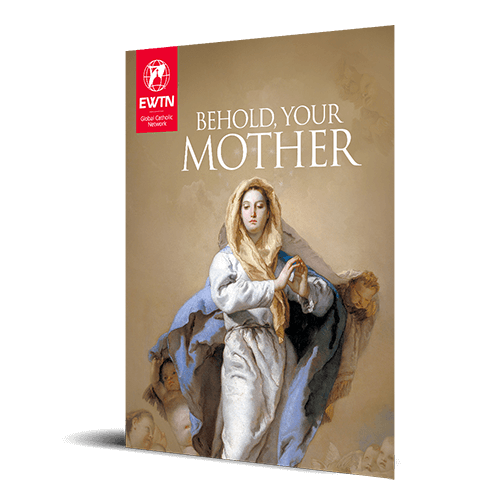
We hope this special eBook will draw you closer to our Blessed Mother and her Son, Jesus Christ. We trust that the following pages will bring your heart under her mantle, as we share a few of the beautiful and befitting names bestowed upon the Blessed Virgin Mary.
As we deepen our relationship with the Eternal Word, Jesus Christ, we grow in grace and are transformed by His love and mercy.
STEP 1
We’re here to serve you. Let us help you complete your gift with confidence.

Send a message to Mission Advancement.

Guidance for DAFs, stock, IRA, and more.

Manage your gifts and preferences.