

Your Faith Journey with EWTN
As we deepen our relationship with the Eternal Word, Jesus Christ, we grow in grace and are transformed by His love and mercy.
3rd century-c. 324

St. Philogonius served as Bishop (Patriarch) of Antioch in a time of both trial and doctrinal unrest.
Born in Antioch, St. Philogonius was educated in the law and became a distinguished advocate, known for his eloquence, integrity, and his defense of the poor, widows, and orphans. Married and with a daughter, St. Philogonius entered private life deeply committed to Christian virtue. After his wife’s death, he embraced asceticism and became a monk.
Around 318, upon the death of Bishop Vitalis of Antioch, St. Philogonius was chosen to lead the Church of Antioch, despite lacking priestly ordination. St. Philogonius’s outstanding reputation and saintly character allowed specific canonical requirements for the bishopric to be waived, securing his election.
As bishop, St. Philogonius fought Arianism, a heresy begun by Arius that denied the divinity of Christ. He joined contemporaries, such as Alexander of Alexandria, in opposing the false doctrine and defending the faith in Antioch, through synodal letters, and at the Council of Nicaea.
Under persecution by Roman authorities and Emperor Licinius, St. Philogonius was imprisoned. His courage in the face of persecution and his suffering for the Faith led to his title of Confessor. In 324, he passed away peacefully.
St. Philogonius was part of the network of bishops who opposed Arius’s teaching that Christ was a created being. When Arius began propagating his heresy around 318 in Alexandria, St. Alexander condemned the heresy and sent letters to bishops. St. Philogonius helped St. Alexander send out synodal letters defending orthodoxy and argued against Arianism at the Council of Nicaea. He worked to guard his flock and provided theological and pastoral support for those resisting false doctrine. His actions contributed to the Church’s ability to maintain unity and resist doctrinal corruption.
In Church tradition, a “Confessor” is someone who suffers for the faith—through persecution, threats, or trials—but does not die as a martyr. St. Philogonius is called a Confessor because he lived during periods of imperial persecution, yet he endured faithfully. He bore witness by his teaching, leadership, courage, and holiness rather than by shedding blood. His peaceful death “after many labors” is held as testimony to his steadfastness.
About 60 years after St. Philogonius’s death, St. John Chrysostom delivered a panegyric (a formal eulogy) in his honor, celebrating the flourishing state of the Church of Antioch under his leadership. St. John Chrysostom used St. Philogonius’s life as a model of pastoral care, doctrinal purity, and peace, praising how the good bishop had guided the Church through turbulent times.
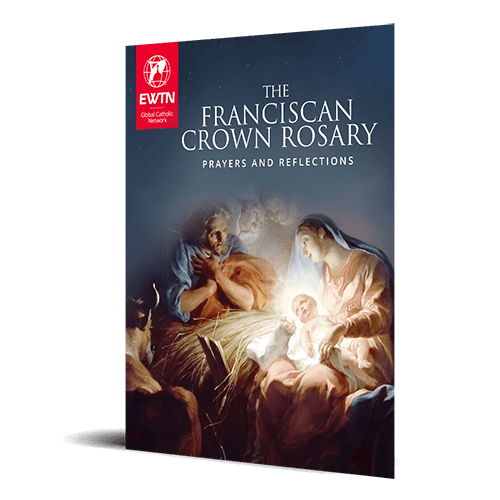
One unique devotion of the Franciscans is a seven-decade rosary known as the Franciscan Crown. While the traditional rosary consists of 5 decades which meditate on 15 mysteries, the 7-decade Franciscan Rosary, known as the Franciscan Crown, is a Rosary consisting of seven decades with each decade describing a particular joy from the life of the Blessed Virgin Mary. We hope that this special resource will help you meditate on each of the Seven Joys of Our Blessed Mother Mary.
As we deepen our relationship with the Eternal Word, Jesus Christ, we grow in grace and are transformed by His love and mercy.
STEP 1
We’re here to serve you. Let us help you complete your gift with confidence.

Send a message to Mission Advancement.

Guidance for DAFs, stock, IRA, and more.

Manage your gifts and preferences.