

Your Faith Journey with EWTN
As we deepen our relationship with the Eternal Word, Jesus Christ, we grow in grace and are transformed by His love and mercy.
c. 6-4 B.C.–c. 4-2 B.C.
Patron Saint of foundlings, babies, Children’s choirs

King Herod’s attempt to eliminate a threat to his throne by killing the Christ Child resulted in the killing of a group of young boys, two years old and younger, known as the Holy Innocents. The Church honors the Holy Innocents on December 28.
This tragic event, recorded in the Gospel of Matthew (2:16–18), fulfilled the prophecy of Jeremiah: “A voice was heard in Ramah, sobbing and loud lamentation; Rachel weeping for her children, and she would not be consoled, since they were no more.”
The Magi who came in search of Jesus had learned about the prophecy of the birth of a Jewish king. Arriving in Jerusalem, it seemed proper to them to inquire with King Herod about the prophecy and where the child might be found.
Herod the Great has gone down in history as a tyrannical king who killed several family members. Fearing a challenge to his throne by a newborn king of the Jews from Bethlehem, it would be consistent with Herod’s character to order the massacre of all boys two years old and under in that region.
While these children could not speak or profess faith, the Church recognizes them as martyrs for Christ. From early centuries, the Church has venerated the Holy Innocents, giving them a special place during the Christmas octave. The Feast of the Holy Innocents is a somber reminder within the joy of Christmas that symbolizes the countless unnamed and unknown who suffer injustice because of sin.
Amid our Christmas joy, we encounter grave injustice in the slaying of the Holy Innocents. The impetus for this evil act was Herod’s unrestrained desire for power. Yet in this tragedy, we see sin and death—the very foes Our Lord came into the world to defeat.
The Holy Innocents are the patron saints of babies and children. Their suffering encourages Christians to protect the dignity of every human life, especially the most vulnerable.
Scripture does not give a number. Early Christian tradition varies on this question. Some writers suggest a few dozen, while later estimates cite much larger numbers. Historically, the number was about a couple of dozen boys under two years old, given the low population of Bethlehem at the time, according to historians.
The feast, celebrated as early as the fifth century, is one of the oldest commemorations of the Church, celebrated with prayers, hymns, and readings. The Feast of the Holy Innocents is recognized in both the Eastern and Western Churches. In medieval Europe, the observance was somber, often involving fasting and penance. Over time, the commemoration has increasingly focused on the sufferings of children—particularly those inflicted by the sins of society—and the need to protect their dignity.
Egypt was already part of the Roman Empire, but it was out of King Herod’s control. An angel told St. Joseph to take the infant Jesus and His Mother to Egypt to protect Him from King Herod’s evil plan to kill the Child. The Holy Family would have traveled for days to reach Egypt, which was a journey of more than 1,200 miles. There were several routes they could have taken along the sea or through the desert, and any route would have been arduous. In Egypt, there was a large Jewish community that would have welcomed them. The Holy Family stayed in Egypt for approximately four years when an angel informed St. Joseph in another dream of Herod the Great’s death and told him to return to Israel.
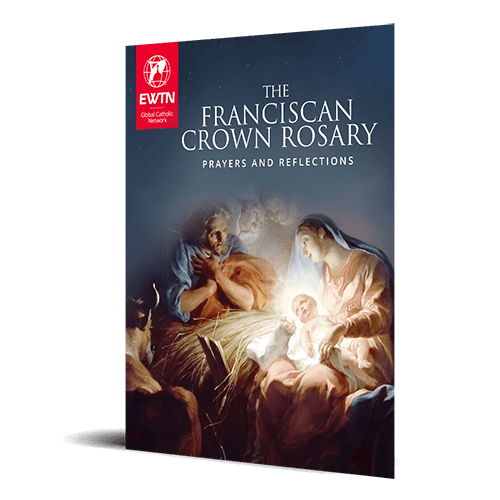
One unique devotion of the Franciscans is a seven-decade rosary known as the Franciscan Crown. While the traditional rosary consists of 5 decades which meditate on 15 mysteries, the 7-decade Franciscan Rosary, known as the Franciscan Crown, is a Rosary consisting of seven decades with each decade describing a particular joy from the life of the Blessed Virgin Mary. We hope that this special resource will help you meditate on each of the Seven Joys of Our Blessed Mother Mary.
As we deepen our relationship with the Eternal Word, Jesus Christ, we grow in grace and are transformed by His love and mercy.
STEP 1
We’re here to serve you. Let us help you complete your gift with confidence.

Send a message to Mission Advancement.

Guidance for DAFs, stock, IRA, and more.

Manage your gifts and preferences.