

Your Faith Journey with EWTN
As we deepen our relationship with the Eternal Word, Jesus Christ, we grow in grace and are transformed by His love and mercy.
c. 1340–November 14, 1391
Patron Saint of Croatia, Franciscan custody of the Holy Land, and the Holy Land in general

St. Nicholas Tavelic, a Franciscan friar in present-day Croatia, was born in the early 14th century to a wealthy noble family. He joined the Franciscan Friars Minor at an early age. A zealous missionary, St. Nicholas Tavelic, answered a call to work as a missionary in Bosnia, where the Faith had fallen into heresy. St. Nicholas spent 12 years in Bosnia, and reports of his missionary efforts indicated that he had converted around 50,000 members of the local church.
In 1383, the Franciscans sent St. Nicholas on a mission to the Holy Land as guardian of the friary in Jerusalem. He lived and preached the Gospel there with his fellow friars, Deodatus Aribert, Peter of Narbonne, and Stephen of Cuneo. The region was under Muslim rule, and Christians were a minority at that time.
He and his companions spent several years learning Arabic and serving at the holy sites connected to Jesus’ life. They preached and conducted their pastoral work quietly at holy Christian sites. Despite the large Muslim population in Jerusalem at the time, they saw few conversions to Christianity. The Franciscan Friars, guided by St. Francis’ Rule of Life, decided to openly preach the Christian Faith to the Muslim people.
They went to the regular gathering of Muslims in Jerusalem and began to preach. They were arrested and imprisoned. Refusing to renounce their Christian beliefs and convert to Islam, they were executed on November 14, 1391, and their remains were burned.
Nicholas and his companions were beatified in 1889 and canonized by Pope Paul VI in 1970. The Franciscan monastery in Šibenik, Croatia, houses a national shrine dedicated to St. Nicholas Tavelic.
St. Nicholas is the first Croatian saint to be canonized by the Catholic Church. He and his companions were canonized in 1970 by Pope Paul VI. Their travels as Franciscan missionaries also show their efforts extended far beyond Western Europe to the Holy Land. It was unusual and dangerous for missionaries to travel to Jerusalem in the late 14th century because the region was under Muslim rule, and public open preaching of Christianity was forbidden and punishable by death. Their decision to evangelize openly was bold and unique, defying the prevailing political and religious climate of the time.
Nicholas and his three companions were executed in Jerusalem in 1391 after openly proclaiming the Gospel to Muslim authorities and refusing to deny their faith. Accounts of how they died vary. Some say they were beheaded, while other accounts say they were killed with a sword and chopped to pieces. What is clear is that their remains were burned completely to prevent Christians from collecting relics of their martyrdom. They are the first Franciscan missionaries known to have been martyred in the Holy Land.
St. Nicholas and his companions discerned before making their decision to preach openly to the Muslim people. Based on St. Francis of Assisi’s Rule, there are two options for friars: ministering in Muslim lands—living a quiet life in witness to Christ or proclaiming the word of God openly when they see it’s God’s will. Nicholas and his companions initially took the first option. Later, St. Nicholas and his companions felt called to give courageous witness to the Truth, even at the risk of martyrdom.
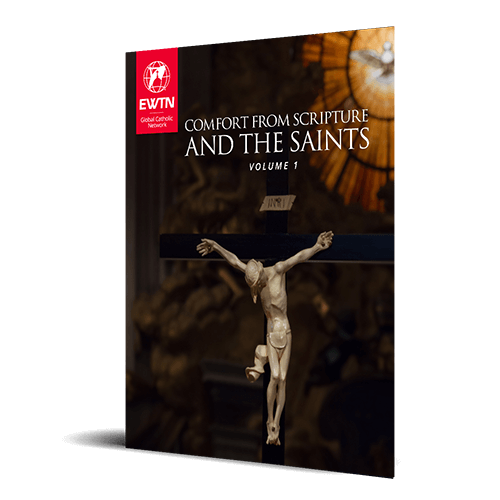
This eBook combines stunning photography from EWTN’s Vatican Bureau along with Bible passages and saints’ quotes that will calm your heart, give you hope, and remind you that God is with us always. Simply fill out the form below and we will send this to you!
Be inspired to follow in the footsteps of the saints. Subscribe to receive the Daily Saint, featuring a brief biography delivered to your inbox each day.
Start now and let the intercession and witness of the saints draw you closer to God.

As we deepen our relationship with the Eternal Word, Jesus Christ, we grow in grace and are transformed by His love and mercy.
STEP 1
We’re here to serve you. Let us help you complete your gift with confidence.

Send a message to Mission Advancement.

Guidance for DAFs, stock, IRA, and more.

Manage your gifts and preferences.