

Your Faith Journey with EWTN
As we deepen our relationship with the Eternal Word, Jesus Christ, we grow in grace and are transformed by His love and mercy.
c. 287–c. 305
Patron Saint of unmarried girls, apologists, dying people, lawyers, librarians, mechanics, millers, nurses, philosophers, scholars

St. Catherine of Alexandria was a noblewoman in the 4th century in Egypt. Being born into a wealthy family made it possible for her to study the arts, philosophy, and the sciences. Her love for learning led her to explore Christian writings. According to tradition, she received a vision of the Blessed Virgin Mary with the Holy Child, and she converted to Christianity.
Her newfound faith soon brought her into conflict with Emperor Maxentius during a time of severe Christian persecution. St. Catherine boldly confronted the emperor, denouncing his cruelty and refusing to renounce her faith. To discredit her, the emperor summoned fifty of his most skilled philosophers to debate her. St. Catherine, however, spoke with such eloquence and conviction that many of them converted to Christianity. Angered, Maxentius had them executed and ordered St. Catherine imprisoned.
While in prison, she reportedly converted even more people, including members of the emperor’s household. According to tradition, when the emperor tried to break her on a spiked torture wheel, the device shattered at her touch. Finally, the emperor had St. Catherine beheaded. It is believed that angels carried her body to Mount Sinai, where the Monastery of St. Catherine still stands today.
St. Catherine’s witness has inspired Christians for centuries. She became one of the Fourteen Holy Helpers in medieval devotion and is honored as the patron saint of philosophers, scholars, students, and anyone seeking wisdom.
She is remembered for her courage, wisdom, and unwavering faith.
St. Catherine’s attempted torture and death by a spinning wheel symbolizes the divine intervention that prevented the initial attempt on her life. By depicting St. Catherine holding or leaning on the wheel, artists symbolize a victory over her torturers and the suffering they inflicted.
The Monastery of St. Catherine at Mount Sinai is an Eastern Orthodox monastery inhabited by monks since its construction in the 6th century. St. Catherine’s relics are housed there, and it is an important pilgrimage site for Christians. The monastery’s location is believed to be the site of the burning bush where God spoke to Moses.
St. Catherine’s feast day was removed from the Roman Catholic Liturgical Calendar in 1969 by Pope St. Paul VI after a commission appointed by the pope reviewed the lives of many saints and concluded that the accounts of St. Catherine’s life lacked sufficient reliable historical details to support the widespread narratives about her life and martyrdom, which emerged centuries after her death.
Pope St. John Paul II restored St. Catherine of Alexandria’s feast day to the Roman Calendar in 2002 as an optional memorial. Visiting the monastery, the pope honored the veneration Eastern Orthodox Christians have for St. Catherine of Alexandria, acknowledged her significance, and affirmed the shared veneration and importance of the saint in both traditions.
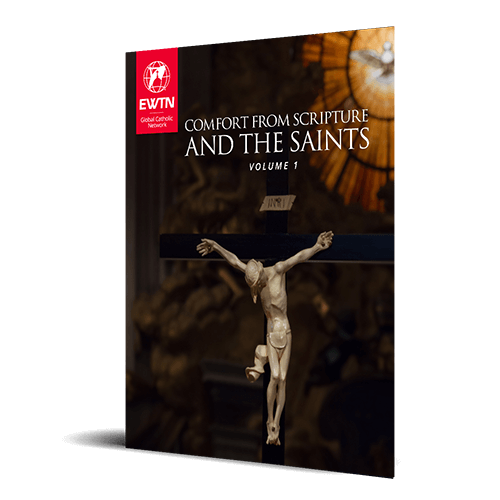
This eBook combines stunning photography from EWTN’s Vatican Bureau along with Bible passages and saints’ quotes that will calm your heart, give you hope, and remind you that God is with us always. Simply fill out the form below and we will send this to you!
Be inspired to follow in the footsteps of the saints. Subscribe to receive the Daily Saint, featuring a brief biography delivered to your inbox each day.
Start now and let the intercession and witness of the saints draw you closer to God.

As we deepen our relationship with the Eternal Word, Jesus Christ, we grow in grace and are transformed by His love and mercy.
STEP 1
We’re here to serve you. Let us help you complete your gift with confidence.

Send a message to Mission Advancement.

Guidance for DAFs, stock, IRA, and more.

Manage your gifts and preferences.