

Your Faith Journey with EWTN
As we deepen our relationship with the Eternal Word, Jesus Christ, we grow in grace and are transformed by His love and mercy.
c. 5 AD–60/70 AD
Patron Saint of fishermen, rope makers, textile workers, farm workers, miners, twelve countries including Scotland, Ukraine, Russia, and Greece, and ten dioceses
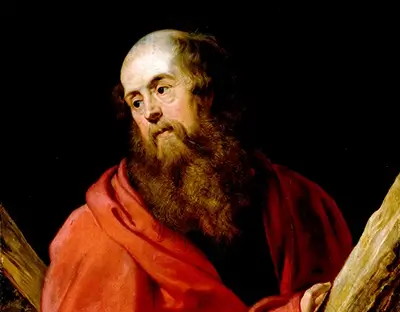
“Rabbi, where are you staying?”
St. Andrew did not hesitate to ask the question that allowed him and another disciple of St. John the Baptist to spend a day in conversation with Jesus Christ just before the start of his ministry.
St. Andrew the Apostle was one of the first disciples called by Jesus Christ. Born in Bethsaida, he and his brother, St. Peter, worked as fishermen along the Sea of Galilee. According to the Gospel of John, St. Andrew was a disciple of St. John the Baptist. After St. John pointed to Christ as the “Lamb of God,” St. Andrew followed Jesus and became one of His first disciples.
St. Andrew is known for bringing people to Christ. He introduced his brother, St. Peter, to Christ. Later, he brought a group of Greeks who asked to meet Him, and a boy whose five loaves and two fish miraculously fed thousands through Christ’s intervention. These moments reflect his desire to help others encounter Christ.
As an Apostle, St. Andrew heard all of Christ’s teachings and witnessed all of Christ’s miracles, including his Resurrection and Ascension. After Christ’s Ascension, St. Andrew proclaimed the Gospel in Greece, Asia Minor, and along the Black Sea. In Patras, Greece, between 60 and 62 AD, St. Andrew was tied to an X-shaped cross, now known as the “St. Andrew’s Cross,” and died a martyr. He bore this suffering with great courage, proclaiming Christ unto death.
Devotion to St. Andrew spread widely. His relics were taken to Constantinople but were moved to Italy during the crusades. His head resides at Petra, Greece. He is honored as the patron saint of Scotland, Russia, Greece, and fishermen.
St. Andrew’s life reminds us of the power of invitation: he was the first to answer Jesus’ call, and he never stopped pointing others toward Him.
Initially, the relics of St. Andrew were kept in Patras, Greece, where he suffered martyrdom. After Christianity became legal in 313, all his relics, except his head, were taken to the Church of the Holy Apostles in Constantinople. During the Crusades in the early 13th century, the relics were relocated to Italy, where they remain in the Cathedral of Amalfi. About 500 years ago, St. Andrew’s skull was taken from Patras to the Vatican. In 1964, Pope St. Paul VI returned it to Patras as a sign of goodwill toward the Greek Orthodox Church.
The name “Andrew” is originally Greek, and its meaning is “man,” “manly,” or “brave/strong.” Pope Benedict commented on St. Andrew’s being of Greek origin in a General Audience. He noted that the interesting thing about St. Andrew is that his name is not Hebrew. Instead, it is Greek. He notes that Jews living in Galilee were exposed to the Greek language and culture and suggested that St. Andrew’s name was an early sign of a broader cultural perspective, which would later serve as a bridge between Jewish and Gentile followers of Jesus.
St. Andrew was a disciple of St. John the Baptist before he met Jesus Christ. St. John the Baptist’s ministry was to prepare the way for Christ. St John the Baptist’s disciples learned about repentance and the coming Messiah. Their decision to follow Jesus was the fulfillment of St. John’s mission to point people to the Messiah.
When St. John the Baptist identified Jesus as the “Lamb of God,” St. Andrew and another disciple immediately began to follow Jesus. St. Andrew was so convinced Jesus was the Messiah that he immediately shared this revelation with his brother, St. Peter. Christ called both brothers to follow Him.
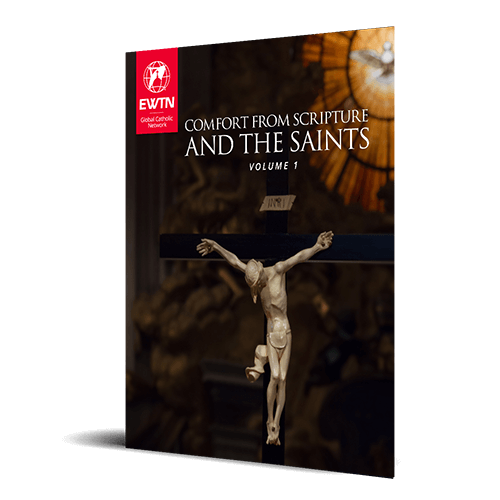
This eBook combines stunning photography from EWTN’s Vatican Bureau along with Bible passages and saints’ quotes that will calm your heart, give you hope, and remind you that God is with us always. Simply fill out the form below and we will send this to you!
St. Andrew, one of the Twelve Apostles, is celebrated as a key collaborator in Jesus’ mission and a foundation of the Church.
Be inspired to follow in the footsteps of the saints. Subscribe to receive the Daily Saint, featuring a brief biography delivered to your inbox each day.
Start now and let the intercession and witness of the saints draw you closer to God.

As we deepen our relationship with the Eternal Word, Jesus Christ, we grow in grace and are transformed by His love and mercy.
STEP 1
We’re here to serve you. Let us help you complete your gift with confidence.

Send a message to Mission Advancement.

Guidance for DAFs, stock, IRA, and more.

Manage your gifts and preferences.