

Your Faith Journey with EWTN
As we deepen our relationship with the Eternal Word, Jesus Christ, we grow in grace and are transformed by His love and mercy.
September 15, 1858–December 1, 1916
While St. Charles has no official patronage, he is recognized as a patron saint of diocesan priests and those who live far from home

“My God, if you exist, let me come to know you.”
These words became a prayer that St. Charles de Foucauld said in the middle of the Sahara Desert among Muslim people. While he admired their strong faith, he wanted to introduce them to Christ.
Born into an aristocratic family in Strasbourg, France, St. Charles experienced much loss in his early years. He was orphaned at the age of six and taken in by his paternal grandmother, who also soon passed away. Although a loving maternal grandfather raised him, he drifted from the Catholic Faith. Later, he served in the military and traveled in Algeria and Morocco.
Seeking ever to know God and find purpose in life, St. Charles entered monastic life as a Trappist monk and was ordained a priest in 1901.
He felt called to live among the most marginalized—particularly the Tuareg people in the Sahara Desert. There, he embraced a life of simplicity, prayer, hospitality, service, and cultural respect. Amid the silence of the desert, the desire for a deeper understanding of his faith came as a prayer from deep within him, “My God, if you exist, let me come to know you.”
He spent eleven years with the Tuareg people. He learned their language, translated Scripture, compiled a Tuareg-French dictionary, and offered them his friendship. He hoped to found a new community following Jesus’ hidden years in Nazareth, inspired by his travel to the Holy Land and expressed in love, humility, and small daily tasks.
He was shot and killed on December 1, 1916, in Tamanrasset, Algeria, by an armed group of tribal Muslim bandits. The attack was prompted by conflicts during World War I and strong sentiments against European foreigners.
St. Charles was canonized by Pope Francis in 2022 following a miracle attributed to him that helped a man inexplicably recover from a fatal accident in 2016.
After serving in Algeria, St. Charles inherited a substantial fortune upon his grandfather’s death. He used it partly to travel to Morocco disguised as a Jew, with help from a rabbi, to explore forbidden territories. Seeing the lived faith of Muslims there and wrestling with spiritual questions awakened in him a longing for God, which led him into a deeper conversion.
St. Charles de Foucauld believed that holiness called him to be “among the furthest removed, the most abandoned.” He moved to Tamanrasset among the Tuareg to share in their daily life. He learned their language, translated the Gospels and Psalms, and created a Tuareg-French dictionary. Their generous hospitality and faith impressed him and shaped his own spiritual practice of brotherhood.
His pilgrimage to the Holy Land awakened in him the desire to live as Jesus did during His hidden years in Nazareth. The spiritual practice centered on doing the ordinary: working, being close to family, and praying in obscurity. This practice led to St. Charles’s labor as a gardener and sacristan, and his choosing to live among the marginalized.
In December 1916, during World War I, tensions and violence flared around French presences in Algeria. While living in his hermitage in Tamanrasset, St. Charles went out to warn two visiting French soldiers of danger from bandits. He and the soldiers were seized; St. Charles was shot and killed. He died a martyr because his assassination occurred in the context of his Christian witness to the Muslim world, a sacrifice he had personally reflected on and chosen. His fidelity to Christ, both in life and in death, was evident in his dedication to the missionary work he was doing when he was killed. His presence in that place and time, and for his purpose there, made his death a witness to his Christian faith.
A carpenter named Charlie survived a 50-foot fall onto a wooden pew. The fall should have been fatal. The pew’s armrest impaled the worker, penetrating near his heart and out through his back. Yet Charlie managed to get up and call emergency assistance for himself. This event took place on the 100th anniversary of St. Charles de Foucauld’s death.
Charlie’s employer, a Catholic, called his wife, who texted the family’s parish priest at St. Charles de Foucauld Parish. The parishioners prayed fervently for Charlie’s recovery. Doctors could not explain his survival. He was hospitalized for a week and soon returned to work. He had no long-term health consequences from the fall. In 2020, the Church recognized the incident as a miracle, paving the way for St. Charles’s canonization in 2022.
Father,
I abandon myself into your hands;
do with me what you will.
Whatever you may do, I thank you:
I am ready for all, I accept all.
Let only your will be done in me,
and in all your creatures—
I wish no more than this, O Lord.
Into your hands I commend my soul:
I offer it to you with all the love of my heart,
for I love you, Lord, and so need to give myself,
to surrender myself into your hands without reserve,
and with boundless confidence,
for you are my Father.
Charles de Foucauld
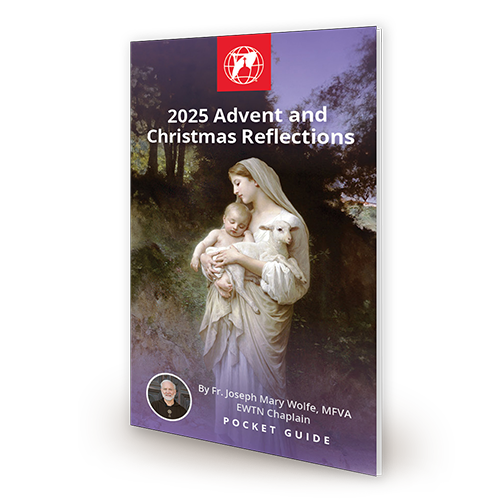
Sign up below for the free 2025 Advent and Christmas Reflections pocket guide, featuring meditations by Fr. Joseph Mary Wolfe, the EWTN Chaplain. His video series will also be sent to your email each Sunday of Advent and throughout the Christmas season. When you request the pocket guide by mail, we’ll also email you the eBook version. Or you may choose to receive just the eBook version and video series.
Send me the Physical Pocket Guide
Only available to homes in the U.S.A., while supplies last.
Send me the eBook



The miracle that led to St. Charles de Foucauld being declared a saint
Be inspired to follow in the footsteps of the saints. Subscribe to receive the Daily Saint, featuring a brief biography delivered to your inbox each day.
Start now and let the intercession and witness of the saints draw you closer to God.

As we deepen our relationship with the Eternal Word, Jesus Christ, we grow in grace and are transformed by His love and mercy.
STEP 1
We’re here to serve you. Let us help you complete your gift with confidence.

Send a message to Mission Advancement.

Guidance for DAFs, stock, IRA, and more.

Manage your gifts and preferences.