

Your Faith Journey with EWTN
As we deepen our relationship with the Eternal Word, Jesus Christ, we grow in grace and are transformed by His love and mercy.
c. 675/676 A.D.–December 4, 749 A.D.
Patron Saint of pharmacists, iconographers, and theology students

St. John Damascene was a monk, an apologist for the Christian faith, and a poet. His theological writings had a similar influence on the Eastern Church as those of St. Thomas Aquinas had on the Western Church.
St. John was born into a wealthy Christian family in Damascus in the late seventh century, during a time when the region was under Muslim rule. His father and grandfather served in government under the early Muslim caliphates.
St. John was educated by a Christian tutor who stirred in him a love for theology, philosophy, and the Christian faith. He studied both Greek and Arabic texts, making him adept at defending the Christian faith. Initially, St. John held a government post in Damascus; however, feeling the call to serve God, he left his position to enter monastic life at Mar Saba, located southeast of Jerusalem.
During this time, the Byzantine emperor sparked a controversy against the use of icons in the Church. The emperor destroyed the icons and forbade their use, creating growing hostility toward religious icons. St. John boldly defended the use and veneration of sacred images as extensions of the Incarnation. His writing, Fountain of Knowledge, used philosophical reasoning and the doctrines of the Greek Fathers to develop theological support for the use of icons in both the Eastern and Western Christian churches.
The argument resulted in St. John’s right arm being severed by the Muslim Caliph, who believed a false account accusing St. John of treason against the Caliphate. The Byzantine emperor, in enraged retaliation for St. John’s defense of icons, forged a letter and spread the lie. According to tradition, the Blessed Virgin Mary restored St. John’s hand through a miraculous intercession.
St. John Damascene’s theological works also include the Exposition of the Orthodox Faith, which summarizes doctrine grounded in the teachings of the Greek Fathers. St. John was also gifted in poetry writing. His contributions to the Church’s liturgy include a major composition of the Easter Canon, as well as canons for the Nativity, Epiphany, Ascension, Transfiguration, Pentecost, and for the departed.
St. John’s tutor was a monk named Cosmas, a native of Sicily. He had been freed from slavery or captivity and was very learned in theology, Greek culture, and the classical sciences. Under Cosmas’s guidance, St. John gained proficiency not only in scriptural theology but in logic, philosophy, astronomy, music, and secular learning. This well-rounded education made St. John especially effective in engaging disputed theological issues of his time.
St. John Damascene’s legacy is his rich collection of writings. His work, titled “The Sources of Knowledge,” presents a synthesis of the doctrine of the Orthodox faith grounded in the Greek Fathers. It also introduces logic and philosophy and addresses heresies and contemporary religious issues. In addition, he wrote with profound insight about the theology of the Mother of God. His many sermons left a robust collection of information and teachings about the Gospels, the saints, and liturgical feasts. St. John was also gifted in poetry writing. His contributions to the Church’s liturgy include a significant composition of the Easter Canon, as well as canons for the Nativity, Epiphany, Ascension, Transfiguration, Pentecost, and for the departed.
The controversy against the use of religious icons refers to edicts issued by Byzantine Emperors forbidding the veneration of religious images (icons) for worship and ordering their destruction. In his treatise, Against Those Who Revile the Holy Icons, St. John argued that the Incarnation of Christ makes images legitimate and helpful in worship, challenging the emperors. Although he faced slander and had his hand cut off because of a false accusation against him, he continued writing. Years later, the Second Council of Nicaea restored the veneration of icons, utilizing arguments that St. John had helped shape.
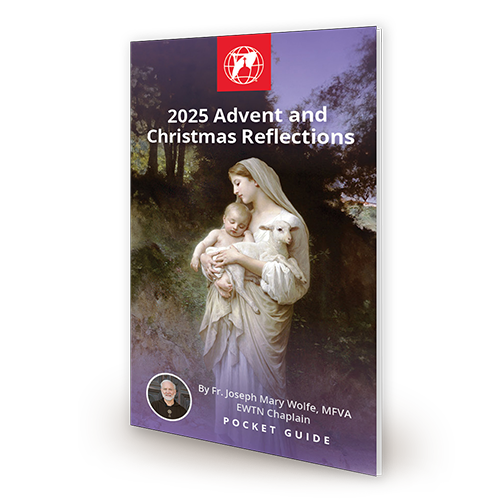
Sign up below for the free 2025 Advent and Christmas Reflections pocket guide, featuring meditations by Fr. Joseph Mary Wolfe, the EWTN Chaplain. His video series will also be sent to your email each Sunday of Advent and throughout the Christmas season. When you request the pocket guide by mail, we’ll also email you the eBook version. Or you may choose to receive just the eBook version and video series.
Send me the Physical Pocket Guide
Only available to homes in the U.S.A., while supplies last.
Send me the eBook
Be inspired to follow in the footsteps of the saints. Subscribe to receive the Daily Saint, featuring a brief biography delivered to your inbox each day.
Start now and let the intercession and witness of the saints draw you closer to God.

As we deepen our relationship with the Eternal Word, Jesus Christ, we grow in grace and are transformed by His love and mercy.
STEP 1
We’re here to serve you. Let us help you complete your gift with confidence.

Send a message to Mission Advancement.

Guidance for DAFs, stock, IRA, and more.

Manage your gifts and preferences.