

Your Faith Journey with EWTN
As we deepen our relationship with the Eternal Word, Jesus Christ, we grow in grace and are transformed by His love and mercy.
439–December 5, 532
Patron Saint of monks, hermits, monasticism

St. Sabas was born into a pious and renowned family in the mid-fifth century near Caesarea in Cappadocia. His father, an army officer, and his mother left for Egypt due to military obligations, leaving five-year-old Sabas in the care of relatives. He faced mistreatment and family discord over property.
Rejecting worldly possessions, St. Sabas traveled to Palestine at a young age and lived under the guidance of hermits, most notably St. Euthymius. He spent time in solitary caves and practiced rigorous prayer, fasting, and manual labor.
His family, regretting their maltreatment of the young man, tried to bring him back to receive his inheritance and marry. But St. Sabas, having experienced the emptiness the world had to offer, held firm to his decision to live his life serving God.
As St. Sabas’s pious way of life drew disciples, he founded two lauras, clusters of caves or cells around a central chapel, where men gathered to live the life of a hermit. The most well-known is Laura of Mar Saba, which still exists today.
Later in life, Sabas was ordained a priest and given oversight of all the monastic communities in Palestine. In addition to his ascetic practices, he cared for others by founding hospices, supporting pilgrims, and guiding monks spiritually.
He defended the Eastern Orthodox faith against Monophysitism and Origenism, heretical theological ideas that spread errors about Christ’s nature. His efforts were successful in preventing Monophysitism from gaining a foothold in the region and laid the groundwork for Origenism being officially condemned by the Church.
St. Sabas died at the age of 93, still serving in his beloved community.
Lauras are a type of monastery where monks live as hermits. They contain a cluster of individual caves or cells, with a chapel or communal center for liturgy where monks live in solitude but gather periodically. Laura Mar Saba, founded around 483 by St. Sabas, became one of the most essential lauras in Palestine, influencing the shape of monastic life, especially in Eastern Orthodox Christianity. It balanced solitude, communal worship, spiritual mentorship, and hospitality.
St. Sabas was a staunch defender of orthodox Christology during times when extremes like Monophysitism—claiming Christ has only one divine nature—and teachings associated with Origen (Origenism) were widespread. He traveled to appeal to emperors Anastasius and, later, Emperor Justinian, for clarity and for the rejection of heretical teachings. He worked both spiritually and politically, involving the monks in his monastery to unite in opposition and urging the Church and state to uphold orthodoxy.
Sabas embraced rigorous ascetic discipline: prayer, fasting, manual labor, long nights, and extended periods of solitude in caves. At about age 30, his abbot permitted St. Saba to spend five days each week in a remote cave, leaving only for essentials. His food was often wild herbs and water from distant springs; he wove baskets to sustain himself. The ascetic practices spiritually strengthened St. Sabas, and through them, he became a more compassionate leader.
The Mar Saba Monastery remains an active and venerated monastic site, particularly in Eastern Orthodoxy. His monastic rule and liturgical traditions significantly shaped Christian monasticism in the East. His practices remain a model of humility, simplicity, and obedience, and demonstrate the importance of both individual asceticism and communal support in monastic life.
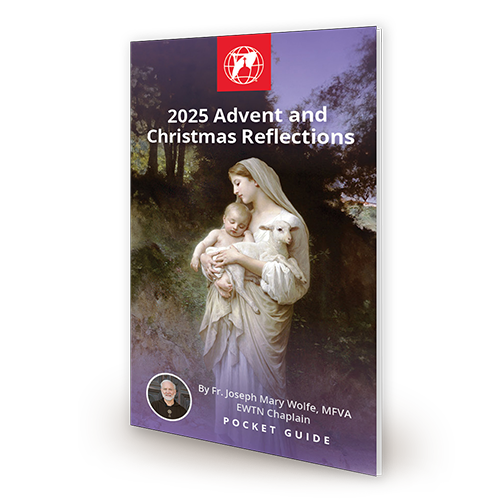
Sign up below for the free 2025 Advent and Christmas Reflections pocket guide, featuring meditations by Fr. Joseph Mary Wolfe, the EWTN Chaplain. His video series will also be sent to your email each Sunday of Advent and throughout the Christmas season. When you request the pocket guide by mail, we’ll also email you the eBook version. Or you may choose to receive just the eBook version and video series.
Send me the Physical Pocket Guide
Only available to homes in the U.S.A., while supplies last.
Send me the eBook
Be inspired to follow in the footsteps of the saints. Subscribe to receive the Daily Saint, featuring a brief biography delivered to your inbox each day.
Start now and let the intercession and witness of the saints draw you closer to God.

As we deepen our relationship with the Eternal Word, Jesus Christ, we grow in grace and are transformed by His love and mercy.
STEP 1
We’re here to serve you. Let us help you complete your gift with confidence.

Send a message to Mission Advancement.

Guidance for DAFs, stock, IRA, and more.

Manage your gifts and preferences.