

Your Faith Journey with EWTN
As we deepen our relationship with the Eternal Word, Jesus Christ, we grow in grace and are transformed by His love and mercy.
c. 339–April 4, 397
Patron Saint of city of Milan and beekeepers

St. Ambrose was gifted as a theologian, a statesman, and a bishop. His prominence as a public figure and contributions as a prolific writer and Christian apologist had a profound impact on the political, religious, and social landscape of his time. He became one of the greatest bishops of the Church.
Born into a Roman Christian family around 340 in what is now Trier, Germany. St. Ambrose’s father was a high-ranking official who governed large territories in Gaul. When his father died, St. Ambrose’s family moved to Rome, where he received an excellent education in law, rhetoric, Greek, and Scripture.
Following his father’s footsteps, he was appointed Governor of Aemilia-Liguria, based in Milan. While he was still a layman, upon the death of the Bishop of Milan, a riot among Catholics and Arians led to his being acclaimed bishop by the people. Although unbaptized, he accepted, was baptized, and was consecrated bishop in 374. St. Ambrose then relinquished secular wealth and devoted himself to pastoral care.
As a defender of the Christian faith, St. Ambrose became a powerful voice against Arianism and paganism, standing up to emperors when needed, defending orthodoxy. St. Ambrose’s influence stretched widely, and his teaching, pastoral zeal, intellectual integrity, and courage earned him recognition as one of the four original Doctors of the Church.
Shortly before St. Ambrose died, he wrote about “The Goodness of Death,” saying he believed he would only live until Easter. On Good Friday, he received the Holy Eucharist and died soon after at age 57. His remains now lie in a basilica named after him in Milan, Italy.
When the Bishop of Milan died in 374, there was a dispute between Catholics and Arians. St. Ambrose, though governor and still unbaptized, was seen by many as a unifying figure. A voice in the crowd reportedly cried, “Ambrose bishop!” and the people approved. He accepted the people’s choice, being baptized and consecrated soon after.
St. Ambrose’s writings encompassed theological and pastoral works, including the Sacraments, the Holy Spirit, justice for the plight of the poor, and the duties of the clergy. He also enriched Church music, and seven of the hymns he wrote are still a part of the liturgy today. These works and others helped shape Western Christian ethics, liturgy, and the Church’s identity.
St. Ambrose saw the Church separate from the authority of the rulers, with its own authority and moral voice. He did not hesitate to admonish Emperor Theodosius I for the massacre of Thessalonica, compelling him to do public penance. He resisted the Emperor when Empress Justina attempted to turn Catholic churches in Milan over to Arians. St. Ambrose spoke truth in the face of injustice and insisted that rulers be accountable for their actions.
The title Doctor of the Church recognizes saints whose teaching has made a lasting and universal contribution to Christian theology and spirituality. St. Ambrose, along with Augustine, Jerome, and Gregory the Great, is one of the four original Doctors of the Catholic Church. His writings, sermons, and pastoral practice were seen as models of doctrine, liturgy, ethics, and pastoral life. The title recognizes both his intellect and his holiness.
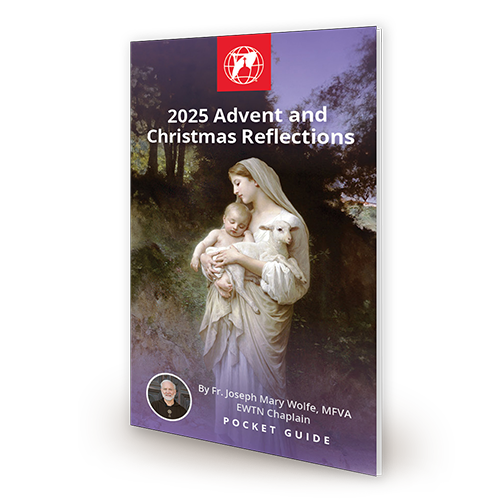
Sign up below for the free 2025 Advent and Christmas Reflections pocket guide, featuring meditations by Fr. Joseph Mary Wolfe, the EWTN Chaplain. His video series will also be sent to your email each Sunday of Advent and throughout the Christmas season. When you request the pocket guide by mail, we’ll also email you the eBook version. Or you may choose to receive just the eBook version and video series.
Send me the Physical Pocket Guide
Only available to homes in the U.S.A., while supplies last.
Send me the eBook
Destined for a political career, St. Ambrose of Milan instead made serving God his life’s mission. As one of our greatest bishops, he defended the authentic teachings of the Church and opened up Scripture to the masses.
Be inspired to follow in the footsteps of the saints. Subscribe to receive the Daily Saint, featuring a brief biography delivered to your inbox each day.
Start now and let the intercession and witness of the saints draw you closer to God.

As we deepen our relationship with the Eternal Word, Jesus Christ, we grow in grace and are transformed by His love and mercy.
STEP 1
We’re here to serve you. Let us help you complete your gift with confidence.

Send a message to Mission Advancement.

Guidance for DAFs, stock, IRA, and more.

Manage your gifts and preferences.