

Your Faith Journey with EWTN
As we deepen our relationship with the Eternal Word, Jesus Christ, we grow in grace and are transformed by His love and mercy.
c. 669–Died November 28, 741
Patron Saint of popes, against iconoclasm

Pope St. Gregory III served as pope from 731 to 741, a period of significant turbulence in the Church’s history. Born in Syria, he was the last pope of Syrian origin, reflecting the diversity of the early Church in Rome. Pope St. Gregory III was elected after the death of Pope St. Gregory III and quickly distinguished himself by his courage in defending the Church’s traditions against powerful political forces.
One of the challenges of his papacy was the controversy over iconoclasm. Pope St. Gregory III strongly opposed a decree issued by the Byzantine Emperor Leo III, which forbade the use of sacred images and insisted on their destruction. Pope St. Gregory III convened synods in Rome that condemned iconoclasm, influencing the decisions of the Second Council of Nicaea (787), which affirmed the veneration of icons.
When Pope St. Gregory III ascended to the papacy, Rome was embroiled in constant feuds with the Lombards, a Germanic people intent on expanding their kingdom in Europe. Investing funds to fortify walls and build fortresses to no avail, Pope St. Gregory III formed an alliance with the Franks, who helped defend Rome against the Lombards’ attacks.
Pope St. Gregory III strengthened the Church’s independence from imperial power by aligning more closely with the Frankish rulers in the West. His papacy laid the groundwork for what would later become an alliance between Pope Leo III and Charlemagne.
Encouraging missionary activity, Pope St. Gregory III supported the evangelization efforts of St. Boniface and others in Central and Northern Europe. He also restored and built churches in Rome, enriching the liturgical life of the Church, developed Gregorian Chant, and made significant reforms to the Mass, which shaped Catholic liturgy for centuries.
He died in 741 and was buried in St. Peter’s Basilica.
Tensions ran high during the Church’s iconoclasm controversy. The Byzantine emperor banned the use of religious icons and threatened the destruction of icons being used as “idols of worship.” Pope St. Gregory III responded swiftly. While the emperor was persecuting the Church and accusing people of idol worship, Pope St. Gregory III held synods in Rome to uphold and affirm the value of icons as aids for prayer and devotion. His actions helped preserve the Church’s tradition of venerating Christ and the saints using religious images. The consequences of the dispute between Pope St. Gregory III and the Byzantine emperor included the emperor’s confiscation of certain papal territories, which distanced Rome from the Byzantine Empire and increased the papacy’s independence.
Pope St. Gregory III gave strong backing to St. Boniface, the “Apostle of Germany,” confirming his authority and helping ensure the spread of Christianity throughout central Europe. He elevated St. Boniface to the rank of archbishop and appointed him papal legate, with authority to organize the Church in key regions. He supported evangelization efforts to convert non-Christians, pagans, and Arian heretics within and outside of Italy. Pope St. Gregory III’s support for missionary activities organized the Church, created new bishoprics, extended the authority and influence of the papacy into new territories, and grew the number of Christians in parts of Europe and the Mediterranean Region.
Pope St. Gregory III’s coalition with the Franks set a precedent for Rome’s independence from Byzantine control and laid the groundwork for the future alliance with the Franks under Charlemagne. Pope St. Gregory III requested help from Byzantine Emperor Leo III when the Lombards threatened to invade Italy and seize Rome in the 730s, but was denied. He then turned to the Franks, whose ruler, Charles Martel, eventually came to his aid. The outreach formed an alliance with the Frankish kingdom. About a decade later, this coalition would help Rome establish the Papal States, securing papal independence.
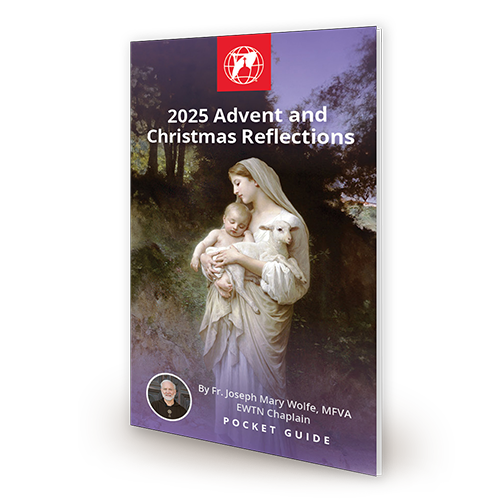
Sign up below for the free 2025 Advent and Christmas Reflections pocket guide, featuring meditations by Fr. Joseph Mary Wolfe, the EWTN Chaplain. His video series will also be sent to your email each Sunday of Advent and throughout the Christmas season. When you request the pocket guide by mail, we’ll also email you the eBook version. Or you may choose to receive just the eBook version and video series.
Send me the Physical Pocket Guide
Only available to homes in the U.S.A., while supplies last.
Send me the eBook
Be inspired to follow in the footsteps of the saints. Subscribe to receive the Daily Saint, featuring a brief biography delivered to your inbox each day.
Start now and let the intercession and witness of the saints draw you closer to God.

As we deepen our relationship with the Eternal Word, Jesus Christ, we grow in grace and are transformed by His love and mercy.
STEP 1
We’re here to serve you. Let us help you complete your gift with confidence.

Send a message to Mission Advancement.

Guidance for DAFs, stock, IRA, and more.

Manage your gifts and preferences.