

Your Faith Journey with EWTN
As we deepen our relationship with the Eternal Word, Jesus Christ, we grow in grace and are transformed by His love and mercy.
c. 305–December 11, 384
Patron Saint of archaeologists, against fever

St. Damasus served as pope between 366 and 384 A.D., guiding the Church in an era of doctrinal conflict, political turmoil, and the consolidation of Christian identity in the Roman world.
His parents were from Lusitania (part of modern-day Spain/Portugal) and moved to Rome either before or soon after the future saint was born. From an early age, St. Damasus devoted himself to serving the Church. He became a deacon and was later ordained as a priest during times of strained relations between the Church and the State.
When Pope Liberius died in 366, St. Damasus was elected Bishop of Rome. The deacon Ursinus and his supporters contested the election, claiming their own right to the office. The conflict escalated into violence that led to bloodshed. Emperor Valentinian I banished Ursinus from Rome, and St. Damasus ascended to the Chair of Peter.
St. Damasus faced many challenges during his pontificate. He fought and condemned heresies such as Arianism, Apollinarianism, and Macedonianism, core teachings of the Church. He also addressed the tensions and threats of schism between the Eastern and Western Churches, as well as questions regarding the authority of the Roman Church.
Among St. Damasus’s principal achievements was his commissioning of St. Jerome’s translation of the Scriptures into Latin, which became the Latin Vulgate. He also established the Liturgy in Latin, restored the Catacombs in Rome to promote veneration of the martyrs, and defined the canon of Scripture at the Council of Rome in 382.
Pope St. Damasus is venerated in both the Catholic Church and the Eastern Orthodox Church.
Pope St. Damasus opposed several heresies of his time, notably Arianism, Apollinarianism, and Macedonianism. Challenging these teachings was vital because they undermined the doctrine of the Trinity and the comprehensive Christian understanding of God as revealed in Scripture and Tradition. St. Damasus helped bring clarity and orthodoxy during a period of theological disputes.
St. Damasus presided over the Council of Rome in 382. He had a vital role in deciding what books would be included in the canon of Scripture. He also supported St. Jerome in revising his Latin translations of Scripture. The project resulted in the Latin Vulgate, a translation that would become standard in Western Christianity.
Although the Eastern and Western Churches did not entirely break communion during St. Damasus’s pontificate, questions about the authority of the Bishop of Rome and periods of non-communication created division. Later schisms included the Acacian Schism, which lasted 35 years from 484, the Photian Schism, which lasted four years from 867, and the Great Schism of 1054, which remains in effect today.
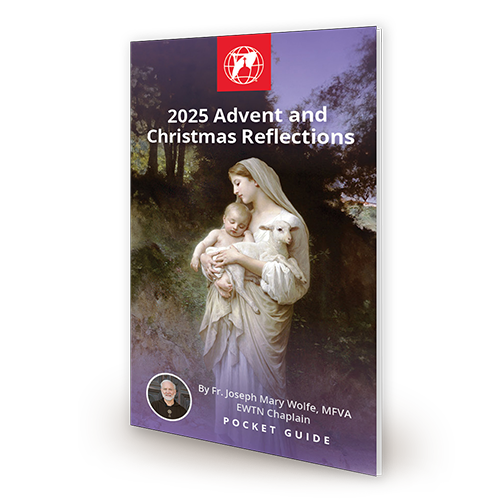
Sign up below for the free 2025 Advent and Christmas Reflections pocket guide, featuring meditations by Fr. Joseph Mary Wolfe, the EWTN Chaplain. His video series will also be sent to your email each Sunday of Advent and throughout the Christmas season. When you request the pocket guide by mail, we’ll also email you the eBook version. Or you may choose to receive just the eBook version and video series.
Send me the Physical Pocket Guide
Only available to homes in the U.S.A., while supplies last.
Send me the eBook
Be inspired to follow in the footsteps of the saints. Subscribe to receive the Daily Saint, featuring a brief biography delivered to your inbox each day.
Start now and let the intercession and witness of the saints draw you closer to God.

As we deepen our relationship with the Eternal Word, Jesus Christ, we grow in grace and are transformed by His love and mercy.
STEP 1
We’re here to serve you. Let us help you complete your gift with confidence.

Send a message to Mission Advancement.

Guidance for DAFs, stock, IRA, and more.

Manage your gifts and preferences.