

Your Faith Journey with EWTN
As we deepen our relationship with the Eternal Word, Jesus Christ, we grow in grace and are transformed by His love and mercy.
470–December 12, 549
Patron Saint of diocese of Meath

St. Finnian of Clonard is revered as one of the most influential founders of monastic life in Ireland and the teacher of many saints, including those who would become known as the “Twelve Apostles of Ireland,” who spread Christianity throughout Ireland and profoundly impacted Irish culture.
Born in the 5th century, his father placed St. Finnian under the care of a bishop at an early age. Some sources suggest that he may have studied at the monastery of Martin de Tours in Gual for a time. Later, he traveled to Wales, where he studied under St. Cadoc and St. Gildas.
Upon his return to Ireland, St. Finnian established the most renowned of his monasteries at Clonard, in County Meath, around 520. There, his reputation for holiness and unique teaching methods attracted thousands of students from all over Ireland and beyond. The curriculum, based on Welsh monastery practices and inspired by the traditions of the Desert Fathers, combined Scripture, theology, and ascetic discipline. St. Finnian’s methods formed scholars, missionaries, and clergy who would carry the Gospel across Europe.
St. Finnian was known for his holiness, gentleness, and wisdom, earning him the affectionate title of “Tutor of the Saints of Ireland.” Many of his pupils—among them St. Columba of Iona, St. Brendan the Navigator, and St. Ciarán of Clonmacnoise—became key figures in spreading Christianity during Ireland’s “Age of Saints.”
St. Finnian died around 549, during a plague that swept through his monastery at Clonard. His monastery was renowned as a seat of scriptural learning for centuries after his death.
St. Finnian earned this title because his monastery at Clonard produced many of Ireland’s most influential early saints, often referred to as the “Twelve Apostles of Ireland.” Through his teaching and example, St. Finnian nurtured a generation of missionaries and leaders who spread Christianity throughout Ireland and beyond. His school at Clonard became a foundation for Ireland’s monastic tradition and spiritual culture.
St. Finnian’s monastery in Clonard provided students with a unique spiritual experience. He insisted on Scriptural training and ascetic discipline, creating a model that inspired future Irish monastic foundations. The balance of learning and holiness formed disciples who carried the light of Christ to new lands. St. Finnian’s excellent exposition of the Sacred Scriptures inspired students. St. Finnian had a gift for teaching and a dedication to the ascetic ideal. These characteristics inspired a whole generation. The Clonard monastery drew students from various parts of Europe.
After his death, St. Finnian was buried at his monastery in Clonard, where his relics were housed in a shrine. Many miracles were reported and attributed to his relics, making the school a significant pilgrimage site in Ireland. Veneration for St. Finnian was sustained for centuries through the renowned school at Clonard. The monastery flourished until the 9th century. But in 887 A.D., the shrine at Clonard Abbey was destroyed by Viking raiders. The monastery was subjected to multiple raids by Vikings and others between the 9th and 11th centuries. While the main shrine was destroyed, some evidence suggests that a portion of St. Finnian’s relics may have survived and were kept in a nearby parish church until the 17th century.
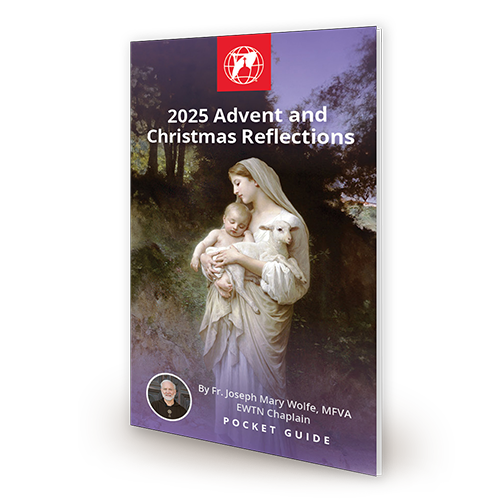
Sign up below for the free 2025 Advent and Christmas Reflections pocket guide, featuring meditations by Fr. Joseph Mary Wolfe, the EWTN Chaplain. His video series will also be sent to your email each Sunday of Advent and throughout the Christmas season. When you request the pocket guide by mail, we’ll also email you the eBook version. Or you may choose to receive just the eBook version and video series.
Send me the Physical Pocket Guide
Only available to homes in the U.S.A., while supplies last.
Send me the eBook
Be inspired to follow in the footsteps of the saints. Subscribe to receive the Daily Saint, featuring a brief biography delivered to your inbox each day.
Start now and let the intercession and witness of the saints draw you closer to God.

As we deepen our relationship with the Eternal Word, Jesus Christ, we grow in grace and are transformed by His love and mercy.
STEP 1
We’re here to serve you. Let us help you complete your gift with confidence.

Send a message to Mission Advancement.

Guidance for DAFs, stock, IRA, and more.

Manage your gifts and preferences.