

Your Faith Journey with EWTN
As we deepen our relationship with the Eternal Word, Jesus Christ, we grow in grace and are transformed by His love and mercy.
c. 283–304
Patron Saint of the blind, martyrs, throat infections, writers, epidemics, and cities in Italy and the Philippines

St. Lucy (c. 283–304), one of the most beloved virgin martyrs of the early Church, is honored for her unwavering faith and courage. Born in Syracuse, Sicily, in the late third century, she belonged to a wealthy noble family.
Her father died when St. Lucy was five, and her mother raised her in the Christian faith. From an early age, St. Lucy made a secret vow to remain a virgin. Her mother, who suffered from a bleeding disorder and was unaware of St. Lucy’s vow of chastity, arranged a marriage for her with a noble Roman pagan to secure St. Lucy’s future.
St. Lucy revealed her secret vow to her mother and suggested they visit the grave of St. Agatha, a virgin martyr, and ask for healing of her mother’s condition. When her mother was miraculously cured, St. Lucy further expressed her desire to use her share of their wealth to support taking care of the poor and live in service to God. Having received her healing, her mother approved her daughter’s decision.
When Lucy’s Roman suitor heard the news, he was enraged. He denounced St. Lucy as a Christian to the governor. The soldiers commanded her to offer a sacrifice to pagan gods, but she courageously refused.
According to tradition, several attempts were made to defile her and harm her, such as dragging her to a brothel and setting her on fire. But their efforts failed miraculously. Finally, her executioners killed her with a sword to her neck.
St. Lucy is particularly associated with light—her name, Lucia, means “light.” According to tradition, her eyes were plucked out and then miraculously restored.
Her name comes from the Latin lux, meaning “light.” One legend about St. Lucy says she wore a crown of candles to light the way while bringing food to persecuted Christians hiding in the dark catacombs. Over the centuries, she has been associated with Christ as the Light of the World, and her feast is celebrated with candles, especially in places with long, dark winter nights.
Legends say that St. Lucy’s eyes were gouged out, then miraculously restored before her death. Some say her eyes were removed during her torture, while others say she plucked them out to avoid marrying a suitor. Whether literal or symbolic, these stories led to her patronage of the blind and those with eye ailments. St. Lucy is often depicted holding a lamp or a dish with her eyes on it.
Being named in the Eucharistic Prayer I of the Roman Canon shows her ancient and universal veneration. Only a few early martyrs and saints are mentioned in the Canon, underscoring St. Lucy’s prominence in the early Church.
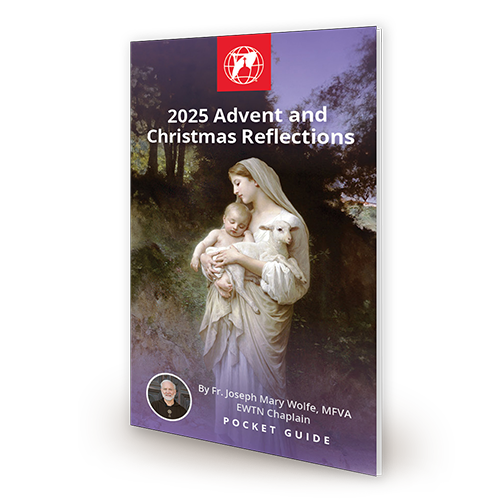
Sign up below for the free 2025 Advent and Christmas Reflections pocket guide, featuring meditations by Fr. Joseph Mary Wolfe, the EWTN Chaplain. His video series will also be sent to your email each Sunday of Advent and throughout the Christmas season. When you request the pocket guide by mail, we’ll also email you the eBook version. Or you may choose to receive just the eBook version and video series.
Send me the Physical Pocket Guide
Only available to homes in the U.S.A., while supplies last.
Send me the eBook
Be inspired to follow in the footsteps of the saints. Subscribe to receive the Daily Saint, featuring a brief biography delivered to your inbox each day.
Start now and let the intercession and witness of the saints draw you closer to God.

As we deepen our relationship with the Eternal Word, Jesus Christ, we grow in grace and are transformed by His love and mercy.
STEP 1
We’re here to serve you. Let us help you complete your gift with confidence.

Send a message to Mission Advancement.

Guidance for DAFs, stock, IRA, and more.

Manage your gifts and preferences.