

Your Faith Journey with EWTN
As we deepen our relationship with the Eternal Word, Jesus Christ, we grow in grace and are transformed by His love and mercy.
June 23, 1160–December 17, 1213
Patron Saint of order of the Most Holy Trinity, captives, prisoners

St. John of Matha was a French priest called by God to free Christian captives during the Crusades. Born into a noble family and to devout Christian parents, St. John received a solid education in his birthplace of Provence, where he acquired the basic skills suitable for a young nobleman. He later attended the University of Paris, where he excelled in theological studies and was ordained a priest.
At the age of 33, St. John was celebrating his first Mass when he experienced a striking vision of an angel with a red and blue cross on its chest, standing between two chained captives, one a Christian and the other a Moor.
This revelation moved him deeply. St. John sought the counsel of St. Felix of Valois, a holy hermit, to discern whether he was being called to release the Christian captives taken by Muslim forces. In prayer and penance, the two men determined a path to realize St. John’s mission. In 1197, St. John traveled to Rome to seek papal approval. Pope Innocent III gave his verbal approval and officially approved the Order of the Most Holy Trinity for the Redemption of Captives a year later. John became the first Superior General and founder of the Order of the Most Holy Trinity, also known as the Trinitarians.
Under John’s leadership, the Trinitarians combined contemplative life and the active ministry of ransoming captives. John himself journeyed to Muslim-controlled territories such as Tunisia and Spain to negotiate the release and ransom of enslaved Christians. On one occasion, after returning with liberated captives, his ship was attacked and disabled; trusting in God, he improvised sails from cloaks and, kneeling in prayer, guided the ship safely to safe harbors.
John spent his remaining years strengthening the Trinitarian communities and expanding their houses of mercy, ensuring their mission would outlive him. He died December 17, 1213, in Rome, and was canonized in 1666 by Pope Alexander VII.
Throughout his life, he demonstrated charity in action, courage in the face of hardship, and fidelity to a divine vision of freedom and redemption. The Trinitarian order remains active today, supporting persecuted Christians worldwide.
When St. John heard the call to free captive Christians from Muslim forces, he realized he would need funding to pay for the freedom of Christians who were enslaved or negotiate ransoms for their freedom. He entrusted this great need to the Blessed Virgin Mary. Her powerful intercession resulted in the raising of large sums of money with which hundreds of Christians were liberated. In gratitude for Mary’s powerful assistance in this “remedy” to the pressing problem of slavery, St. John of Matha gave her the title “Our Lady of Good Remedy.”
According to medieval accounts, John and his brothers ransomed hundreds of Christian captives. In Tunis, 110 were freed, and on another return voyage, around 120 were liberated. These numbers reflect the zealous nature of his mission, even if precise records are not always verifiable.
St. John’s work of freeing enslaved Christians led to the creation of many Trinitarian monasteries throughout Europe and North Africa. The monasteries served as spaces to collect alms that were used to liberate Christians from their Muslim captors. The monks dedicated themselves to lives of prayer, poverty, and sacrifice, invoking the intercession of the Blessed Mother to fund their mission. A central monastery used by the Trinitarian order was founded in Rome at the Church of San Tommaso in Formis.
The Trinitarian order grew quickly. Within the first two decades, the Trinitarians had established more than 40 foundations across France, Spain, and Italy. Their work was so compelling that wealthy benefactors donated large sums of money, and the poor would ask for alms to support the cause. By the end of the Middle Ages, the Trinitarian Order had more than 150 houses in Europe.
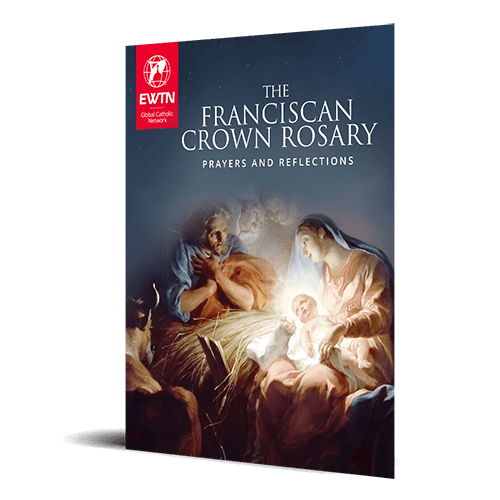
One unique devotion of the Franciscans is a seven-decade rosary known as the Franciscan Crown. While the traditional rosary consists of 5 decades which meditate on 15 mysteries, the 7-decade Franciscan Rosary, known as the Franciscan Crown, is a Rosary consisting of seven decades with each decade describing a particular joy from the life of the Blessed Virgin Mary. We hope that this special resource will help you meditate on each of the Seven Joys of Our Blessed Mother Mary.
Be inspired to follow in the footsteps of the saints. Subscribe to receive the Daily Saint, featuring a brief biography delivered to your inbox each day.
Start now and let the intercession and witness of the saints draw you closer to God.

As we deepen our relationship with the Eternal Word, Jesus Christ, we grow in grace and are transformed by His love and mercy.
STEP 1
We’re here to serve you. Let us help you complete your gift with confidence.

Send a message to Mission Advancement.

Guidance for DAFs, stock, IRA, and more.

Manage your gifts and preferences.