

Your Faith Journey with EWTN
As we deepen our relationship with the Eternal Word, Jesus Christ, we grow in grace and are transformed by His love and mercy.
Third century–Late-third century
Patron Saint of Tours

St. Gatianus served as the founding Bishop of Tours in the mid-third century. He was one of the Seven Bishops of Gaul sent from Rome by Pope Fabian to evangelize the region of Gaul around 250 A.D.
Arriving in a land that had little to no exposure to the Gospel, he planted the seeds of the Faith and established the first Christian community. Worship of the Roman god Mithras was predominant there, and accounts say St. Gatianus would go out only when there were opportunities to preach. Accounts say that, during a particularly fierce persecution, he remained hidden in a cave for an extended period.
St. Gatianus devoted 50 years to establishing a Christian community in Tours. Facing numerous obstacles and constant threats, he often operated in secret, celebrating Mass in caves or grottoes, hiding from pagan hostility, and moving cautiously to avoid conflicts. He founded a hospice for the poor just outside the city walls, providing outreach to those in need.
St. Gatianus remained faithful to his mission. Despite many setbacks, he continued to preach, baptize, and administer the Sacraments to his struggling church. He was successful in growing a small Christian community in Tours and laying the foundation for his successor.
After his death, it took another 36 years for a second bishop to continue the work, which flourished with time. St. Gatianus’s memory remains firmly rooted in Tours, where the cathedral bears his name.
The “Seven Apostles of Gaul” is a traditional title given to seven bishops sent from Rome to the region of Gaul by Pope Fabian during the mid-third century. Pope Fabian sent them to help evangelize in cities located in what is now France. St. Gatianus was sent to Tours, along with Trophimus, who went to Arles, Paul to Narbonne, Saturnin to Toulouse, Denis to Paris, Austromoine to Clermont, and Martial to Limoges. They proclaimed the Gospel in pagan-dominated regions with little or no existing church structure. While some were more successful than others, all the bishops left a foundation that later led to the flourishing of the Church in areas extremely hostile to Christianity.
The primary biographical sources for St. Gatianus date from centuries later, such as Gregory of Tours in the sixth century. Records of St. Gatianus’s years in Tours may have been destroyed during the period of severe Christian persecution that occurred following his death. Scholars accept some core facts, such as the long term of his bishopric and his evangelization of Tours, but details about his administration are unavailable, uncertain, or legendary. Despite the absence of records, the Cathedral in Tours bears his name as the founder of the bishopric there. St. Gatianus’s story remains central to the local Church’s identity.
After St. Gatianus died, severe Christian persecution broke out in Gaul. It was 36 years before another bishop arrived in Tours to establish a Christian church in the area. During this time, Christianity in Tours was suppressed, Christians were dispersed, and the Christian community’s structures were weakened. It was only later, under successors such as St. Martin of Tours, that the Church in Tours was rebuilt visibly and regained strength.
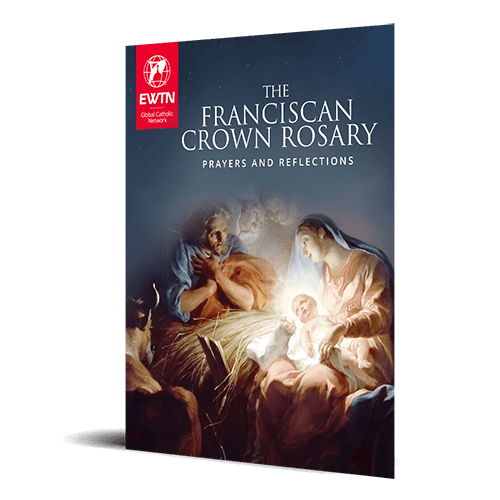
One unique devotion of the Franciscans is a seven-decade rosary known as the Franciscan Crown. While the traditional rosary consists of 5 decades which meditate on 15 mysteries, the 7-decade Franciscan Rosary, known as the Franciscan Crown, is a Rosary consisting of seven decades with each decade describing a particular joy from the life of the Blessed Virgin Mary. We hope that this special resource will help you meditate on each of the Seven Joys of Our Blessed Mother Mary.
Be inspired to follow in the footsteps of the saints. Subscribe to receive the Daily Saint, featuring a brief biography delivered to your inbox each day.
Start now and let the intercession and witness of the saints draw you closer to God.

As we deepen our relationship with the Eternal Word, Jesus Christ, we grow in grace and are transformed by His love and mercy.
STEP 1
We’re here to serve you. Let us help you complete your gift with confidence.

Send a message to Mission Advancement.

Guidance for DAFs, stock, IRA, and more.

Manage your gifts and preferences.