

Your Faith Journey with EWTN
As we deepen our relationship with the Eternal Word, Jesus Christ, we grow in grace and are transformed by His love and mercy.
May 8, 1521–December 21, 1597
Patron Saint of Catholic press, Germany

St. Peter Canisius was born within the Roman Empire in 1521 in what is now the Netherlands. His mother died soon after giving birth to him. His father, a wealthy city official, sent him to the University of Cologne, where he completed a master’s degree by the age of 19.
While at the university, St. Peter Canisius met Bl. Peter Faber, one of the founders of the Society of Jesus (the Jesuits). Drawn to the Jesuit mission, he made the Spiritual Exercises under the guidance of Bl. Peter Faber. He entered the Jesuits in 1543. He was ordained a Jesuit priest after completing his studies in theology.
St. Peter Canisius excelled as a scholar, teacher, and preacher. Over the decades, he worked in Germany, Austria, Bohemia, and Switzerland, preaching widely, caring for the sick, and devoting himself to the education of both clergy and laypeople. He taught at the universities of Cologne, Ingolstadt, and Vienna; later, he became the first provincial of the Jesuit Province of Upper Germany, overseeing the organization’s growth and the reform of Jesuit houses. He also founded several Jesuit colleges.
St. Peter Canisius’s writings were among his most enduring legacies. His major work, Summa Doctrinae Christianae (Summary of Christian Doctrine), and two smaller catechisms addressed theological controversies of the day, clarified doctrine for students and laity, and became widely used, translated, and reprinted many times.
St. Peter Canisius devoted his life to renewing and defending the Catholic Faith in the turbulent age of the Reformation. He was involved in the work of the Counter-Reformation and attended several sessions of the Council of Trent. He was successful in converting many German Protestants back to the Catholic Faith, using his books as tools for catechizing.
In 1591, St. Peter Canisius suffered a stroke and was paralyzed. He continued to preach and write with the help of a secretary until his death on December 21, 1597. He was canonized and declared a Doctor of the Church in 1925 by Pope Pius XI. He is often referred to as the Second Apostle of Germany.
St. Peter Canisius published Summa Doctrinae Christianae (the major or “large” catechism) for students and those able to grasp theological content in more depth; a Catechismus minor (smaller catechism) for children or beginners; and a Parvus Catechismus Catholicorum (little catechism) for laity in general. St. Peter Canisius designed the books to meet people where they were, both educationally and spiritually.
St. Peter Canisius advocated for using a charitable tone when discussing the Faith with Protestants during the Counter-Reformation movement. He used a pastoral rather than purely theological approach, emphasizing what Catholics and Protestants held in common, while gently correcting errors. He avoided deepening division with combative debates, saying, “With words like these, we don’t cure patients, we make them incurable.” Using these methods, he successfully brought many German Protestants back to the Catholic Church.
St. Peter Canisius made significant contributions to Catholic education during the Counter-Reformation era. He understood that a strong Catholic education system was necessary to counter the spread of Protestantism. He founded many Jesuit colleges and seminaries across Central Europe. He served in leadership positions (rector, dean, provincial), overseeing universities as well. His educational work was central to his mission, forming clergy, laity, and future leaders, and ensuring a firm intellectual foundation for the Catholic renewal.
In 1577, St. Peter Canisius wrote a substantial work on the Blessed Virgin Mary, comprised of five Books on the Incomparable Virgin Mary, Mother of God. Additionally, he composed numerous letters—approximately eight volumes’ worth—encompassing correspondence with princes, clergy, and laypeople, which demonstrate his pastoral concern, diplomatic skills, and care for individuals.
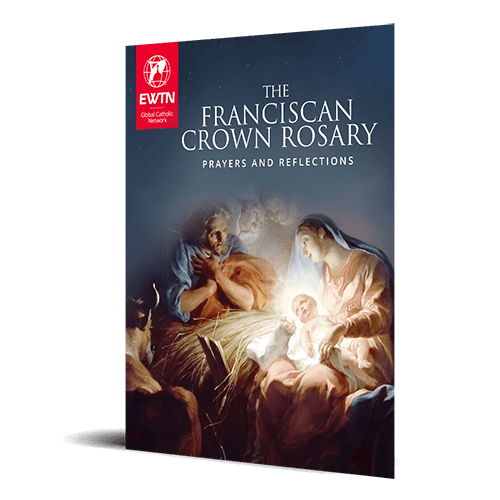
One unique devotion of the Franciscans is a seven-decade rosary known as the Franciscan Crown. While the traditional rosary consists of 5 decades which meditate on 15 mysteries, the 7-decade Franciscan Rosary, known as the Franciscan Crown, is a Rosary consisting of seven decades with each decade describing a particular joy from the life of the Blessed Virgin Mary. We hope that this special resource will help you meditate on each of the Seven Joys of Our Blessed Mother Mary.
St. Peter Canisius was a man of deep prayer and relentless action, establishing more than 40 universities, helping re-evangelize Central Europe, and healing the Church in a divided era.
Be inspired to follow in the footsteps of the saints. Subscribe to receive the Daily Saint, featuring a brief biography delivered to your inbox each day.
Start now and let the intercession and witness of the saints draw you closer to God.

As we deepen our relationship with the Eternal Word, Jesus Christ, we grow in grace and are transformed by His love and mercy.
STEP 1
We’re here to serve you. Let us help you complete your gift with confidence.

Send a message to Mission Advancement.

Guidance for DAFs, stock, IRA, and more.

Manage your gifts and preferences.