

Your Faith Journey with EWTN
As we deepen our relationship with the Eternal Word, Jesus Christ, we grow in grace and are transformed by His love and mercy.
June 23, 1390–December 24, 1473
Patron Saint of students, scholars, Poland, Lithuania, and Jagiellonian University

St. John of Kanty, also known as John Cantius, was a Polish priest in the 15th century. He was a scholar and teacher and was respected for his holiness, self-denial, and charity. He was born in 1390 in Kęty a small town in Poland, to devout Christian parents.
St. John studied at the University of Kraków, earning first a bachelor’s degree, then progressing to a master’s and a doctorate in philosophy. He later also completed a doctorate in theology.
Ordained a priest, St. John was deeply committed to academic work and teaching. He served as a professor of philosophy and Sacred Scripture at the University of Kraków. His students admired him for his patience, kindness, and moral integrity.
Despite his academic standing, St. John experienced opposition. At one point, jealous faculty members had him removed from his post, and he was sent to serve as a parish priest in the small town of Olkusz. Despite being unaccustomed to parish work and initially facing some resistance from parishioners, he won over the people with his genuine pastoral care and humility.
St. John lived a life of remarkable austerity. He ate little, abstained from meat, slept on the floor, and gave away whatever he could to the poor, retaining only what was strictly necessary. He made several pilgrimages, including one to Jerusalem and four on foot to Rome.
St. John of Kanty died at age 83 in Kraków on December 24, 1473. He was canonized in 1767 by Pope Clement XIII. After St. John died, his tomb in St. Anne’s Church in Kraków became a site of veneration and miracles.
Before the printing press was widely used, St. John of Kanty preserved books and meticulously copied manuscripts of the Holy Scriptures, as well as other theological and philosophical texts. He donated his vast collection of more than three hundred volumes to the university library upon his death.
St. John’s popularity and integrity stirred jealousy among other faculty at the University of Kraków. False accusations against him led to his removal and reassignment to a parish ministry in Olkusz. St. John was unprepared to assume the numerous responsibilities of pastoral work, but over time, he grew in wisdom and humility, gaining the respect of his community.
His experience in pastoral work deepened his charity and fostered greater compassion. Pope St. John Paul II would later remark on St. John of Kanty’s legacy as an example of what happens when “knowledge and wisdom seek a covenant with holiness.”
St. John of Kanty was given the title of Confessor, which in the history of the Church distinguished saints who were not martyred, but bore witness to the Faith by living a holy life. He is honored in the Roman Breviary with three hymns. He is the patron saint of Poland and Lithuania, as well as of students, scholars, and the University of Kraków, now known as Jagiellonian University. His tomb at St. Anne’s Church in Kraków is a pilgrimage site.
According to accounts, St. John Cantius helped a poor girl at the market who had dropped and broken her jug of milk, which was vital to her family’s well-being and a significant loss to their limited income. When St. John prayed over the broken glass, the jug and the milk were miraculously restored. Another story recounts how crooks robbed St. John Kanty, taking everything from him. After remembering he had some coins sewn into his clothing, he called the robbers back and gave them the coins as well. Astonished by his integrity, they returned everything they had taken. After St. John’s death, many more miracles were attributed to his intercession, including healings of the sick and the recovery of stolen possessions.
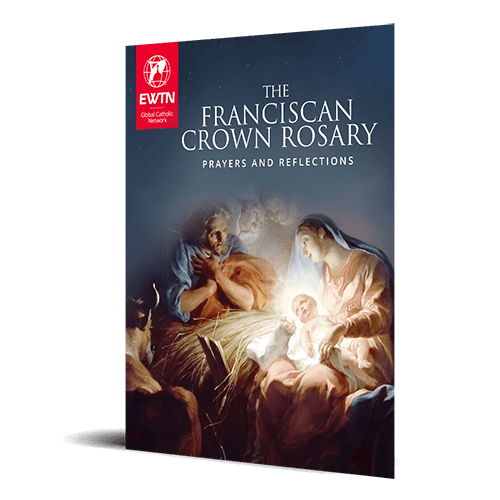
One unique devotion of the Franciscans is a seven-decade rosary known as the Franciscan Crown. While the traditional rosary consists of 5 decades which meditate on 15 mysteries, the 7-decade Franciscan Rosary, known as the Franciscan Crown, is a Rosary consisting of seven decades with each decade describing a particular joy from the life of the Blessed Virgin Mary. We hope that this special resource will help you meditate on each of the Seven Joys of Our Blessed Mother Mary.
Be inspired to follow in the footsteps of the saints. Subscribe to receive the Daily Saint, featuring a brief biography delivered to your inbox each day.
Start now and let the intercession and witness of the saints draw you closer to God.

As we deepen our relationship with the Eternal Word, Jesus Christ, we grow in grace and are transformed by His love and mercy.
STEP 1
We’re here to serve you. Let us help you complete your gift with confidence.

Send a message to Mission Advancement.

Guidance for DAFs, stock, IRA, and more.

Manage your gifts and preferences.