

Your Faith Journey with EWTN
As we deepen our relationship with the Eternal Word, Jesus Christ, we grow in grace and are transformed by His love and mercy.
c. 5 A.D.–33-36 A.D.
Patron Saint of altar servers, deacons, bricklayers, masons, casket makers, headaches, Pueblo Native American tribes, various countries, states, and cities
“You stiff-necked people, uncircumcised in heart and ears, you always resist the Holy Spirit.”
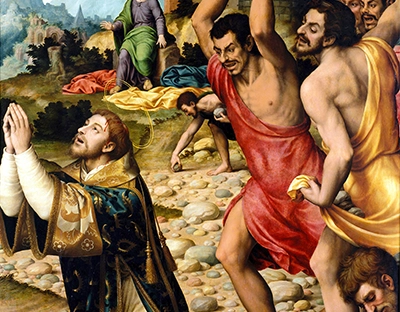
These were the words of St. Stephen to the Jewish leaders who were accusing him of blasphemy after he made a lengthy appeal attempting to reveal from Scripture that Jesus was the fulfillment of God’s promises. But his last words addressed to God as he lay dying after they stoned him were, “Lord, do not hold this sin against them.”
St. Stephen, honored as the protomartyr (the first Christian martyr), lived in the earliest days of the Church in Jerusalem. A man “full of faith and the Holy Spirit” (Acts 6:5), Stephen was chosen as one of the first seven deacons to serve the Christian community, assisting the Apostles by caring for widows and the poor so that the Twelve Apostles could devote themselves to prayer and preaching.
St. Stephen’s Greek name suggests that he was a Hellenistic Jew. He would have grown up in an environment surrounded by the Greek community, able to speak, read, and understand the language and culture. When the Hellenistic Jewish widows voiced their concern about not being included in the distribution of food, St. Stephen was sent to minister to their needs.
St. Stephen engaged in debates with members of Jewish synagogues in Jerusalem. After one such discussion, members of a synagogue were unable to refute St. Stephen’s wisdom and boldness with which the Spirit allowed him to present his arguments.
St. Stephen was accused of blasphemy against the Jewish Law and the Temple and brought before the Sanhedrin. He gave a long appeal recounting salvation history and witnessing to Jesus as the promised Messiah. Enraged, his accusers dragged him outside the city and stoned him to death.
Saul of Tarsus, who later became the Apostle St. Paul, witnessed and approved their actions that day. The death of St. Stephen marked the beginning of a journey of faith that paved the way for Saul’s later conversion.
Relics of St. Stephen were later said to have been discovered in the fifth century and enshrined in Jerusalem and Constantinople.
The word protomartyr means that St. Stephen was the first disciple to be killed after Christ’s Resurrection, making him the first Christian martyr. After St. Stephen’s death, many Christians, sensing the escalation of persecution, left Jerusalem, spreading Christianity to other regions such as Samaria and Judea. Stephen’s example of courage and unwavering faith gave the young Christian community courage to persevere and continue spreading the message of Jesus.
In God’s Divine Providence, Saul of Tarsus was meant to witness St. Stephen’s martyrdom. Saul was well-versed in Scripture, and St. Stephen’s eloquent appeal, courageous witness, and forgiveness before his death may have moved Saul’s heart. Many biblical commentators suggest that St. Stephen’s work with Hellenistic Jews may have inspired Saul’s own missionary calling, paving the way for his extensive missionary work among the Gentiles as the Apostle St. Paul.
According to tradition, in the fifth century, the Rabbi Gamaliel, who had taught St. Paul, appeared to a priest named Lucian in his church near Jerusalem. He instructed Lucian on where to find St. Stephen’s remains on a property that once belonged to Gamaliel. Lucian went to Patriarch John of Jerusalem, and together they opened the tomb, discovering the relics of St. Stephen. The relics were distributed to various churches. Portions were taken to Constantinople and Rome, where the Basilica of St. Lawrence Outside the Walls enshrines them alongside relics of St. Lawrence.
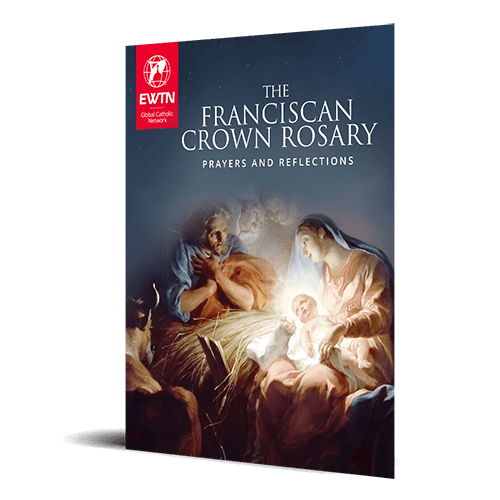
One unique devotion of the Franciscans is a seven-decade rosary known as the Franciscan Crown. While the traditional rosary consists of 5 decades which meditate on 15 mysteries, the 7-decade Franciscan Rosary, known as the Franciscan Crown, is a Rosary consisting of seven decades with each decade describing a particular joy from the life of the Blessed Virgin Mary. We hope that this special resource will help you meditate on each of the Seven Joys of Our Blessed Mother Mary.
Be inspired to follow in the footsteps of the saints. Subscribe to receive the Daily Saint, featuring a brief biography delivered to your inbox each day.
Start now and let the intercession and witness of the saints draw you closer to God.

As we deepen our relationship with the Eternal Word, Jesus Christ, we grow in grace and are transformed by His love and mercy.
STEP 1
We’re here to serve you. Let us help you complete your gift with confidence.

Send a message to Mission Advancement.

Guidance for DAFs, stock, IRA, and more.

Manage your gifts and preferences.