

Your Faith Journey with EWTN
As we deepen our relationship with the Eternal Word, Jesus Christ, we grow in grace and are transformed by His love and mercy.
Third century–December 30, 274

When St. Felix I ascended to the Chair of Peter in the late third century, he inherited a problem regarding a heresy his predecessor had left for him to resolve. He served during a time of increased persecution against the Church and division within it.
During his papacy, Pope St. Felix I faced a controversy with Paul of Samosata, a heretical bishop whose anti-Trinitarian doctrine led to his removal from the office of Bishop of Antioch. However, Paul would not turn over the property to a righteous bishop. Pope St. Felix I appealed to Emperor Aurelian, who sided with the Roman bishops. Pope St. Felix I promptly appointed the new bishop and ousted the disgraced bishop from the property.
Pope St. Felix I made other significant theological contributions. His dogmatic letter addressing the unity of Christ’s person, which defended Christ’s divine nature, was cited at the Council of Ephesus in 431, where Christ’s two natures—human and divine—were affirmed.
Pope St. Felix I is also credited with encouraging the Mass to be celebrated over or near the tombs of Christian martyrs in the Roman catacombs. In emphasizing veneration of the saints, popes and bishops like Pope St. Felix I have kept alive the sacrifice of the Church’s martyrs throughout the centuries and confirmed the veracity of St. Tertullian’s words: “The blood of the martyrs is the seed of the Church.”
Pope St. Felix I died in 274 and was buried in the Roman catacombs of St. Callistus. Pope St. Felix’s steadfast teaching and his devotion to the Eucharist and the martyrs reveal a shepherd who guided the Church through doctrinal confusion and a hostile empire with clarity and courage.
Early in his pontificate, Pope St. Felix I was called to defend Church doctrine against the heresies of Paul of Samosata, a heretical bishop who denied the divinity of Christ. He had a following and continued to spread his errors. Rejecting the doctrine of the Holy Trinity, Paul argued that Jesus was the adopted son of the Father, and He received the Logos, a divine attribute like reason, from the Father.
Pope Felix I responded by holding a council of bishops that condemned Paul’s teachings and removed him as the Bishop of Antioch. When Paul refused to leave the property, Pope St. Felix I sent a report to Rome. He also wrote a crucial dogmatic letter to the bishops, restating the orthodox doctrine of the Trinity and the Incarnation, refuting Paul’s teachings. Finally, he allied with Emperor Aurelian to have Paul removed so he could replace him with a faithful bishop.
Pope St. Felix I has been credited with ordering the celebration of the Mass over the tombs of the martyrs in the catacombs. The catacomb of Callixtus, where Pope Felix I was buried, contained the graves of many popes and martyrs. The catacombs became important pilgrimage sites because they housed the remains of revered martyrs. In the early fourth century, Christianity was legalized, and large basilicas were built over the catacombs, allowing Christians to honor the martyrs publicly. Later, churches incorporated relics of the martyrs into their altars. The tradition of placing relics in or beneath Catholic church altars continues today.
Pope Felix I was buried in the Catacomb of Callixtus on the Via Appia in Rome. This vital burial site of the early Church contained the remains of nine popes from the second to fourth centuries. When Pope St. Felix I died, his information was recorded erroneously because he was confused with a Roman martyr of the same name. For centuries, he was listed in the Liber Pontificalis as a martyr buried at a different burial site. The error was eventually corrected.
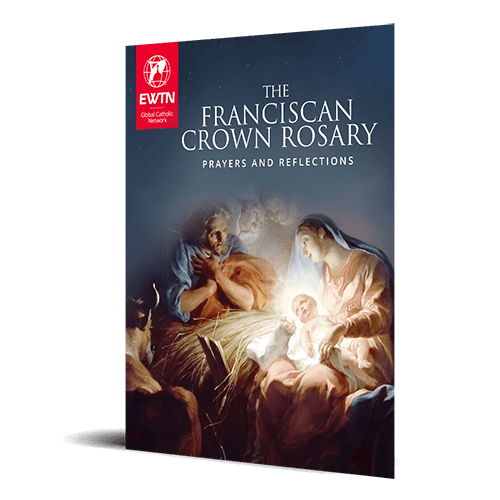
One unique devotion of the Franciscans is a seven-decade rosary known as the Franciscan Crown. While the traditional rosary consists of 5 decades which meditate on 15 mysteries, the 7-decade Franciscan Rosary, known as the Franciscan Crown, is a Rosary consisting of seven decades with each decade describing a particular joy from the life of the Blessed Virgin Mary. We hope that this special resource will help you meditate on each of the Seven Joys of Our Blessed Mother Mary.
Be inspired to follow in the footsteps of the saints. Subscribe to receive the Daily Saint, featuring a brief biography delivered to your inbox each day.
Start now and let the intercession and witness of the saints draw you closer to God.

As we deepen our relationship with the Eternal Word, Jesus Christ, we grow in grace and are transformed by His love and mercy.
STEP 1
We’re here to serve you. Let us help you complete your gift with confidence.

Send a message to Mission Advancement.

Guidance for DAFs, stock, IRA, and more.

Manage your gifts and preferences.