

Your Faith Journey with EWTN
As we deepen our relationship with the Eternal Word, Jesus Christ, we grow in grace and are transformed by His love and mercy.
c. 1175–January 6, 1275
Patron Saint of canon lawyers, all lawyers, Barcelona, Kingdom of Navarre

St. Raymond of Peñafort was a Spanish Dominican friar whose expertise in canon law and theological knowledge made significant contributions to the Church.
Born into a noble family near Barcelona, in Catalonia, St. Raymond enjoyed a strong early education in philosophy, rhetoric, and law. He earned doctorates in both canon and civil law in Bologna and later taught there.
Pope Gregory IX commissioned him to gather and organize papal decrees and decisions into a coherent collection known as the Decretals of Gregory IX, which standardized canon law and remained central to its practice in the Western Church until recent codifications in 1917. St. Raymond also wrote a manual called Summa of Cases of Penance to assist confessors in resolving moral and canonical questions.
St. Raymond also had a strong concern for the plight of Christian captives. Together with St. Peter Nolasco, he helped found the Order of Mercedarians with the approval of King James I. Their mission was to ransom Christian slaves held by the Moors.
St. Raymond also encouraged missionary work, debate, and the study of Arabic and Hebrew to foster understanding of the Christian Faith. He urged his fellow friars to engage in dialogue with Muslims and Jews, and he persuaded Thomas Aquinas to write his Summa Contra Gentiles as a tool for evangelization and defense of the Faith.
At about age 47, St. Raymond entered the Dominican Order in Barcelona, drawn by the preaching of Blessed Reginald and a growing zeal to preach the Gospel. Later, he was elected Master General of the Dominicans and reorganized the order’s constitutions.
He died in Barcelona on January 6, 1275, at the age of 100. He was canonized by Pope Clement VIII in 1601.
St. Raymond was elected the third Superior General of the Dominicans and reorganized the order’s constitutions. He even added a clause that allowed for the retirement of officeholders, which he promptly used to step down after two years. He promoted evangelization by establishing schools for the study of Asian languages. St. Raymond encouraged his fellow friars to engage in dialogue with Muslims and Jews, including persuading Thomas Aquinas to write his Summa Contra Gentiles as an apologetics tool.
According to the legend, St. Raymond of Peñafort crossed the Mediterranean Sea on his cloak after King James I of Aragon refused to let him leave the island. The king was angry because St. Raymond rebuked him for his sinful lifestyle and chose to return to Barcelona, discontinuing his work for the king. In response, the king forbade any captain from giving the saint passage from the island back to the mainland. In defiance of the king’s actions, St. Raymond spread his cloak on the water, used his staff as a mast, and sailed the 160 miles to Barcelona in six hours. The event was witnessed by sailors and spectators who were astonished by the miracle. The king was deeply moved and renounced his life of sin.
St. Raymond of Peñafort joined the Dominicans later in life. The preaching of Blessed Reginald, a Dominican friar, moved him. At the time, St. Raymond was already a well-known scholar and canon lawyer who had returned to Barcelona from Bologna, Italy, to serve as the archdeacon for the Bishop of Barcelona. He was attracted to the Dominican way of life and their charisms of preaching, teaching, and service. St. Raymond wanted to dedicate himself to serving God and responding to the call to help souls grow in holiness. And since the Dominican Order was founded to preach the Gospel, defend the faith, and combat heresy through intellectual rigor, St. Raymond’s academic background aligned well with the work of the Dominicans. Later, he served as Master General of the Dominicans and reorganized the order’s constitutions.
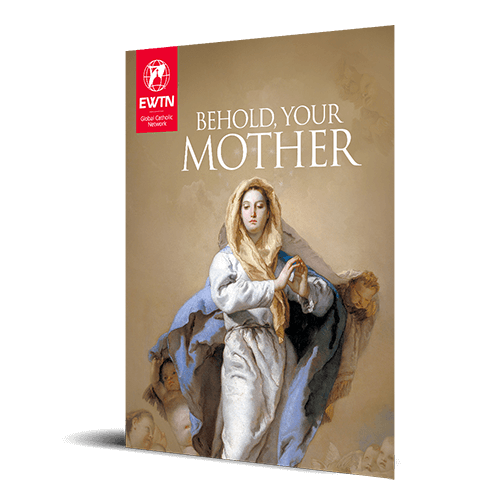
We hope this special eBook will draw you closer to our Blessed Mother and her Son, Jesus Christ. We trust that the pages will bring your heart under her mantle, as we share a few of the beautiful and befitting names bestowed upon the Blessed Virgin Mary.
Be inspired to follow in the footsteps of the saints. Subscribe to receive the Daily Saint, featuring a brief biography delivered to your inbox each day.
Start now and let the intercession and witness of the saints draw you closer to God.

As we deepen our relationship with the Eternal Word, Jesus Christ, we grow in grace and are transformed by His love and mercy.
STEP 1
We’re here to serve you. Let us help you complete your gift with confidence.

Send a message to Mission Advancement.

Guidance for DAFs, stock, IRA, and more.

Manage your gifts and preferences.