

Your Faith Journey with EWTN
As we deepen our relationship with the Eternal Word, Jesus Christ, we grow in grace and are transformed by His love and mercy.
577–January 10, 681
Patron Saint of Palermo

When Pope St. Agatho ascended to the Chair of Peter, he was 100 years old, according to Church records. He was described as kind, good with people, and efficient in business. His papacy was brief but impactful.
Born in Sicily in the latter part of the sixth century, St. Agatho served as the 79th pope of the Catholic Church from 678 until he died in 681. St. Agatho was of Greek descent and spent much of his early life as a Benedictine monk. He was known for his holiness and learning.
Significant ecclesial and theological achievements marked St. Agatho’s pontificate. He is best remembered for his role in resolving the Monothelite controversy—a theological dispute over whether Christ had one will or two. St. Agatho firmly upheld the doctrine of Christ’s two wills—divine and human—in a letter upholding the Church’s teaching.
St. Agatho sent a large Western Church delegation, along with his letter, to the Third Council of Constantinople, which affirmed this orthodox position and condemned the heresy. Patriarch George of Constantinople and most of the bishops present at the council agreed that “Peter spoke” through St. Agatho.
St. Agatho also worked to restore unity between the Roman Church and the Eastern Churches. He helped build bridges with the Eastern Churches.
An English bishop requested help from Rome after the Archbishop of Canterbury usurped his rights. St. Agatho judged in the bishop’s favor, reinforcing the authority of the Roman Church in ecclesiastical disputes.
St. Agatho died on January 10, 681. Although his reign was short, his legacy endures in the Church’s Christological clarity and in his gestures toward Church unity.
Monothelitism was a significant issue that caused division in the Church for more than 40 years, from its promotion around 638 A.D. until its condemnation in 681 A.D. It posed a fundamental problem by compromising the biblical teaching that Jesus was fully human in every way except sin. To be fully human, Christ needed a human will, which the heresy denied. Orthodox theology argues that Christ needed a fully human will to make his sacrifice truly representative and atoning for humanity.
Monothelitism was introduced around 622 A.D., promoted by Emperor Heraclius and Patriarch Sergius of Constantinople, and became official in the mid-600s in the Eastern Church. Years later, the doctrine gained traction in the East, and Pope Honorius tolerated it in the Western Church. The controversy escalated. Clergy who opposed the doctrine were exiled. Emperor Constantine IV convened the ecumenical Third Council of Constantinople to resolve the issue once and for all. St. Agatho played a critical role in officially condemning the heresy and ending its assault on Church orthodoxy.
Constantine IV convened the Third Council of Constantinople (680–681 A.D.) to end the Monothelite controversy, which taught that Christ had only one will. The council read a letter from Pope Agatho, which presented the Church’s traditional belief that Christ had two wills—divine and human—and most bishops accepted it. The council formally condemned Monothelitism as heretical. Those who had supported the heresy and refused to accept the orthodox position were deposed, including Patriarch Macarius and Pope Honorius. The attending bishops and the emperor signed the council’s decrees and sent them to Rome for Approval. St. Agatho had died several months before the council completed its work, so his successor, Pope Leo II, approved the decrees, restoring unity between the Churches.
The Byzantine Exarch, the emperor’s representative, was influenced by the emperor to support independence from papal authority. But when Theodore was appointed as Exarch, he reversed this policy. He went to Rome to pay homage to St. Agatho, acknowledging the pope’s supremacy. The Exarch’s submission improved the pope’s standing and relationship with the Byzantine court in Constantinople. It helped St. Agatho project an image of strength and stability that later helped to restore unity between the Eastern and the Western Churches.
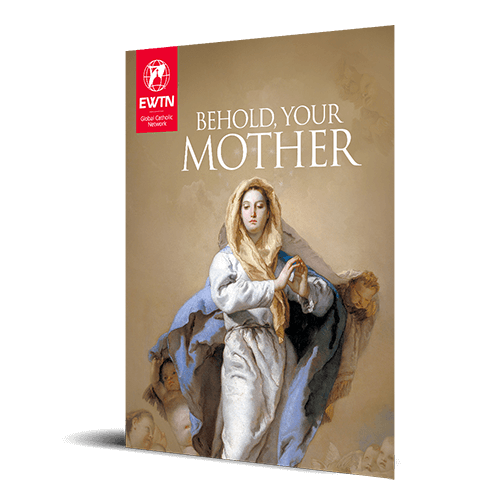
We hope this special eBook will draw you closer to our Blessed Mother and her Son, Jesus Christ. We trust that the pages will bring your heart under her mantle, as we share a few of the beautiful and befitting names bestowed upon the Blessed Virgin Mary.
Be inspired to follow in the footsteps of the saints. Subscribe to receive the Daily Saint, featuring a brief biography delivered to your inbox each day.
Start now and let the intercession and witness of the saints draw you closer to God.

As we deepen our relationship with the Eternal Word, Jesus Christ, we grow in grace and are transformed by His love and mercy.
STEP 1
We’re here to serve you. Let us help you complete your gift with confidence.

Send a message to Mission Advancement.

Guidance for DAFs, stock, IRA, and more.

Manage your gifts and preferences.