

Your Faith Journey with EWTN
As we deepen our relationship with the Eternal Word, Jesus Christ, we grow in grace and are transformed by His love and mercy.
St. Timothy: First century–97 A.D.
St. Titus: First century–96 or 107 A.D.
St. Timothy: Patron Saint against stomach and intestinal disorders
St. Titus: Patron Saint of Crete

In two of St. Paul’s Epistles, he writes to Sts. Timothy and Titus, his devoted disciples and companions. They shared in St. Paul’s missionary journeys and continued his work of evangelization.
St. Timothy was born in Lystra to a Jewish mother and a Greek father. Raised in the Jewish faith by his mother, Eunice, and grandmother, Lois, he embraced the Gospel when St. Paul visited Lystra during his second missionary journey. His mother and grandmother also became devout Christians.
Since his father was not a Christian, St. Timothy was not circumcised. St. Paul circumcised him so that he could accompany him in preaching to the Jews. Later, St. Timothy was appointed Bishop of Ephesus, and St. Paul addressed two pastoral letters to him, offering instruction on faith, leadership, and perseverance. Tradition holds that St. Timothy was stoned to death by a crowd of angry pagans for defending the Christian Faith in Ephesus.
St. Titus was a Gentile convert who became another of Paul’s faithful disciples. Paul called him “my true child in our common faith.” Titus served as a peacemaker and organizer within the early Church, serving as a mediator between St. Paul and the Corinthians, and was later named Bishop of Crete. His pastoral work is reflected in the Letter to Titus, which emphasizes sound teaching and good works rooted in faith. Tradition says Titus died peacefully in Crete at an advanced age.
Sts. Timothy and Titus are remembered for their missionary zeal and steadfast devotion to Christ’s Church.
Sts. Timothy and Titus had different backgrounds and capabilities that supported St. Paul’s missionary work. St. Timothy oversaw the teaching and governance in Ephesus, while St. Titus’s work centered on organization and reconciliation in Crete and Corinth. Timothy was of mixed Jewish and Gentile heritage and was assigned to pastoral care in Ephesus. Titus was a Greek Gentile assigned to a more challenging role in Crete. Their relationship with St. Paul was similarly strong, but St. Paul’s letters and assignments reveal the two had different personalities. St. Paul saw Timothy as a son in the faith needing encouragement. At the same time, Titus was a trusted and capable messenger and peacemaker for difficult tasks. St. Titus, a Gentile, also accompanied St. Paul to the Council of Jerusalem, where the Apostles discussed the requirements for Gentiles to enter the Church. Both men reflected complementary gifts within Paul’s missionary circle.
St. Eusebius, a bishop and early Church historian, and others offer limited details about the later lives and deaths of St. Timothy and St. Titus. We learn that St. Timothy remained as Bishop of Ephesus for many years. According to tradition, he was martyred around the year 97 A.D. by a pagan mob who beat him, dragged him through the streets, and stoned him to death for denouncing the worship of the idol of the goddess Diana at a local festival. He was around 80 years old. St. Titus continued to lead the Church in Crete, working to promote the Faith and overthrow paganism on the island. Tradition holds that St. Titus died a natural death around 96 A.D. in Crete. He was approximately 94 years of age. His head was venerated in Venice for centuries before being returned to Crete in 1966.
The relics of St. Timothy are in the Cathedral of Termoli, Italy, where they were rediscovered in the cathedral’s crypt during restoration work in 1945. His relics were relocated from Ephesus to Constantinople in the fourth century and subsequently transferred to Italy during the Crusades around 1239. A marble slab marks the burial place with an inscription that reads, “Here rests in peace the body of the blessed Timothy, disciple of the blessed Apostle.” St. Titus’s relics, consisting of his skull, were taken to Venice during the Ottoman rule of Crete. His relics were returned to the island in 1966 and are preserved in the Church of St. Titus in Heraklion, Crete.
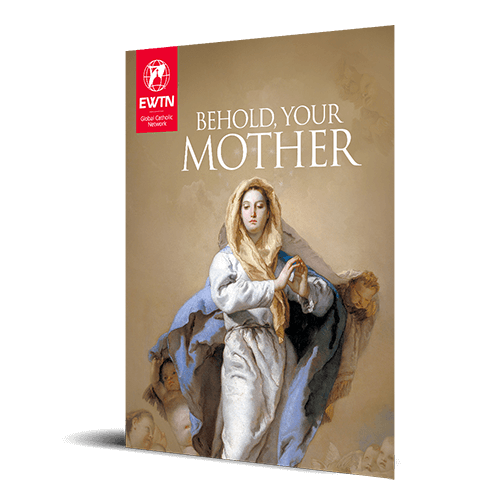
We hope this special eBook will draw you closer to our Blessed Mother and her Son, Jesus Christ. We trust that the pages will bring your heart under her mantle, as we share a few of the beautiful and befitting names bestowed upon the Blessed Virgin Mary.
Be inspired to follow in the footsteps of the saints. Subscribe to receive the Daily Saint, featuring a brief biography delivered to your inbox each day.
Start now and let the intercession and witness of the saints draw you closer to God.

As we deepen our relationship with the Eternal Word, Jesus Christ, we grow in grace and are transformed by His love and mercy.
STEP 1
We’re here to serve you. Let us help you complete your gift with confidence.

Send a message to Mission Advancement.

Guidance for DAFs, stock, IRA, and more.

Manage your gifts and preferences.