

Your Faith Journey with EWTN
As we deepen our relationship with the Eternal Word, Jesus Christ, we grow in grace and are transformed by His love and mercy.
c. 363–c. 425

St. Sulpicius Severus was a Gallo-Roman priest, theologian, and historian whose writings helped preserve the memory of early Christian holiness—especially that of his friend and mentor, St. Martin of Tours. Known for his elegant Latin style and devout faith, St. Sulpicius combined literary skill with deep spirituality, offering the Church both historical insight and a model of conversion.
As a nobleman in Aquitaine, France, St. Sulpicius received a classical education. He pursued a promising career in law. He married a wealthy woman and enjoyed social prominence, but after her early death, he turned away from worldly ambition and devoted himself to God. Inspired by the example of St. Martin, he embraced a life of simplicity and prayer, eventually becoming a priest.
St. Sulpicius’s most famous work, Vita Sancti Martini (The Life of Saint Martin), is one of the earliest and most influential Christian biographies. In it, he recounts the miracles, humility, and holiness of St. Martin, helping to spread devotion to the saint throughout Gaul and beyond. He also wrote the Chronica, a concise history from Creation to his own time, which includes valuable information about the Church in the late fourth century.
Although he lived a quiet life, St. Sulpicius’s writings had a profound influence on later Christian thought. His works promoted Christian doctrine, narrated sacred history, and strengthened faith through accounts of the life of a beloved saint.
As an early Christian biography, St. Sulpicius’s book, Life of St. Martin, recounts the life of a pivotal figure in the early Christian Church, recording his transformation from a soldier to a monastic leader and bishop. His story is a powerful example of virtue and inspires many Christians today. St. Sulpicius’s story of St. Martin’s life is a testimony to the transformative power of faith, encouraging Christians to live lives of courage, charity, and virtue.
Sulpicius’s writings promoted orthodox Christian doctrine and advocated for the monastic life. His writings were informative and educational. His major works include his book, Life of St. Martin, which was written to honor his mentor and presented an ideal of the monastic life, and Chronica, a history of the world that provided valuable information in the context of the heresies of that period. He also sought to challenge clergy who were too involved in worldly politics.
St. Sulpicius wrote a letter to St. Eusebius defending St. Martin of Tours from critics. His book on St. Martin of Tours and his letters were written to protect St. Martin’s sanctity and legitimacy as a bishop from attacks by figures like Ithacius, a Spanish bishop who accused St. Martin of heresy when he tried to prevent the state’s execution of heretics in favor of a more lenient solution. This letter, sent to Eusebius, a Christian historian, was titled “Against Some Envious Assailants of Martin.” It addressed a criticism by an unnamed individual who accused St. Martin of not being a holy man. The claim was that since he was injured in a fire that had occurred by accident, St. Martin was not protected by divine assistance. St. Sulpicius explained the details of the fire and made the case that the sweeping flames would have consumed any other man, whereas St. Martin was spared, receiving no life-threatening injuries.
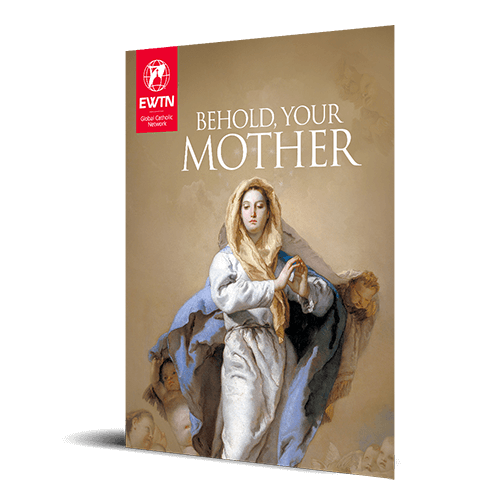
We hope this special eBook will draw you closer to our Blessed Mother and her Son, Jesus Christ. We trust that the pages will bring your heart under her mantle, as we share a few of the beautiful and befitting names bestowed upon the Blessed Virgin Mary.
Be inspired to follow in the footsteps of the saints. Subscribe to receive the Daily Saint, featuring a brief biography delivered to your inbox each day.
Start now and let the intercession and witness of the saints draw you closer to God.

As we deepen our relationship with the Eternal Word, Jesus Christ, we grow in grace and are transformed by His love and mercy.
STEP 1
We’re here to serve you. Let us help you complete your gift with confidence.

Send a message to Mission Advancement.

Guidance for DAFs, stock, IRA, and more.

Manage your gifts and preferences.