

Your Faith Journey with EWTN
As we deepen our relationship with the Eternal Word, Jesus Christ, we grow in grace and are transformed by His love and mercy.
c. 451–c. 525
Patron Saint of healers; poets; blacksmiths, livestock and daily workers; Kildare, Ireland

St. Brigid of Ireland (also known as St. Brigid of Kildare) was born in the mid-fifth century. She is one of three patron saints of Ireland, alongside St. Patrick and St. Columba. She became one of the most beloved figures of early Irish Christianity and is remembered for her extraordinary charity, leadership, and trust in God.
Born near Dundalk to a pagan chieftain and a Christian slave woman, St. Brigid was a slave in her father’s household. She received the Christian Faith from her mother and was later baptized by St. Patrick. She showed a remarkable generosity that foreshadowed her lifelong service to the poor. She resisted pressures from her family to marry, desiring instead a life given in service to Christ. Her father threatened to sell her, but she stayed steadfast to her vocation and finally won her freedom.
Around 470, St. Brigid received the veil from St. Mel of Ardagh, who—according to tradition—mistakenly but providentially conferred episcopal blessings upon her, symbolizing her spiritual authority in the Church. Along with a group of like-minded women, she founded a monastery at Kildare, which became one of the most influential centers of prayer and Christian learning in Ireland. She also founded a monastery where monks lived and served under her direction.
Numerous stories tell of her compassion: feeding the hungry, healing the sick, and giving freely even from meager resources. One famous tale tells how she gave away her father’s sword to a beggar so he could sell it and feed his family. Brigid’s hospitality became legendary, and her monasteries offered refuge to travelers, the poor, and those in need.
St. Brigid died around 525 at Kildare and was soon revered throughout Ireland and beyond. Her spiritual legacy also includes the “St. Brigid’s Cross,” woven of rushes and traditionally hung in Irish homes as a sign of protection and blessing.
The St. Brigid’s Cross tradition originated from a legend about St. Brigid converting a dying pagan chieftain. According to legend, St. Brigid was asked to help a dying pagan chieftain in great pain and distress. To comfort him, she began weaving rushes from the floor into a cross shape. As she explained the meaning of the cross and the story of Jesus, the chieftain converted to Christianity and was baptized just before his death. St. Brigid’s cross became a symbol of peace and goodwill between Christians and pagans who coexisted in Ireland at that time. People began the custom of making rush crosses to hang in doorways to bless and protect their homes. In Ireland today, St. Brigid crosses are made, blessed, and given away during Mass on her feast day.
St. Brigid’s monasteries offered refuge to travelers and those in need. She had a compassionate nature, evident even as a young girl. Her communities emphasized sharing blessings with others. As a girl, Brigid was known for giving away her family’s dairy products and other food to the poor and hungry. After she and her mother gained their freedom, she dedicated her life to God and established a convent where she continued to serve the poor.
According to tradition, St. Brigid’s community once offered refuge to a young woman who had fled to her for help and was falsely accused of theft. She remained there until the situation was resolved, when a fish caught by one of St. Brigid’s fishermen turned out to contain the lost item. St. Brigid’s motto, shared with her nuns, said, “What is mine is theirs.” This principle of God’s generosity was a cornerstone of the communal religious life she established for both women and men through education, prayer, and service in centers that ministered to the broader community.
St. Brigid’s father, a pagan chieftain, opposed her desire to pursue religious life. He wanted her to marry and mocked her desire for a consecrated life. She prayed for her beauty to be taken away so that no one would seek her in marriage. Refusing all proposals, she continued to give away her father’s possessions to the poor, which annoyed him. When her father tried to sell her as a slave to the king, St. Brigid took her father’s sword and gave it to a poor beggar to sell and provide food for his family. The king, seeing the goodness in St. Brigid, convinced her father to set her free. Eventually, he granted her permission to pursue religious life. With the help of St. Mel of Ardagh, St. Brigid consecrated her life to Christ and later founded the monastery of Kildare.
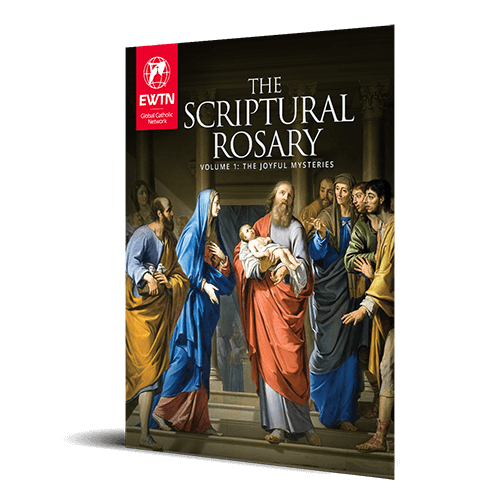
The Holy Rosary is an amazing prayer, encouraged by popes, loved by saints, and prayed by the faithful. At its heart, the Rosary is a meditation on Sacred Scripture, on the lives of Jesus and Mary.
Through this Scriptural Rosary, we hope that you will be able to better meditate on each Hail Mary and deepen your understanding of Sacred Scripture. Use the form below to get your free copy of The Scriptural Rosary.
A documentary on one of the pillars of Irish Christianity, St. Brigid of Kildare: a religious foundress and tireless champion for the poor and Ireland’s people.
Be inspired to follow in the footsteps of the saints. Subscribe to receive the Daily Saint, featuring a brief biography delivered to your inbox each day.
Start now and let the intercession and witness of the saints draw you closer to God.

As we deepen our relationship with the Eternal Word, Jesus Christ, we grow in grace and are transformed by His love and mercy.
STEP 1
We’re here to serve you. Let us help you complete your gift with confidence.

Send a message to Mission Advancement.

Guidance for DAFs, stock, IRA, and more.

Manage your gifts and preferences.