

Your Faith Journey with EWTN
As we deepen our relationship with the Eternal Word, Jesus Christ, we grow in grace and are transformed by His love and mercy.
February 3, c.281–February 2, 316
Patron Saint of infants, animals, builders, stonecutters, wool industry, physicians, veterinarians, healing, throats, and head and neck conditions

St. Blaise, Bishop of Sebaste in Armenia and martyr, is one of the most beloved early Christian saints, known primarily for his intercession in ailments of the throat. Little is known with certainty about his early life, but tradition holds that St. Blaise was a physician before becoming a bishop. He served the Christian community of Sebaste during a time of increasing persecution under Emperor Licinius in the early fourth century.
As persecution intensified, St. Blaise withdrew to a cave in the mountains, seeking solitude and safety. There, according to ancient accounts, wild animals gathered around him, and he gently tended their wounds. His hidden life ended when soldiers discovered and arrested him. Along the way to prison, he encountered a frantic mother whose child was choking on a fish bone. St. Blaise prayed over the child, who was immediately healed—a miracle that became central to his enduring patronage against throat illnesses.
A second miracle happened on his way to prison when an older woman had a pig seized by a wolf. She asked St. Blaise for help, and at his command, the wolf returned the pig to the woman unharmed. This woman visited him in prison, bringing him two fine wax candles to dispel the darkness in his cell. Thus, during the annual “Blessing of Throats” celebrated on February 3, two candles crossed at the throat are used to ask for St. Blaise’s intercession for healing throat ailments.
During his imprisonment, St. Blaise was tortured severely in attempts to force him to deny Christ, but he remained faithful. He was beaten, combed with iron hooks, and beheaded around the year 316. St. Blaise stands as a witness of courage and unwavering faith.
As one of the Fourteen Holy Helpers, St. Blaise was highly venerated throughout Central Europe. Today, St. Blaise’s memory lives on in the Church’s traditional annual Blessing of Throats on his feast day of February 3.
St. Blaise has a robust and easily identifiable iconography. He is usually depicted in icons with bishop’s vestments, often holding two crossed candles that symbolize the Blessing of Throats. The candles recall the gift a woman gave him in prison to overcome the darkness of the prison cell. Other images include a palm branch signifying martyrdom or the instruments used to torture him. He is sometimes depicted surrounded by wild animals seeking his blessing. His miracles of healing a choking boy and saving a pig from a wolf have also been represented in St. Blaise’s iconography.
St. Blaise became the patron saint of the wool industry because he was martyred with iron combs, similar to those used to comb sheep’s wool. St. Blaise was tortured by having his flesh scraped with iron combs before he was beheaded for refusing to renounce his Christian faith. Since the instruments used to torture him looked like wool combers, the entire wool trade became a part of the saint’s patronage over time. The expansion was likely due to the importance of the wool trade in medieval Europe. For example, a historic church located between an ancient marketplace and the market center in southwestern London has a 14th-century wall painting of St. Blaise. It marks the economic expansion of the wool trade in the market town during the 14th and 15th centuries.
St. Blaise’s following was widespread throughout Europe during the Middle Ages. In the East, veneration of St. Blaise began in the sixth century and spread to Europe by the eighth century. St. Blaise became one of the most popular saints in the Middle Ages, known for the miraculous cure of a boy with a fishbone in his throat. He was also considered one of the Fourteen Holy Helpers. St. Blaise’s cult spread across Europe and beyond to numerous countries. Cities in England, Italy, Portugal, Paraguay, and the Philippines claim him as a patron saint, as well as Dubrovnik, Croatia, which honors him for saving the city from an attack in 971. Around the world, many churches have been named after St. Blaise over the years, and in Italy, even a mountain bears his name: Monte San Biagio.
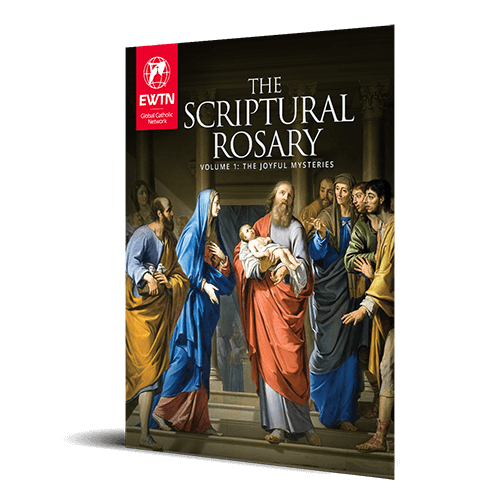
The Holy Rosary is an amazing prayer, encouraged by popes, loved by saints, and prayed by the faithful. At its heart, the Rosary is a meditation on Sacred Scripture, on the lives of Jesus and Mary.
Through this Scriptural Rosary, we hope that you will be able to better meditate on each Hail Mary and deepen your understanding of Sacred Scripture. Use the form below to get your free copy of The Scriptural Rosary.
Be inspired to follow in the footsteps of the saints. Subscribe to receive the Daily Saint, featuring a brief biography delivered to your inbox each day.
Start now and let the intercession and witness of the saints draw you closer to God.

As we deepen our relationship with the Eternal Word, Jesus Christ, we grow in grace and are transformed by His love and mercy.
STEP 1
We’re here to serve you. Let us help you complete your gift with confidence.

Send a message to Mission Advancement.

Guidance for DAFs, stock, IRA, and more.

Manage your gifts and preferences.