

Your Faith Journey with EWTN
As we deepen our relationship with the Eternal Word, Jesus Christ, we grow in grace and are transformed by His love and mercy.
c. 1562–February 5, 1597
Patron Saint of Japan

St. Paul Miki and his companions—known collectively as the Martyrs of Japan—were 26 Christians who gave their lives for Christ and the Truth of the Christian Faith in Nagasaki on February 5, 1597.
Their witness marks one of the earliest and most remarkable chapters in the history of Christianity in Japan. St. Paul Miki was born into a noble Japanese family in the late 16th century. Joining the Society of Jesus, he became a Jesuit seminarian. A gifted preacher, he was renowned for his ability to explain the Catholic Faith with clarity and enthusiasm.
In the late 16th century, tensions between Christian missionaries and Japanese authorities intensified. Japanese ruler Toyotomi Hideyoshi, seeking to limit foreign influence, ordered the arrest of several missionaries and Christian laypeople. The group included St. Paul Miki, two other Jesuits, six Franciscan friars, and 17 lay faithful, including catechists and altar servers, who were young boys.
The group was forced to march six hundred miles from Kyoto to Nagasaki, where the Japanese soldiers would execute them. It was a month-long journey, and along the way, they prayed, sang hymns, and encouraged each other to remain steadfast.
When they arrived at Nishizaka Hill, they were bound to crosses and executed by spear. St. Paul Miki preached his final sermon from the cross, proclaiming forgiveness for his persecutors and affirming his joy in dying for Christ and the Truth of his Christian Faith.
In 1862, Pope Pius IX canonized St. Paul Miki and his 25 companions. They left a powerful witness to Truth that sustained the Church in Japan for centuries. Japanese Christians worshiped in secret and kept faith alive for generations until freedom of religion was legalized.
The Twenty-Six Martyrs Museum and Monument in Nagasaki, Japan, commemorates the 26 Christians martyred for the Faith there on February 5, 1597, under the order of Japanese ruler Toyotomi Hideyoshi. Constructed on the site are a museum displaying artifacts and historical documents, a memorial monument, and an adjacent church dedicated to the martyrs, which is a Catholic pilgrimage site. The monument is located on Nishizaka Hill, the actual execution site, chosen because it was considered a resemblance to the Hill of Golgotha. The monument, built in 1962 to mark the centennial of their canonization, was created by architect Imai Kenji. The museum details the history of Christianity in Japan and the persecution of the martyrs. The site was officially designated as a Catholic pilgrimage site by Pope Pius XII in 1950.
In 1596, the Spanish galleon San Felipe was shipwrecked off the coast of Japan. While local authorities were confiscating its cargo, the Spanish captain reportedly boasted during negotiations about the Spanish conquest. The information was communicated to the Japanese ruler, who saw it as confirmation of his fears that missionaries were part of a Spanish plot to conquer Japan. As a result, St. Paul Miki and 25 other Christian missionaries and converts were arrested and executed in 1597. While the Japanese government laxly enforced the 1587 edict for a period, the San Felipe incident dramatically shifted the government’s policy toward severe Christian persecution. The persecution drove Japanese Christians underground, leading to the survival of Catholicism in Japan through the “hidden Christians” communities that kept their faith and passed it on to the next generations in secret for centuries.
Christianity was legalized in Japan in 1873, when the Meiji government lifted the ban on the religion. Previously, an initial edict banning foreign religions was ordered in 1857, which led to the martyrdom of the 26 Japanese Martyrs. An official ban on Christianity was declared in 1614. The continued persecution drove Japanese Christians underground. These “hidden Christians” (Kakure Kirishitan) preserved their faith in secret for centuries, without priests and without contact with the outside Church. The concept of freedom of religion in Japan resulted from a broader effort to modernize and open the country to Western influence after centuries of isolation. In 1889, a constitution further solidified religious freedom, explicitly granting liberty of religion and conscience. Today, about two million Christians live in Japan, which is about 1% of the population. Christianity is more prevalent in western Japan, the region where missionaries first had success. Catholics and Protestants combined make up about 70% of the Japanese Christian population.
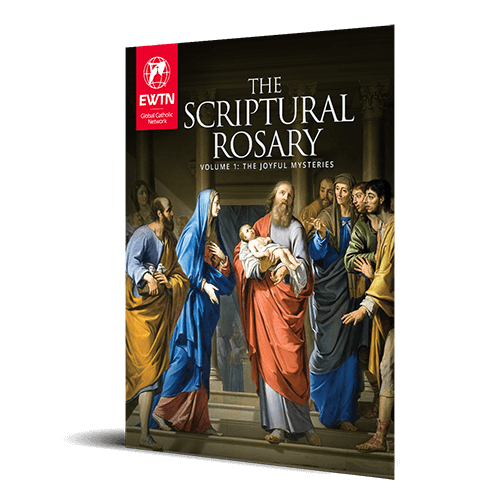
The Holy Rosary is an amazing prayer, encouraged by popes, loved by saints, and prayed by the faithful. At its heart, the Rosary is a meditation on Sacred Scripture, on the lives of Jesus and Mary.
Through this Scriptural Rosary, we hope that you will be able to better meditate on each Hail Mary and deepen your understanding of Sacred Scripture. Use the form below to get your free copy of The Scriptural Rosary.
Be inspired to follow in the footsteps of the saints. Subscribe to receive the Daily Saint, featuring a brief biography delivered to your inbox each day.
Start now and let the intercession and witness of the saints draw you closer to God.

As we deepen our relationship with the Eternal Word, Jesus Christ, we grow in grace and are transformed by His love and mercy.
STEP 1
We’re here to serve you. Let us help you complete your gift with confidence.

Send a message to Mission Advancement.

Guidance for DAFs, stock, IRA, and more.

Manage your gifts and preferences.