

Your Faith Journey with EWTN
As we deepen our relationship with the Eternal Word, Jesus Christ, we grow in grace and are transformed by His love and mercy.
Second century–249
Patron Saint of dentists, against toothaches and dental problems

St. Apollonia, virgin and martyr, is one of the most revered early Christian witnesses of the third century, celebrated for her extraordinary courage during a sudden, violent attack against Christians in Alexandria, Egypt. Most of what we know about her comes from a letter written by St. Dionysius of Alexandria, preserved by the Church historian Eusebius. In that account, St. Apollonia is described as a mature consecrated virgin, deeply respected for her holiness and dedication to the Christian community.
During an outbreak of anti-Christian riots around 249 A.D., a mob seized St. Apollonia and subjected her to horrific torture. Her teeth were violently shattered and extracted as they demanded that she renounce Christ and repeat blasphemous statements. Her captors threatened to burn her alive if she did not deny her faith. Faced with the choice, St. Apollonia boldly chose martyrdom.
Filled with the Holy Spirit, St. Apollonia leapt into the fire voluntarily rather than betray her faith. In a situation of continued torture and certain death, St. Apollonia’s act was not considered suicide but a heroic witness and consistent with the Church’s ancient understanding of martyrdom.
Veneration of St. Apollonia spread rapidly in both East and West. Medieval Christians invoked her intercession particularly for protection against toothaches and dental diseases, a devotion that continues today. St. Apollonia’s unwavering and courageous witness, even in the face of torture and death, continues to fortify the faith of believers today.
St. Dionysius, the Bishop of Alexandria, wrote a letter describing St. Apollonia’s martyrdom to Fabius, the Bishop of Antioch. The letter, widely preserved in the Ecclesiastical History by Historian Eusebius of Caesarea, is the only authentic historical source of the events surrounding the martyrdom of St. Apollonia and other Christians during a local persecution in Alexandria around 249 A.D. The riot occurred a year before the severe persecution by the Roman Emperor Decius. St. Dionysius’s account described St. Apollonia as an “aged virgin” or deaconess, relating that her persecutors seized her and “knocked out all her teeth by hitting her jaws.” The mob then built a fire and threatened to burn her alive unless she uttered impious words or denied her faith. After asking for and being granted a moment’s freedom, she quickly jumped into the flames, preferring death to apostasy.
The mob that attacked St. Apollonia and other Christians in Alexandria (around 249 A.D.) consisted of local pagan citizens. They were not acting under a formal imperial edict at the time, but instead participated in a spontaneous, “grassroots” riot. During a celebration commemorating the one-thousandth anniversary of the founding of Rome, the pagan mob incited violence fueled by underlying resentment toward the Christian community for refusing to participate in Roman civic and religious life. When a local poet and prophet of “evil” stirred up the populace by foretelling a calamity, widespread fury broke out. The Christians were easy targets to blame for various misfortunes and problems within the Roman Empire and the city of Alexandria. Christians, like St. Apollonia, were seized and given the choice to curse their God or sacrifice to pagan idols. Their refusal to renounce their faith infuriated the mob. This local uprising foreshadowed the later persecutions across the Roman Empire initiated by Emperor Decius around 250 A.D. Bishop Dionysius of Alexandria documented these events, including St. Apollonia’s martyrdom, in a letter to Fabius, Bishop of Antioch.
The relics of St. Apollonia are venerated in many churches across Europe, most notably at the Basilica of Santa Maria in Trastevere, the Basilica di San Lorenzo fuori le Mura, and San Basili, all located in Rome, Italy. Other churches housing smaller relics are in Naples, Volterra, Bologna, Croatia, Antwerp, Brussels, Cologne, and Liège.
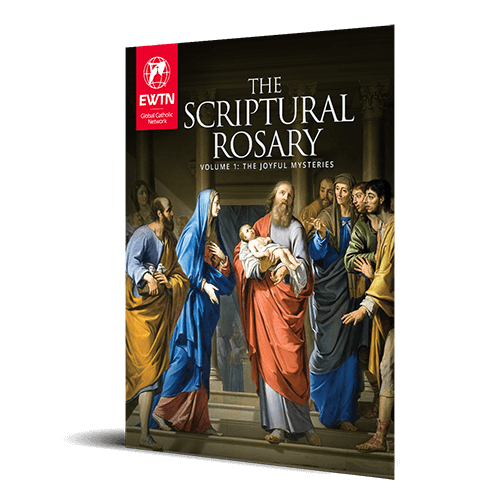
The Holy Rosary is an amazing prayer, encouraged by popes, loved by saints, and prayed by the faithful. At its heart, the Rosary is a meditation on Sacred Scripture, on the lives of Jesus and Mary.
Through this Scriptural Rosary, we hope that you will be able to better meditate on each Hail Mary and deepen your understanding of Sacred Scripture. Use the form below to get your free copy of The Scriptural Rosary.
Be inspired to follow in the footsteps of the saints. Subscribe to receive the Daily Saint, featuring a brief biography delivered to your inbox each day.
Start now and let the intercession and witness of the saints draw you closer to God.

As we deepen our relationship with the Eternal Word, Jesus Christ, we grow in grace and are transformed by His love and mercy.
STEP 1
We’re here to serve you. Let us help you complete your gift with confidence.

Send a message to Mission Advancement.

Guidance for DAFs, stock, IRA, and more.

Manage your gifts and preferences.