

Your Faith Journey with EWTN
As we deepen our relationship with the Eternal Word, Jesus Christ, we grow in grace and are transformed by His love and mercy.
April 23, 1522–February 2, 1590
Patron Saint of illness and the sick; Prato, Italy

St. Catherine de’ Ricci was a Dominican mystic in the 16th century whose life of prayer, charity, and extraordinary union with Christ made her a revered figure of the Renaissance Church.
Born Alessandra Lucrezia Romola de’ Ricci in Florence, she was raised by relatives after losing her mother at an early age. From childhood, she showed remarkable piety, a contemplative spirit, and a tender devotion to the Passion of Christ.
At age 13, she entered the Dominican convent of San Vincenzo in Prato, taking the religious name Catherine. Although she endured early misunderstandings from some sisters due to her mystical gifts, she persevered in humility and obedience. Over time, she became known for her deep prayer life and for the many graces she received, including visions, ecstasies, and the bearing of the stigmata.
One of the most striking features of Catherine’s spiritual life was the weekly ecstasy she experienced on Thursdays and Fridays for several years, during which she visibly contemplated Christ’s Passion. Witnesses recounted that her body reflected the agony of Christ’s suffering, receiving the marks of the stigmata during ecstasy.
Despite these mystical consolations, Catherine excelled in practical charity and wise leadership. She served as novice leader and later as prioress for decades, guiding her community with gentleness and sound judgment. She corresponded with numerous Church leaders of her time, including St. Philip Neri, to whom she is said to have appeared miraculously in Rome while remaining physically in her convent in Tuscany.
Catherine died on February 2, 1590, beloved by her sisters and revered for her holiness. She was canonized in 1746.
Because of her extraordinary love for Christ’s Passion, God granted St. Catherine profound mystical experiences of ecstasy. These incidents typically lasted hours and occurred over twelve years. During these periods, she saw visions and received the wounds of stigmata on her body. The incidents were documented by her community and evaluated by medical professionals and the Church.
In addition to visions, St. Catherine received visible wounds on her body, including a mark from the crown of thorns and the wound in her side. Medical professionals called to assist her verified these incidents. In addition to the side and crown of thorns, she was also said to bear the imprints of the nail wounds. St. Catherine’s wounds were recognized by many as a sign of her holiness and profound devotion to Christ’s suffering.
St. Catherine de’ Ricci befriended and corresponded with three cardinals who later became popes: Pope Marcellus II (Marcello Cervini degli Spannocchi), Pope Clement VIII (Ippolito Aldobrandini), and Pope Leo XI (Alessandro Ottaviano de’ Medici). She also corresponded with St. Philip Neri and St. Charles Borromeo. Her reputation for holiness and wisdom drew many prominent figures, including princes, bishops, and future pontiffs, who sought her spiritual counsel and advice, both in person and by letter.
The relics of St. Catherine de’ Ricci are preserved under the altar in the Minor Basilica of Santi Vicenzo e Catrina de’ Ricci in Prato, Italy. Contained in a silver urn, her relics lie beneath the altar in the basilica. The basilica was built after her canonization and is connected to her original convent, where she lived and died. Her body was discovered incorrupt during her canonization process.
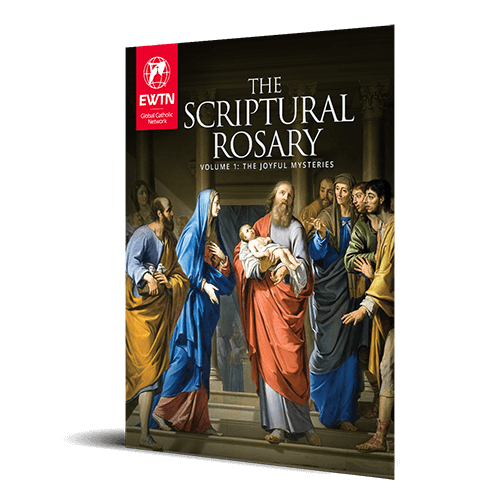
The Holy Rosary is an amazing prayer, encouraged by popes, loved by saints, and prayed by the faithful. At its heart, the Rosary is a meditation on Sacred Scripture, on the lives of Jesus and Mary.
Through this Scriptural Rosary, we hope that you will be able to better meditate on each Hail Mary and deepen your understanding of Sacred Scripture. Use the form below to get your free copy of The Scriptural Rosary.
Be inspired to follow in the footsteps of the saints. Subscribe to receive the Daily Saint, featuring a brief biography delivered to your inbox each day.
Start now and let the intercession and witness of the saints draw you closer to God.

As we deepen our relationship with the Eternal Word, Jesus Christ, we grow in grace and are transformed by His love and mercy.
STEP 1
We’re here to serve you. Let us help you complete your gift with confidence.

Send a message to Mission Advancement.

Guidance for DAFs, stock, IRA, and more.

Manage your gifts and preferences.