

Your Faith Journey with EWTN
As we deepen our relationship with the Eternal Word, Jesus Christ, we grow in grace and are transformed by His love and mercy.
February 10, 1805–January 3, 1871
Patron Saint of Institutions of the Carmelites of Mary Immaculate and the Congregation of Mother of Carmel; education, families, spiritual growth, and the sick

St. Kuriakose Elias Chavara was a priest and social reformer who uplifted the marginalized. He removed barriers to education for the poor, provided food for impoverished students, and promoted humanitarian aid for the sick and elderly.
Born in the early 19th century in Kainakary, Kerala, St. Kuriakose is one of the most beloved figures of the Syro-Malabar Catholic Church in India—a priest, founder, reformer, and spiritual guide whose life helped renew Christian Faith in Kerala. He was a staunch advocate for education, family life, and care for the poor.
St. Kuriakose was raised in a devout Catholic family. Drawn early to prayer and study, he entered seminary and was ordained a priest in 1829. His holiness, humility, and keen pastoral sense soon made him a trusted counselor to clergy and laity alike.
In 1831, together with two other priests, he founded what would become the Carmelites of Mary Immaculate (CMI), the first men’s religious congregation founded by Indian Catholics. Inspired by Carmelite spirituality and devoted to the Blessed Virgin, the community provided education, mission work, and service to the marginalized. St. Kuriakose later assisted in founding the Congregation of the Mother of Carmel (CMC), the first indigenous women’s religious congregation in India.
St. Kuriakose introduced parish reforms that strengthened family prayer, catechesis, and unity. He urged families to gather daily for prayer and to practice reading Scripture at home. His love for the poor shaped initiatives such as Pidiyari, a practice of setting aside a handful of rice daily to assist those in need.
The rice from the Pidiyari program supplied the midday meal that drew poor children to school, preparing their minds and souls for a life of grace. St. Kuriakose said, “As those who have no eyes are called ‘blind,’ so too those who have no learning are to be called ‘intellectually blind.’ Hence, it is the responsibility of [the] priest to teach the faithful and of parents to teach their children.”
St. Kuriakose died on January 3, 1871, and was canonized in 2014 by Pope Francis. He is celebrated as a visionary educator, spiritual father, and champion of Christian family life. His legacy includes religious congregations, churches, schools, monasteries, a newspaper, and numerous writings. He remains a guiding light for Christian families and for all who seek holiness in service and community.
St. Kuriakose Elias Chavara is called a social reformer for his pioneering efforts in Kerala to uplift the marginalized through education. He challenged caste (social class) barriers and championed the motto “a school attached to each parish church,” ensuring that educational learning opportunities reached underprivileged groups. Through his St. Joseph’s Press, he published educational materials and laid the foundation for the first Malayalam newspaper, which fostered social consciousness. He established charitable homes for the sick, elderly, and destitute, and initiated the Pidiyari idea of daily rice contributions to feed the needy. His foundational belief in the inherent dignity of every person, regardless of caste or creed, drove his social and educational reforms.
St. Kuriakose Elias Chavara was a pivotal figure in the Syro-Malabar Church. He founded the first male and female religious orders: the Carmelites of Mary Immaculate (CMI) for men and the Congregation of the Mother of Carmel (CMC) for women. He pioneered Kerala’s education system (Pallikoodams), linking schools to parishes and making education accessible to all. As a Vicar General, he maintained a strong, independent community. He successfully guided the Church through a major threat of schism in the 1860s, preserving its unity. He introduced important liturgical reforms, promoted devotion to the Eucharist and Holy Family, and significantly influenced family life.
St. Kuriakose’s diverse writings had an impact in many areas. His works include spiritual epics such as Atmanuthapam (Repentant Soul’s Lament), contemplative works such as Dhyana Sallapangal (Meditative Colloquies), practical guides for families such as Nalla Appante Chavarul (Testament of a Loving Father), and poems such as Maranaveetil Cholvanulla Parvam (Song for the Bereaved). He pioneered Malayalam drama with his Eclogues, reflecting deep faith and social guidance. He also established a printing press in Mannanam to produce Catholic literature, a vital step for Malayalam literature and education. He wrote catechism texts and devotional songs, contributing to religious education.
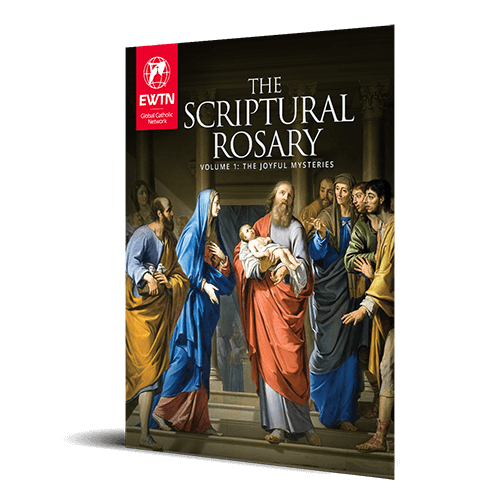
The Holy Rosary is an amazing prayer, encouraged by popes, loved by saints, and prayed by the faithful. At its heart, the Rosary is a meditation on Sacred Scripture, on the lives of Jesus and Mary.
Through this Scriptural Rosary, we hope that you will be able to better meditate on each Hail Mary and deepen your understanding of Sacred Scripture. Use the form below to get your free copy of The Scriptural Rosary.
Be inspired to follow in the footsteps of the saints. Subscribe to receive the Daily Saint, featuring a brief biography delivered to your inbox each day.
Start now and let the intercession and witness of the saints draw you closer to God.

As we deepen our relationship with the Eternal Word, Jesus Christ, we grow in grace and are transformed by His love and mercy.
STEP 1
We’re here to serve you. Let us help you complete your gift with confidence.

Send a message to Mission Advancement.

Guidance for DAFs, stock, IRA, and more.

Manage your gifts and preferences.