

Your Faith Journey with EWTN
As we deepen our relationship with the Eternal Word, Jesus Christ, we grow in grace and are transformed by His love and mercy.
1290–February 19, 1351
Patron Saint of hermits, penitents, agricultural workers, against hernias

Admitting guilt for a senseless mistake with life-or-death consequences can be both heart-wrenching and transformational. St. Conrad of Piacenza was a 14th-century nobleman who, after a moment of carelessness, chose a path that led to a new life of holiness and service.
St. Conrad of Piacenza was a nobleman-turned-hermit whose dramatic conversion took him from a life of comfort to one of solitude, penance, and charity. Born into an influential family in Piacenza, Italy, St. Conrad enjoyed the privileges of the nobility and married a devout woman named Euphrosyne. Though he lived a respectable life, a single moment of recklessness became the turning point toward holiness.
While hunting in 1315, St. Conrad ordered his attendants to set a fire to drive out game. The flames spread out of control, destroying fields and forests. A poor man was wrongly accused and nearly executed for the damage, but St. Conrad was stricken with guilt and ashamed of his cowardice, and he confessed publicly. He lost all of his properties and his family. His life was spared due to his noble status.
Leaving behind his former life, St. Conrad entered the Third Order of St. Francis, embracing a life of penance and simplicity. He first lived as a hermit near Piacenza, later withdrawing to Noto in Sicily, where he spent more than three decades in prayer and penance.
St. Conrad’s reputation for holiness grew, and many sought his spiritual counsel. Miracles were attributed to him both during his life and after his death—especially healings and the ability to read hearts. He died on February 19, 1351, in Noto, where his tomb soon became a place of pilgrimage. His remains were found incorruptible and are housed at the Cathedral of Noto in Sicily, Italy.
St. Conrad was canonized in 1625 by Pope Urban XIII. His life teaches that God can transform even our failures into pathways toward sanctity when we surrender ourselves to His mercy.
A legendary account of St. Conrad of Piacenza’s life states that he embarked on several pilgrimages before moving to Sicily, where he lived for decades as a hermit. Some believe the constant stream of visitors disrupted his desired solitude, prompting him to become a pilgrim. He is said to have traveled to Rome, the Holy Land, and Malta as a wandering hermit before settling in Sicily, seeking solitude. After his pilgrimages, St. Conrad returned to Sicily around 1340 and eventually settled in a grotto near the modern-day town of Noto. He lived an ascetic life there for many years, dedicating himself to serving the sick.
St. Conrad of Piacenza joined the Franciscan Third Order for laymen, specifically living as a hermit within its rule, which emphasized deep prayer, penance, poverty, and obedience to the Gospel. He became an example of a devout lay penitent. Later, he moved to Sicily and lived as a hermit there for decades. This choice, which is a path open to Tertiaries, gave him greater solitude within the Franciscan family. St. Conrad’s life of radical solitude and prayer exemplified the Franciscan commitment to poverty, humility, and love for God and neighbor.
About 130 years after his death, St. Conrad’s body was reported to be incorrupt when it was exhumed in 1485 as part of the canonization process. His remains are enshrined in the Cathedral of Noto, Sicily, Italy, where he died as a hermit. His relics are preserved in a silver shrine within the Cathedral of Noto in Sicily, Italy, a popular and significant pilgrimage site, where many miracles are attributed to him.
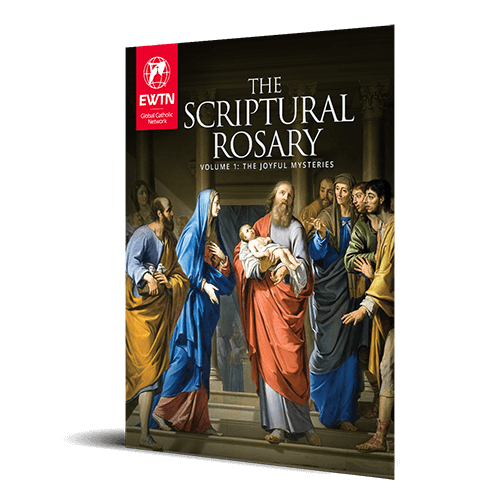
The Holy Rosary is an amazing prayer, encouraged by popes, loved by saints, and prayed by the faithful. At its heart, the Rosary is a meditation on Sacred Scripture, on the lives of Jesus and Mary.
Through this Scriptural Rosary, we hope that you will be able to better meditate on each Hail Mary and deepen your understanding of Sacred Scripture. Use the form below to get your free copy of The Scriptural Rosary.
Be inspired to follow in the footsteps of the saints. Subscribe to receive the Daily Saint, featuring a brief biography delivered to your inbox each day.
Start now and let the intercession and witness of the saints draw you closer to God.

As we deepen our relationship with the Eternal Word, Jesus Christ, we grow in grace and are transformed by His love and mercy.
STEP 1
We’re here to serve you. Let us help you complete your gift with confidence.

Send a message to Mission Advancement.

Guidance for DAFs, stock, IRA, and more.

Manage your gifts and preferences.