

Your Faith Journey with EWTN
As we deepen our relationship with the Eternal Word, Jesus Christ, we grow in grace and are transformed by His love and mercy.
c. 560–March 11, 638
Patron Saint of Orthodox unity, defenders of Christ’s true nature, scholars, and theologians

St. Sophronius of Jerusalem was a scholar, monk, and bishop who dedicated his life to defending the Christian Faith during a turbulent period in Church history. Born around 560 in Damascus, he received a classical education that prepared him for a lifetime of theological reflection and teaching.
He traveled extensively among Eastern monastic communities with St. Maximus the Confessor. Together, they opposed doctrinal errors that threatened the Church’s understanding of Christ. St. Sophronius was one of the strongest voices against Monothelitism, a heresy claiming that Christ had only one will. He firmly defended the teaching that Christ possesses both a divine will and a human will, fully united.
In 634, St. Sophronius was elected Patriarch of Jerusalem. His appointment coincided with immense political turmoil, including the Muslim conquest of the Holy Land. When Jerusalem fell to the Rashidun Caliphate in 637, St. Sophronius negotiated terms of surrender that safeguarded Christian lives, churches, and holy places. His actions reflected pastoral concern and courage amid overwhelming circumstances.
In addition to his theological writings, St. Sophronius’s hymns, sermons, and poetry are still treasured in Eastern Christian liturgy. He died on March 11, 638, shortly after the fall of Jerusalem.
Both Eastern and Western Christian traditions venerate St. Sophronius of Jerusalem as a saint. He is remembered as a faithful shepherd who defended Truth, preserved peace, and sought to protect his people amid profound tribulation.
During his brief four-year term as Patriarch of Jerusalem, St. Sophronius championed the orthodoxy of the Faith by fiercely opposing the Monothelitism heresy. His letter to the pope aligned the Eastern and Western Churches with orthodox Christological doctrine. He compiled a collection of more than six hundred patristic texts, crucial for later councils. He led the city’s defense during the Arab attacks and, recognizing inevitable defeat, negotiated a pact to preserve the Christian community and holy sites. His patriarchate was defined by his defense of orthodoxy in writing and by his steadfast protection of his city and flock during a pivotal moment in history.
Umar’s Assurance, also known as the Covenant of Umar, was a pact of safety and religious freedom granted by Caliph Umar to the Christians of Jerusalem after the city’s conquest in 637. St. Sophronius, Patriarch of Jerusalem, negotiated and signed on behalf of the Christians, marking a rare historical instance of protection for a conquered religious minority. The pact guaranteed protection for churches, crosses, property, and the right to practice Christian rituals without forced conversion in exchange for the payment of tribute (jizya). The pact became a foundational document for Muslim-Christian relations in conquered territories because, instead of the massacres that often followed conquests elsewhere, the conquered people were afforded minority rights and religious tolerance under early Islamic rule.
St. Sophronius’s Synodal Letter to Pope Honorius I was profoundly significant, both as a well-defined confirmation of doctrinal orthodoxy and as an urgent appeal to the Bishop of Rome for support against the rising Monothelitism heresy. The letter defended the orthodox doctrine of Christ’s two natures and two wills (divine and human). St. Sophronius’s clear writing about traditional Christian beliefs laid crucial groundwork for the condemnation of the heresy at the Third Council of Constantinople years later. The letter also underscored Rome’s role as the center of doctrinal authority and unity in the Eastern Church. By seeking Rome’s definitive resolution of the doctrinal dispute, the Eastern Church recognized the Pope’s role as the final voice on the matter and as protector of Christian Truth.
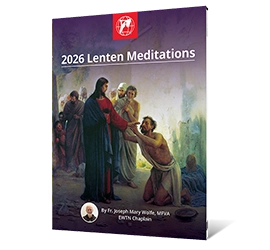
Prepare your soul for the glorious Resurrection with free weekly prayers and reflections from EWTN Chaplain Fr. Joseph Mary Wolfe, MFVA—exploring the healing power of Christ’s love. You’ll also receive weekly emails from Fr. Joseph beginning on Ash Wednesday, continuing each Sunday of Lent and Easter Sunday.
Draw closer to Our Lord as you pause, meditate, and return to Him with your whole heart.
Send me the Physical Pocket Guide
Only available to homes in the U.S.A.
Send me the
eBook
Be inspired to follow in the footsteps of the saints. Subscribe to receive the Daily Saint, featuring a brief biography delivered to your inbox each day.
Start now and let the intercession and witness of the saints draw you closer to God.

As we deepen our relationship with the Eternal Word, Jesus Christ, we grow in grace and are transformed by His love and mercy.
STEP 1
We’re here to serve you. Let us help you complete your gift with confidence.

Send a message to Mission Advancement.

Guidance for DAFs, stock, IRA, and more.

Manage your gifts and preferences.