

Your Faith Journey with EWTN
As we deepen our relationship with the Eternal Word, Jesus Christ, we grow in grace and are transformed by His love and mercy.
c. 534–March 13, 601
Patron Saint of Seville, Spain; episcopal attire; liturgical garments

St. Leander, Bishop of Seville, was a prominent Spanish bishop whose life and work profoundly shaped the Church in Visigothic Spain. He was born in Cartagena into a noble, devoutly Catholic family around the mid-sixth century. He received an excellent classical education and enjoyed the advantages of his privileged elite lineage. St. Leander became a Benedictine monk and was later appointed Bishop of Seville.
As bishop, St. Leander faced the challenge of guiding a kingdom divided by the Arian faith of the Visigothic rulers. St. Leander first influenced Prince Hermenegild, son of King Leovigild, to convert and later helped convert King Reccared and others to orthodox Catholicism, promoting unity and strengthening the Church’s position in the region.
King Leovigild exiled St. Leander for having converted his son. He spent three years in Constantinople and North Africa, where he befriended the future Pope Gregory the Great. St. Leander returned to Spain after the king’s death.
St. Leander was deeply involved in early councils, including the Third Council of Toledo, where Church leaders renounced Arianism and St. Leander delivered a rousing closing sermon. In his pastoral work, he encouraged education, wrote theological and liturgical texts, and urged both clergy and laity to live in holiness. His guidance laid the foundation for the Spanish Church’s flourishing under his brother, St. Isidore of Seville, who succeeded him as bishop.
St. Leander died in 600. He left a legacy that helped bridge Roman Catholic traditions and Visigothic rule, unifying the kingdom under one Faith.
St. Leander was instrumental in converting Visigothic rulers to Catholicism. He mentored the king’s eldest son, Hermenegild, who converted to Catholicism. His father, King Leovigild, had his son Hermenegild executed for it, and his martyrdom for the Faith assured his sainthood. After King Leovigild’s death, King Reccared, influenced by St. Leander, converted and formally brought the Visigoths to the Catholic Faith at the Third Council of Toledo in 589. Ministering to the faithful throughout the Visigothic Kingdom, he introduced liturgical practices, such as the recitation of the Nicene Creed at Mass, to combat Arianism. St. Leander’s efforts helped bridge Roman Catholic traditions with Visigothic rule, unifying the kingdom and laying the foundation for a Catholic Spain, a process continued by his brother, St. Isidore of Seville.
St. Leander left his younger brother, Isidore, a powerful legacy of faith, learning, and leadership, instilling in him a deep love for study, ensuring his rigorous education in the liberal arts and theology, and setting him up to succeed as Archbishop of Seville. St. Isidore continued the vital work of unifying the Visigothic kingdom under Nicene Catholicism, becoming the “Schoolmaster of the Middle Ages.” St. Leander’s influence encouraged St. Isidore to compile his monumental Etymologiae. This encyclopedia preserved classical knowledge and became a cornerstone of medieval education, securing St. Isidore’s place as a Doctor of the Church. In essence, St. Leander provided the blueprint and initial training for St. Isidore to become an intellectual and spiritual leader who would significantly shape early medieval Spain and Western Europe.
Yes, St. Leander of Seville and Pope St. Gregory the Great were close friends. They met before Pope St. Gregory was elected pope when he was still a papal legate. They formed a significant bond during St. Leander’s exile in Constantinople, with St. Leander even encouraging Pope St. Gregory to write his famous Morals on the Book of Job (Moralia in Job). They exchanged letters and supported each other’s religious goals, despite their geographical distance. Their friendship, rooted in shared Faith and theological discussions, supported St. Leander’s efforts to restore Spain to Catholic Orthodoxy after Arianism.
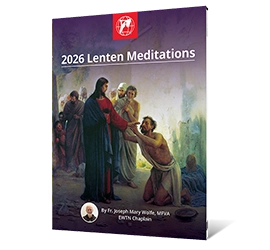
Prepare your soul for the glorious Resurrection with free weekly prayers and reflections from EWTN Chaplain Fr. Joseph Mary Wolfe, MFVA—exploring the healing power of Christ’s love. You’ll also receive weekly emails from Fr. Joseph beginning on Ash Wednesday, continuing each Sunday of Lent and Easter Sunday.
Draw closer to Our Lord as you pause, meditate, and return to Him with your whole heart.
Send me the Physical Pocket Guide
Only available to homes in the U.S.A.
Send me the
eBook
Be inspired to follow in the footsteps of the saints. Subscribe to receive the Daily Saint, featuring a brief biography delivered to your inbox each day.
Start now and let the intercession and witness of the saints draw you closer to God.

As we deepen our relationship with the Eternal Word, Jesus Christ, we grow in grace and are transformed by His love and mercy.
STEP 1
We’re here to serve you. Let us help you complete your gift with confidence.

Send a message to Mission Advancement.

Guidance for DAFs, stock, IRA, and more.

Manage your gifts and preferences.