

Your Faith Journey with EWTN
As we deepen our relationship with the Eternal Word, Jesus Christ, we grow in grace and are transformed by His love and mercy.
c. 313–386
Patron Saint of catechists, catechumens, Christian unity, orthodoxy, Jerusalem

St. Cyril of Jerusalem was a caring pastor and teacher whose life and writings helped clarify Christian doctrine during the turbulent fourth century. Born around the year 313, he was ordained a priest in Jerusalem and became known for his ability to articulate the teachings of the Faith clearly. In about 350, he was consecrated Bishop of Jerusalem, a role that placed him at the center of theological and political conflict.
St. Cyril lived during the Arian heresy controversy, which questioned the full divinity of Christ and caused widespread division within the Church. While St. Cyril consistently upheld the Church’s teaching and remained in communion with orthodox belief, his association with certain clerics who supported the heresy led to his being unjustly suspected of being a heretic. But declaring his fidelity came at high personal cost. St. Cyril was exiled from Jerusalem three times over 20 years by emperors and Eastern Church leaders who supported Arianism.
One of St. Cyril’s most enduring contributions is his Catechetical Lectures, delivered to catechumens preparing for Baptism. These teachings provided an ordered process for instruction in the Christian Faith, moral life, and the Sacraments. His mystagogical catechesis, which refers to teachings on the mysteries of the Faith given to new Christians, offered profound reflections on the Eucharist and other Sacraments, revealing the depth of early Christian worship.
Despite years of hardship and displacement, St. Cyril continued to serve the Church with patience and humility. He was eventually restored to his bishopric and participated in the First Council of Constantinople in 381, which reaffirmed the Nicene Creed and condemned Arianism.
St. Cyril of Jerusalem died in 386. Recognized for the lasting value of his teachings, he was declared a Doctor of the Church in 1883.
St. Cyril of Jerusalem’s most important surviving writings are his Catechetical Lectures, a collection of 23 discourses for catechumens, including 18 lectures on pre-baptismal instruction and five post-baptismal mystagogical lectures explaining the Sacraments. St. Cyril also left behind a sermon on the Paralytic at the Pool of Bethesda, a letter to Emperor Constantius describing a miraculous cross of light, and fragments of other sermons that offer crucial insights into early Christian teaching and liturgy. These documents have great instructional value because they detail the process and content of Christian initiation in fourth-century Jerusalem. Liturgically, they provide valuable information about early Church liturgy and practices and contain early expressions of Eucharistic theology, including doctrines such as Transubstantiation.
St. Cyril of Jerusalem described the Apparition of the Holy Cross in 351 in his writings. The event was miraculous: a huge, luminous cross appeared in the sky over Jerusalem, stretching about 5.5 miles from Golgotha to the Mount of Olives. The sign was visible to the entire city for hours, and the entire population of Jerusalem, including Christians, Jews, and pagans, saw it, prompting many conversions to Christianity. As Bishop of Jerusalem, St. Cyril was an eyewitness and wrote a detailed letter to Emperor Constantius, a supporter of Arianism, describing the miracle as proof of the truth of Orthodox Christianity and urging the Emperor to abandon heresy. This vision, appearing on Pentecost, strengthened the Orthodox faith against Arianism, which denied Christ’s divinity, and is commemorated as a feast day.
St. Cyril of Jerusalem died in 386 at the age of 73 in Jerusalem, where he served as Bishop. It is believed that he died from natural causes and was buried within his city. His remains were eventually taken from Jerusalem and brought to Rome by his successor, St. John II, and placed in the Basilica of San Clemente. His main relics were lost or scattered during the late 18th-century French occupation of Rome. A small relic was rediscovered and is now housed in the chapel of Saints Cyril and Methodius within the Basilica of San Clemente in Rome.
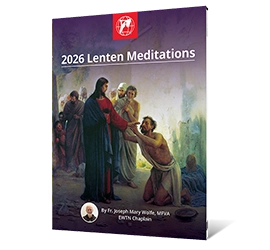
Prepare your soul for the glorious Resurrection with free weekly prayers and reflections from EWTN Chaplain Fr. Joseph Mary Wolfe, MFVA—exploring the healing power of Christ’s love. You’ll also receive weekly emails from Fr. Joseph beginning on Ash Wednesday, continuing each Sunday of Lent and Easter Sunday.
Draw closer to Our Lord as you pause, meditate, and return to Him with your whole heart.
Send me the Physical Pocket Guide
Only available to homes in the U.S.A.
Send me the
eBook
Be inspired to follow in the footsteps of the saints. Subscribe to receive the Daily Saint, featuring a brief biography delivered to your inbox each day.
Start now and let the intercession and witness of the saints draw you closer to God.

As we deepen our relationship with the Eternal Word, Jesus Christ, we grow in grace and are transformed by His love and mercy.
STEP 1
We’re here to serve you. Let us help you complete your gift with confidence.

Send a message to Mission Advancement.

Guidance for DAFs, stock, IRA, and more.

Manage your gifts and preferences.