

Your Faith Journey with EWTN
As we deepen our relationship with the Eternal Word, Jesus Christ, we grow in grace and are transformed by His love and mercy.
March 21, 1417–March 21, 1487
Patron Saint of Switzerland, Pontifical Swiss Guards

St. Nicholas of Flüe, also known as Brother Klaus, is revered as the patron saint of Switzerland for his profound spiritual life and his role in promoting peace. Born in 1417 in Flüe, Switzerland, St. Nicholas lived for many years as a farmer, soldier, and public servant. He married Dorothea Wyss, and together they raised ten children.
Deeply devoted to prayer, St. Nicholas felt increasingly drawn to a contemplative life. After long discernment prompted by a vision, and with his family’s consent, he withdrew from public life at the age of 50 and became a hermit. He lived in a simple cell near his home, dedicating himself to fasting, prayer, and penance. According to tradition, St. Nicholas survived for many years without food, sustained only by the Eucharist.
Although St. Nicholas lived in solitude, his reputation for holiness spread widely. People sought his counsel, including political leaders and clergy. His most significant contribution came in 1481, when his advice prevented a civil war among the Swiss cantons. His wise plan for unification averted the war and preserved the stability of the Swiss Confederation.
St. Nicholas of Flüe died in 1487 on his 70th birthday from what was reportedly his first illness. His wife and children surrounded him. He was canonized in 1947 by Pope Pius XII.
St. Nicholas of Flüe became the patron of the Swiss Guard, an elite corps that protects the Pope and the Vatican. The Pontifical Swiss Guard officially adopted St. Nicholas as a patron because he embodies the virtues and unity they protect. St. Nicholas has a deep connection to Swiss identity and is known as a unifier and peacemaker who prevented civil war in 1481. Additionally, he embodies values such as integrity, piety, and service, which made him a revered national figure. These characteristics align with the Swiss Guard’s mission and make him an appropriate patron saint. He was officially named a co-patron of the Swiss Guard by Pope Pius XII in 1947, the same year he was canonized, solidifying his spiritual link to the corps.
St. Nicholas of Flüe had a pivotal vision of a plow horse eating a lily. The horse represented his duties as a farmer, husband, father, and political figure, while the lily symbolized purity, prayer, and his deeper calling to God. The vision showed him that the demands of his worldly life were consuming his spiritual essence, prompting him to devote his life to God. Convinced that he should leave his family for a hermit’s life of prayer, he asked and received their permission and established his hermitage near his family. Initially, St. Nicholas planned to leave his canton in Switzerland. However, on his way, he received further visions, including one of a burning town (Liestal), which led him to realize his vocation was to serve his own community.
St. Nicholas of Flüe (Brother Klaus) is often depicted as a hermit with a beard, wearing a simple brown tunic, sometimes holding a Rosary or gazing at a crucifix. He may also be shown with symbols of peace or images of the Swiss landscape, underscoring his role as a spiritual father and patron of Switzerland. Other portrayals include a stern or contemplative expression, symbolizing his withdrawal from affairs of the world. Common portrayals show him receiving visitors, emphasizing his role as a peacemaker and mystic. Paintings frequently place him in the Swiss Alps, sometimes with his hermitage or cattle, linking him to his homeland and simple life. Some scenes show him mediating disputes or appearing before political figures, highlighting his work for peace in Switzerland. St. Nicholas’s image is popular in Swiss woodcarvings, often depicting him in prayer or with symbolic elements.
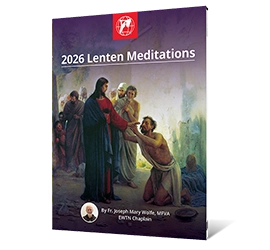
Prepare your soul for the glorious Resurrection with free weekly prayers and reflections from EWTN Chaplain Fr. Joseph Mary Wolfe, MFVA—exploring the healing power of Christ’s love. You’ll also receive weekly emails from Fr. Joseph beginning on Ash Wednesday, continuing each Sunday of Lent and Easter Sunday.
Draw closer to Our Lord as you pause, meditate, and return to Him with your whole heart.
Send me the Physical Pocket Guide
Only available to homes in the U.S.A.
Send me the
eBook
Be inspired to follow in the footsteps of the saints. Subscribe to receive the Daily Saint, featuring a brief biography delivered to your inbox each day.
Start now and let the intercession and witness of the saints draw you closer to God.

As we deepen our relationship with the Eternal Word, Jesus Christ, we grow in grace and are transformed by His love and mercy.
STEP 1
We’re here to serve you. Let us help you complete your gift with confidence.

Send a message to Mission Advancement.

Guidance for DAFs, stock, IRA, and more.

Manage your gifts and preferences.