

Your Faith Journey with EWTN
As we deepen our relationship with the Eternal Word, Jesus Christ, we grow in grace and are transformed by His love and mercy.
Martyred c. third century
Patron Saint of the Diocese of Narbonne, healing

St. Paul of Narbonne is venerated as one of the earliest bishops of southern Gaul. According to tradition, he was one of seven bishops consecrated by Pope Fabian to rebuild Christian communities decimated by Roman persecution during the reign of Emperor Decius.
St. Paul was assigned to Narbonne, a strategic Roman center and key location for the spread of Christianity. As a bishop, St. Paul labored to establish and strengthen the local Christian community, preaching, teaching, and providing pastoral care. His leadership laid the foundation for the development of an important center of Christian life in France.
Historical records regarding St. Paul’s death are scarce, and conflicting accounts leave the circumstances unclear. While some accounts affirm his martyrdom and list his name among the martyrs during Roman persecutions, no details about his martyrdom were known until accounts surfaced as late as the twelfth century. However, in the sixth century, St. Gregory of Tours described St. Paul living a pious life and dying peacefully after successfully founding two or more Christian communities in Narbonne.
Regardless of the discrepancy, St. Paul would have suffered persecution of some sort as a Church leader building Christian communities in a region steeped in paganism and an environment violently opposed to the Christian Faith.
St. Paul of Narbonne is described as a charismatic man of great sanctity. He is remembered as one of the early shepherds whose faith, fortitude, and sacrifice helped the Church flourish.
Narbonne was a major Roman city and transportation hub, connecting Italy with Spain and the western provinces. The city was the capital of the province of Gallia Narbonensis and a seat of Roman governance. Its strategic location allowed Christian missionaries to reach large populations to spread the Faith. Establishing a bishopric there helped ensure the long-term growth and stability of Christianity throughout southern Gaul. When Emperor Constantine converted to Christianity and later legalized it, a bishop was officially appointed in Narbonne, and an archbishopric was founded, making it a powerful religious seat in Southern Gaul.
As a founding bishop, St. Paul is considered the first leader of the Christian community in Narbonne. The first bishop of Narbonne is listed as Aphrodisius, who is credited with founding Christian communities in Gaul, including Narbonne. However, Aphrodisius was martyred, and according to accounts, St. Paul was sent to rebuild the Church in Narbonne, which Roman persecutors had dismantled. He helped organize the Church locally, provided sacramental leadership, and established infrastructure that allowed the Faith to endure beyond his lifetime. St. Paul’s labor laid the groundwork for future bishops and for Christian life in the region.
The Basilica of Saint-Paul-Serge in Narbonne, France, was built above the tomb of St. Paul, the first bishop of Narbonne. It’s unique because it stands on an elaborate necropolis, a third-to-fourth-century cemetery, with its crypt containing early Christian stone coffins decorated with ornate scenes from the Bible. It’s one of the oldest churches in Southern France and the first Gothic church in Narbonne. With construction beginning in the twelfth century, the structure was built on the site of an even older church and the ancient Christian cemetery. The crypt is a major attraction, preserving parts of the original fourth-century necropolis, including St. Paul’s tomb. Pope Pius XII gave the church the distinction of minor basilica in 1953, recognizing its spiritual importance. The basilica is a significant historical and pilgrimage site.
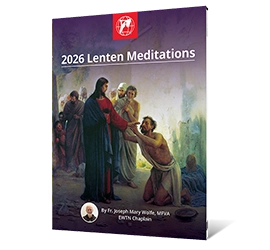
Prepare your soul for the glorious Resurrection with free weekly prayers and reflections from EWTN Chaplain Fr. Joseph Mary Wolfe, MFVA—exploring the healing power of Christ’s love. You’ll also receive weekly emails from Fr. Joseph beginning on Ash Wednesday, continuing each Sunday of Lent and Easter Sunday.
Draw closer to Our Lord as you pause, meditate, and return to Him with your whole heart.
Send me the Physical Pocket Guide
Only available to homes in the U.S.A.
Send me the
eBook
Be inspired to follow in the footsteps of the saints. Subscribe to receive the Daily Saint, featuring a brief biography delivered to your inbox each day.
Start now and let the intercession and witness of the saints draw you closer to God.

As we deepen our relationship with the Eternal Word, Jesus Christ, we grow in grace and are transformed by His love and mercy.
STEP 1
We’re here to serve you. Let us help you complete your gift with confidence.

Send a message to Mission Advancement.

Guidance for DAFs, stock, IRA, and more.

Manage your gifts and preferences.