

Your Faith Journey with EWTN
As we deepen our relationship with the Eternal Word, Jesus Christ, we grow in grace and are transformed by His love and mercy.
c. 660–March 27, 718
Patron Saint of Salzburg, Austria; salt miners; bishops; missionaries; and evangelization efforts

St. Rupert was a devoted missionary bishop whose life’s work laid the foundation for Christianity in Salzburg and the surrounding regions. Born around 660 into a noble Frankish family, St. Rupert received a strong Christian formation and was ordained a bishop, serving initially in the Diocese of Worms in present-day Germany.
As Bishop of Worms, he administered with simplicity, prudence, and piety. He was charitable and a lover of truth and he offered wise counsel. But the people of Worms, many of them pagans, rejected him, beat him, and threw him out of the town. Dismayed, St. Rupert retreated to Rome and prayed for Divine Guidance.
Around the year 696, Duke Theodo of Bavaria invited St. Rupert to evangelize his territories. Accepting this call as an answer to his prayers, St. Rupert traveled through Bavaria and Austria, preaching the Gospel and baptizing many souls who were receptive to the Christian Faith.
St. Rupert settled in the ruins of the former Roman city of Juvavum, which he restored and renamed Salzburg. There, he founded a bishopric and established monasteries, including the Abbey of St. Peter and the Nonnberg Convent. These religious foundations became centers of worship, education, and missionary outreach, shaping the region’s spiritual life for generations.
St. Rupert also contributed to Salzburg’s economic development. He is credited with reviving salt mining in the region to strengthen the local economy. This association earned Salzburg its name, meaning “Salt Fortress.”
St. Rupert died in 718, after preaching and celebrating Mass. Honored as the first Bishop of Salzburg, St. Rupert also served the people of Salzburg as the first abbot of the Benedictine monastery he founded there. Through his efforts, many souls were converted to the Christian Faith.
St. Rupert received help from a group of priests and monks he recruited. Twelve priests, including his friend, Chuniald, helped build St. Peter’s Monastery, the first Benedictine monastery for men at St. Peter’s in Salzburg, which formed the nucleus of the city’s religious life. He brought his niece, St. Erentrudis, to serve as the first abbess of Nonnberg Abbey, a significant women’s monastery. Together, the group worked to convert souls, build churches, and establish Christian practices. The institutions St. Rupert established served as centers of prayer, education, and missionary activity. They helped train clergy and religious, preserve Christian learning, and provide charitable services, ensuring that the Faith would continue to grow and flourish long after St. Rupert’s death.
St. Rupert’s missionary work in Bavaria was said to be accompanied by numerous miracles, primarily reported as widespread healings of diseases that facilitated mass conversions. His preaching, confirmed by miracles, overcame pagan practices. The practical successes in his work were seen as divine help. These included establishing the vital salt-mining industry in Salzburg, which brought prosperity and resources to the region and contributed to his reputation as the “Apostle to the Bavarians.” St. Rupert used these divine confirmations, along with preaching, to help convert nobles and the general populace, spreading Christianity across the region.
The salt mine industry in Salzburg was important because it provided a vital economic foundation and stability for both the people of Salzburg and St. Rupert’s new Christian settlements. Salt offered a valuable resource for preserving and seasoning. The salt mines provided a stable income to support the monasteries, churches, and missionary work that brought broader economic development, education, and agricultural improvements for the community. St. Rupert leveraged the city’s natural resource, salt, to lay the groundwork for Salzburg to become a significant religious center and a thriving community. St. Rupert is honored as the patron saint of Salzburg.
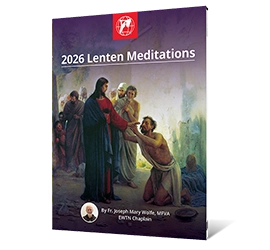
Prepare your soul for the glorious Resurrection with free weekly prayers and reflections from EWTN Chaplain Fr. Joseph Mary Wolfe, MFVA—exploring the healing power of Christ’s love. You’ll also receive weekly emails from Fr. Joseph beginning on Ash Wednesday, continuing each Sunday of Lent and Easter Sunday.
Draw closer to Our Lord as you pause, meditate, and return to Him with your whole heart.
Send me the Physical Pocket Guide
Only available to homes in the U.S.A.
Send me the
eBook
Be inspired to follow in the footsteps of the saints. Subscribe to receive the Daily Saint, featuring a brief biography delivered to your inbox each day.
Start now and let the intercession and witness of the saints draw you closer to God.

As we deepen our relationship with the Eternal Word, Jesus Christ, we grow in grace and are transformed by His love and mercy.
STEP 1
We’re here to serve you. Let us help you complete your gift with confidence.

Send a message to Mission Advancement.

Guidance for DAFs, stock, IRA, and more.

Manage your gifts and preferences.