

Your Faith Journey with EWTN
As we deepen our relationship with the Eternal Word, Jesus Christ, we grow in grace and are transformed by His love and mercy.
329–c. 424
Patron Saint of deacons, missionaries, persecuted Christians, and those imprisoned for their faith

St. Benjamin was a faithful deacon whose courageous witness strengthened the Church during a time of persecution in Persia. Although few personal details of his life have survived, tradition places his martyrdom in the early fifth century, during the reign of Persian King Yazdegerd I, when Christians faced periods of severe oppression.
As a deacon, St. Benjamin was entrusted with preaching the Gospel and teaching the Christian Faith. His zeal for Christ and dedication to evangelization made him a respected figure among the faithful. However, his public ministry drew the attention of authorities who sought to suppress Christian teaching.
The persecution of Christians in Persia had been escalating for four years, when a Christian bishop had burned down a pagan temple. The king demanded that the bishop rebuild the temple, or he would destroy all the Christian churches. The bishop refused and was put to death. Then, the enraged king had all Christian churches destroyed.
Persian authorities found St. Benjamin publicly preaching and arrested and imprisoned him. After a year in prison, he was released through the intervention of a Roman ambassador on the condition that he cease preaching Christianity. Faithful to his calling, St. Benjamin resumed proclaiming the Gospel and was arrested a second time.
St. Benjamin was ordered to renounce Christ and abandon his ministry, under penalty of death, but he refused. He endured extreme torture and was subjected to a painful death intended to deter others from practicing the Christian Faith.
St. Benjamin died around the year 424. Having remained faithful to Christ, his martyrdom strengthened believers through his powerful example of courageous discipleship.
An incident involving Abdas, Bishop of Susa, in which a Zoroastrian fire temple in Persia was burned down around 420, is detailed in historical accounts. The event triggered a severe persecution of Christians that lasted 40 years. Bishop Abdas was accompanied by a group of clergy and laymen, with one priest justifying the act as a “pious demonstration” against false worship. When the king demanded that Abdas rebuild the shrine, he refused, believing it wrong to restore a place of idolatry. The king then ordered the destruction of all Christian churches, initiated a general persecution of Christians, and executed Abdas, who became the first martyr of this period. Many Christians were killed, including St. Benjamin, who was tortured and killed around 424 after refusing to stop preaching. Historians such as Theodore of Cyrus and Socrates of Constantinople recorded the incident.
There is a detailed written account of the torture and death of St. Benjamin, a Persian deacon and martyr, in 424. The details of his martyrdom are recorded in Christian hagiography and were documented by early Church historians. The primary, near-contemporary source for persecution in Persia is Theodore (Ecclesiastical History, Book V, Chapter 39). According to this account, the tyrant king ordered cruel tortures, which included sharpened reeds of wood to be repeatedly thrust between his nails and his flesh on his hands and feet. The method of death was excruciating. His internal organs were torn with a stake. The accounts state that St. Benjamin was martyred for refusing to stop preaching the Gospel, viewing it as his duty. In a reflection on martyrs, St. Ephrem said that tyrants and judges were amazed at the faith, resolve, and joy of these holy champions.
St. Benjamin’s life highlights the Christian principle that obedience to God takes precedence over human authority. Although he was released on the condition of silence, he chose fidelity to his calling as a deacon. His example reminds believers that remaining faithful to Christ can involve risk or sacrifice. St. Benjamin is honored in the Church as a model of courage for clergy and missionaries. His witness continues to inspire those who face persecution for proclaiming the Gospel. He is the patron saint of deacons, missionaries, persecuted Christians, and those imprisoned for their faith.
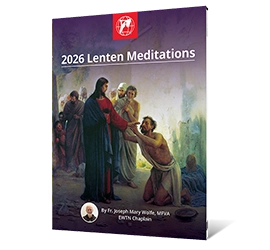
Prepare your soul for the glorious Resurrection with free weekly prayers and reflections from EWTN Chaplain Fr. Joseph Mary Wolfe, MFVA—exploring the healing power of Christ’s love. You’ll also receive weekly emails from Fr. Joseph beginning on Ash Wednesday, continuing each Sunday of Lent and Easter Sunday.
Draw closer to Our Lord as you pause, meditate, and return to Him with your whole heart.
Send me the Physical Pocket Guide
Only available to homes in the U.S.A.
Send me the
eBook
Be inspired to follow in the footsteps of the saints. Subscribe to receive the Daily Saint, featuring a brief biography delivered to your inbox each day.
Start now and let the intercession and witness of the saints draw you closer to God.

As we deepen our relationship with the Eternal Word, Jesus Christ, we grow in grace and are transformed by His love and mercy.
STEP 1
We’re here to serve you. Let us help you complete your gift with confidence.

Send a message to Mission Advancement.

Guidance for DAFs, stock, IRA, and more.

Manage your gifts and preferences.