

Your Faith Journey with EWTN
As we deepen our relationship with the Eternal Word, Jesus Christ, we grow in grace and are transformed by His love and mercy.
c. 1193–April 5, 1258
Patron Saint of devotion to the Eucharist, religious educators, those misunderstood or opposed for their faith

St. Juliana of Liège was a woman of deep interior faith whose recurring visions transformed the Church’s liturgical life.
Born around 1193 near Liège, in present-day Belgium, St. Juliana was orphaned as a child and placed in the care of Augustinian nuns, where she received a strong religious education and developed an intense love for prayer and Scripture.
At 13, St. Juliana entered religious life and became prioress. At 16, she began seeing recurring mystical visions of a full moon with a dark band. After years of prayer, she understood the moon symbolized the Church and the dark band represented the absence of a feast dedicated to the Holy Eucharist.
Reluctant and humble, St. Juliana hesitated to share her visions. Obedience led her to confide in her sisters and then to share her visions with trusted clergy. She faced misunderstanding and resistance and was exiled twice by a superior opposed to her reforms. Despite these trials, she remained steadfast in devotion and trust.
With help from priest John of Lausanne, St. Juliana’s advocacy of a Eucharistic feast reached influential figures like Jacques Pantaléon, the future Pope Urban IV. In 1264, years after St. Juliana’s death, Pope Urban IV established the Feast of Corpus Christi, affirming her devotion.
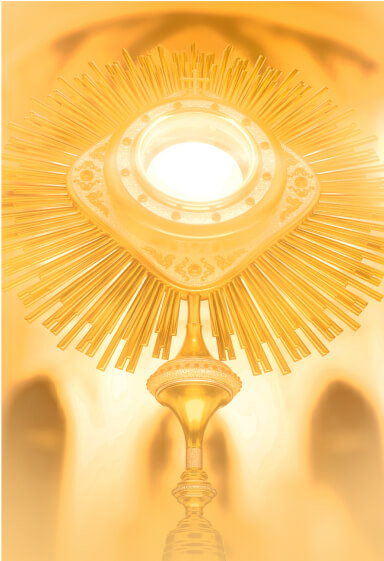
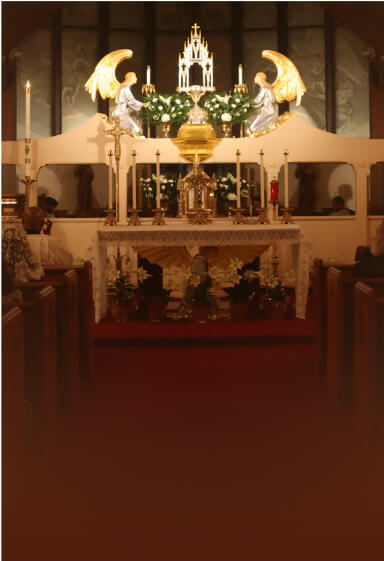
St. Juliana lived in obscurity in her later years and died on April 5, 1258. According to her biographer, the Blessed Sacrament was exposed by her side, and her last contemplations were about her love for the Holy Eucharist. She was canonized in 1869.
St. Juliana of Liège was twice forced into exile due to intense opposition within her convent, driven by a corrupt superior named Roger, who opposed her strict reforms and efforts to establish the Feast of Corpus Christi. He stirred up the local citizenry and brought false accusations of financial misconduct against St. Juliana regarding the hospital funds she managed. With help from a local bishop, St. Juliana was vindicated of wrongdoing and returned to her role as abbess. However, Roger regained control of her congregation and exiled her again. She spent her last years in poverty and seclusion in Namur and Fosses until her death in 1258. Despite being banished, her work was ultimately vindicated, and the feast of Corpus Christi was formally established for the Universal Church after her death.
The Feast of Corpus Christi, advocated by St. Juliana, met the Church’s need for greater devotion to the Real Presence of Christ and addressed 13th-century theological disputes. St. Juliana kept her visions secret for 20 years; the dark line in the full moon showed the absence of a Eucharistic feast. Her visions, supported by clergy, led to Pope Urban IV’s establishment of the feast in 1264—a few years after her death. That year, a miracle at Orvieto, Italy, confirmed the Real Presence and propelled Pope Urban IV to institute the feast globally.
The primary relics of St. Juliana of Liège, the 13th-century Norbertine canoness who initiated the Feast of Corpus Christi, are venerated in Belgium at Villers Abbey, a major shrine to St. Juliana. Following her death in 1258, her remains were buried at the monastery of Fosses-la-Ville but were later moved. However, significant relics were preserved there. St. Juliana is highly venerated in the Roman Catholic Diocese of Liège.
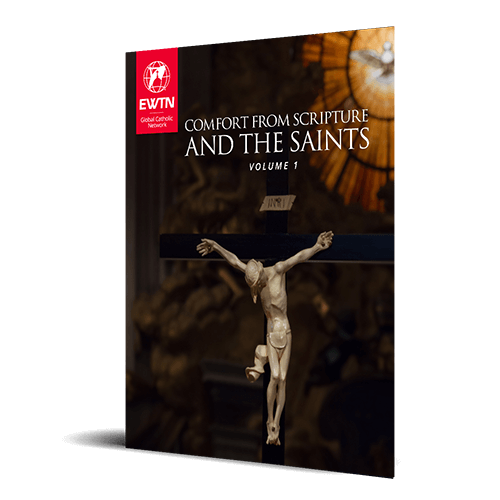
This eBook combines stunning photography from EWTN’s Vatican Bureau along with Bible passages and saints’ quotes that will calm your heart, give you hope, and remind you that God is with us always. Simply fill out the form below and we will send this to you!
Be inspired to follow in the footsteps of the saints. Subscribe to receive the Daily Saint, featuring a brief biography delivered to your inbox each day.
Start now and let the intercession and witness of the saints draw you closer to God.

As we deepen our relationship with the Eternal Word, Jesus Christ, we grow in grace and are transformed by His love and mercy.
STEP 1
We’re here to serve you. Let us help you complete your gift with confidence.

Send a message to Mission Advancement.

Guidance for DAFs, stock, IRA, and more.

Manage your gifts and preferences.