

Your Faith Journey with EWTN
As we deepen our relationship with the Eternal Word, Jesus Christ, we grow in grace and are transformed by His love and mercy.
Eleventh century
Patron Saint of converts to Christianity; infertile women; Toledo, Spain

St. Casilda of Toledo is remembered as a woman whose life was transformed by compassion and grace during a time of religious division in medieval Spain. Born into a wealthy Muslim family in eleventh-century Toledo, St. Casilda was the daughter of a Moorish ruler. Though raised in a privileged environment, she showed an early concern for those who suffered unjustly.
At the time, many Christians were imprisoned for their faith. Moved by mercy, St. Casilda secretly brought food to the prisoners, hiding bread beneath her garments. When her father and his Muslim soldiers questioned her about what she was carrying, the bread was miraculously changed into roses. This event, later known as the “Miracle of the Roses,” spared her from being punished for her actions.
As a young woman, St. Casilda developed a serious illness. Lacking faith in local physicians, she traveled to a healing spring at the shrine of St. Vincent in Briviesca, located in Christian territory. There, she experienced a miraculous recovery. As a result, St. Casilda underwent an interior conversion to Christianity and was baptized, leaving behind her former life of wealth and status.
After her conversion, St. Casilda chose a life of prayer, penance, and solitude. She lived as a hermit near Briviesca, devoting herself to contemplation and works of mercy. She lived a peaceful life and died at the age of 100. She is highly venerated in Burgos, Spain, where she was baptized, and in Toledo.
The Miracle of the Roses is the most well-known event from St. Casilda’s life. The eleventh-century legend tells how St. Casilda, princess and daughter of the Muslim King of Toledo, risked her life to feed starving Christian captives by hiding bread in her clothing. Suspecting her curious and frequent visits to the prisoners, she was confronted by her father and his guards, who demanded to know what she was carrying. She claimed it was flowers. Upon investigation, the bread had turned into a bouquet of roses, saving her from punishment. St. Casilda did not continue feeding the prisoners. She fell ill with a serious illness, which later led to her conversion to Christianity.
St. Casilda of Toledo was cured of a severe, lingering hemorrhagic fever or uncontrolled, chronic bleeding that caused great weakness. As an eleventh-century Muslim princess who secretly helped Christian prisoners, she lacked faith in local doctors and refused their treatment. She traveled to the shrine of San Vicente in Briviesca, near Burgos in northern Spain, where a well-known healing spring was located. When she was miraculously healed by its waters, she converted to Christianity, was baptized, and lived as a hermitess near the healing spring. St. Casilda is often invoked for help by those suffering from hemorrhages and infertility.
Today, St. Casilda is especially venerated in Briviesca, Spain, where a church and shrine were built near the site of her hermitage. Her relics are preserved there, and she is honored with an annual pilgrimage. She is particularly invoked by those seeking healing and by parents praying for sick children. St. Casilda was initially venerated in Burgos, where she was baptized, and is still venerated there, as well as in Toledo, Spain, which named her its patron saint. She is remembered for her conversion from Islam to Christianity, her life of penance and holiness, and the legend of the “Miracle of the Roses.”
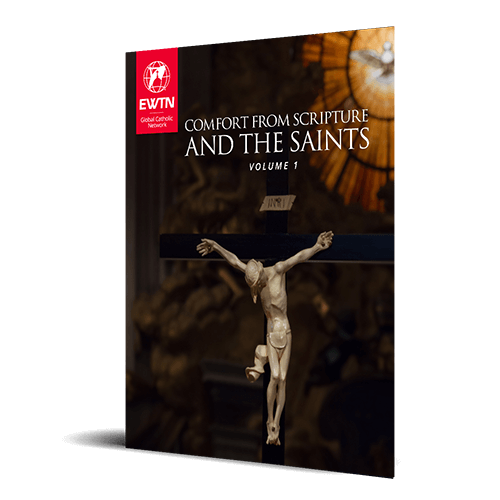
This eBook combines stunning photography from EWTN’s Vatican Bureau along with Bible passages and saints’ quotes that will calm your heart, give you hope, and remind you that God is with us always. Simply fill out the form below and we will send this to you!
Be inspired to follow in the footsteps of the saints. Subscribe to receive the Daily Saint, featuring a brief biography delivered to your inbox each day.
Start now and let the intercession and witness of the saints draw you closer to God.

As we deepen our relationship with the Eternal Word, Jesus Christ, we grow in grace and are transformed by His love and mercy.
STEP 1
We’re here to serve you. Let us help you complete your gift with confidence.

Send a message to Mission Advancement.

Guidance for DAFs, stock, IRA, and more.

Manage your gifts and preferences.