

Your Faith Journey with EWTN
As we deepen our relationship with the Eternal Word, Jesus Christ, we grow in grace and are transformed by His love and mercy.
c. July 26, 1030–April 11, 1079
Patron Saint of Poland, Kraków, moral order, those persecuted for justice

St. Stanislaus, Bishop of Kraków, stands as a powerful witness to the courage required of Christian leadership. His fidelity to God’s law made him one of Poland’s most revered saints.
Born around 1030 near Kraków, Poland, St. Stanislaus received an excellent education and was ordained a priest after completing his studies. He served the Church faithfully as pastor, preacher, and vicar general, eventually being appointed Bishop of Kraków, where he became a shepherd deeply committed to justice, reform, and the spiritual well-being of his people.
As bishop, St. Stanislaus worked tirelessly to strengthen his flock’s faith and spiritual well-being, advocating for justice for the poor and vulnerable and calling clergy, laity, and political leaders to adhere to God’s law.
St. Stanislaus had advised Duke Bolesław and assisted in his coronation as King Bolesław II of Poland. But soon after his ascension to the throne, the king and the bishop were at odds over minor issues such as property rights. However, a later incident involving members of his flock created a deep rift between them. Soldiers in the king’s service deserted duty when they received word their wives were being unfaithful. Enraged, the king chose to punish the women severely.
This action brought St. Stanislaus into direct conflict with the king, whose own violent and immoral behavior, including abducting the wife of a nobleman, was scandalizing the nation. St. Stanislaus repeatedly admonished the king, urging repentance and reform. When these efforts failed, he took the grave step of excommunicating the ruler, which caused the king to accuse St. Stanislaus of treason.
According to tradition, on April 11, 1079, while celebrating Mass, St. Stanislaus was brutally murdered by the king himself because his guards refused to harm the good bishop. The bishop’s death sent shockwaves throughout Poland and led to the king fleeing to Hungary and dying in exile.
St. Stanislaus was canonized in 1253 and became a national symbol of moral conscience. St. Stanislaus is remembered as a faithful shepherd who laid down his life to defend justice and proclaim the Christian call to live in obedience to God’s law.
As the patron saint of Poland, St. Stanislaus continues to inspire bishops, leaders, and laypeople to stand firm for truth, even in the face of persecution.
The conflict between St. Stanislaus, Bishop of Kraków, and King Bolesław II arose during a military campaign. Weary Polish soldiers, having been away for a long time, heard reports that their wives had been unfaithful and that their estates were being seized by others. Due to these reports, many deserted the army to return home. King Bolesław II was furious at this desertion and punished the soldiers’ wives severely. St. Stanislaus strongly condemned the king’s actions as extreme cruelty. He admonished the king for his tyranny, immoral life, and scandalous abduction of a nobleman’s wife. St. Stanislaus excommunicated King Bolesław. In retaliation, King Bolesław accused the bishop of treason and ordered his execution. According to tradition, the king’s guards refused to kill St. Stanislaus, so the king himself murdered the bishop while he was celebrating Mass in 1079.
The 1079 martyrdom of St. Stanislaus, Bishop of Kraków, deeply impacted Poland by creating an enduring symbol of moral authority against tyranny. The incident fostered national unity during feudal fragmentation and strengthened the Roman Catholic Church’s influence. His death gave Poland its first saint and sent the tyrant king into exile, bolstering the belief that Poland would reunite just as his body parts were said to have done. St. Stanislaus’s death immediately made him a patron saint of Poland, and his veneration fostered a shared national identity during centuries of division. Subsequent Polish kings were crowned while kneeling at his burial site in Wawel Cathedral to legitimize their rule. The 1791 Constitution, a major Polish reform, was dedicated to St. Stanislaus. Over time, the saint became a symbol of national unity and moral conscience, reinforcing the Church’s role as a guardian of justice and human dignity within Polish society.
St. Stanislaus of Kraków is primarily renowned for raising several people from the dead. The most well-known story is about a deceased nobleman named Piotr. St. Stanislaus purchased land for the diocese from Piotr, who died shortly after. Piotr’s family claimed the land was theirs, prompting the king to rule against the Church. In response, Stanislaus had the body of the deceased, who had been dead for three years, exhumed, commanded him to rise, and brought him to court to testify that he had been paid. His actions, particularly the resurrection of Piotr, were considered a “clear demonstration of divine justice” against the abuses of power. Following St. Stanislaus’s martyrdom, his body was cut into pieces on the orders of King Bolesław II in retaliation for excommunicating him. Tradition holds that St. Stanislaus’s body miraculously grew back together. After his canonization, many healing miracles were attributed to his intercession in addition to those that led to his canonization.
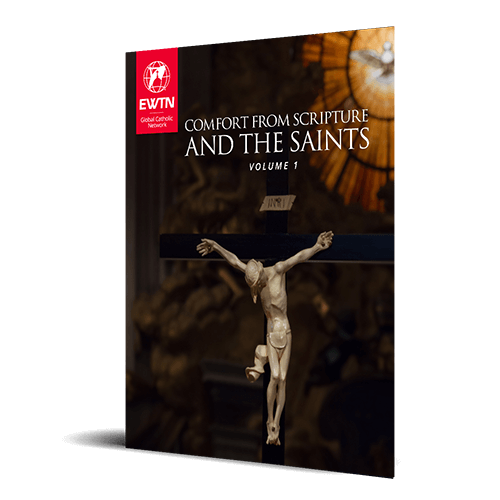
This eBook combines stunning photography from EWTN’s Vatican Bureau along with Bible passages and saints’ quotes that will calm your heart, give you hope, and remind you that God is with us always. Simply fill out the form below and we will send this to you!
Be inspired to follow in the footsteps of the saints. Subscribe to receive the Daily Saint, featuring a brief biography delivered to your inbox each day.
Start now and let the intercession and witness of the saints draw you closer to God.

As we deepen our relationship with the Eternal Word, Jesus Christ, we grow in grace and are transformed by His love and mercy.
STEP 1
We’re here to serve you. Let us help you complete your gift with confidence.

Send a message to Mission Advancement.

Guidance for DAFs, stock, IRA, and more.

Manage your gifts and preferences.