

Your Faith Journey with EWTN
As we deepen our relationship with the Eternal Word, Jesus Christ, we grow in grace and are transformed by His love and mercy.
c. 600–September 16, 655
Patron Saint of popes, defenders of Church doctrine, those suffering persecution for the Faith

Pope St. Martin I stands as a powerful witness for the Truth of the Catholic Faith. Born around the year 600 in Italy, Pope St. Martin I was well-educated and deeply committed to the Church. Before his election as pope, he served as a deacon and papal representative in Constantinople, gaining firsthand experience with theological and political tensions within the Eastern Empire.
In 649, Pope St. Martin I was elected pope during a time of doctrinal conflict. The Church was confronting the Monothelite heresy, which denied that Christ possessed both a human and a divine will. Immediately after taking office, he was urged to confront the heresy to preserve orthodoxy.
Pope St. Martin I convened the Lateran Council of 649. The council clearly affirmed the Church’s teaching on Christ’s two wills and condemned the heresy. These actions placed the pope in direct conflict with Emperor Constans II, who favored Monothelitism to preserve political unity. Pope St. Martin I refused to submit to imperial pressure, remaining firm in defending Church doctrine. In response, the emperor ordered his arrest.
Imperial authorities seized Pope St. Martin I and took him to Constantinople. He endured public humiliation, harsh imprisonment, and neglect. During a sham trial that tried his endurance, he remained steadfast, despite his weakened state. He was condemned and exiled to the remote region of modern-day Crimea. There, suffering from illness, harsh treatment, and being “deprived of the means to live,” he continued to place his trust in God.
Pope St. Martin I died in exile in 655. Although he was not executed, he was a martyr for the Faith through his prolonged suffering and consequent death. He remains the last of the early popes to be venerated as a martyr.
Emperor Constans II supported Monothelitism primarily to restore unity within a Byzantine Empire fractured by religious dispute and in crisis from territorial losses to the Arabs. He thought that if he could bridge the gap between orthodox Chalcedonians and Monophysite populations in the eastern provinces, he could unite the empire. Unity was necessary to counter external threats posed by the Arab conquests. He saw Monothelitism as a theological compromise to reconcile the divided eastern regions. He issued the Typus of Constans, an edict that prohibited debate regarding Christ’s nature and enforced the doctrine by law. He persecuted, arrested, and exiled Pope St. Martin I for opposing the Imperial policy. Rather than bringing unity, the emperor’s policy led to conflict with the Western Church.
For Pope St. Martin I, the sentence of exile meant a life of extreme deprivation, physical suffering, and profound isolation, ending in his death. He was exiled to Cherson, modern-day Crimea, a region suffering from severe famine. He was left without sufficient food or resources, relying on whatever aid he could find, and was often “deprived of the means to live.” Already sick from prior imprisonment in Constantinople, where he was kept in a cold, filthy cell, the aging pope received no care in exile. He was plagued by cold and starvation, which caused his condition to deteriorate. And, he was forced to move frequently, forbidden from finding a stable, quiet place to live. Despite these conditions, Pope St. Martin I remained steadfast in his refusal to accept the emperor’s heretical doctrines, offering his suffering in union with Christ. After enduring two years of hardships that started with his imprisonment, Pope St. Martin I was released from his sufferings when he died on September 16, 655.
The Lateran Council of 649, which was convened by Pope St. Martin I and condemned the Monothelite heresy, was officially adopted by the Byzantine Emperor Constantine IV at the Third Council of Constantinople in 680-681. While the council was initially met with hostility when it was convened during the reign of Emperor Constans II, its doctrinal position was vindicated and accepted about 30 years later. The Sixth Ecumenical Council (Constantinople III) endorsed the condemnations made by the 649 Lateran Council, officially ending the Monothelite controversy and reconciling the Byzantine Empire’s stance with that of Rome.
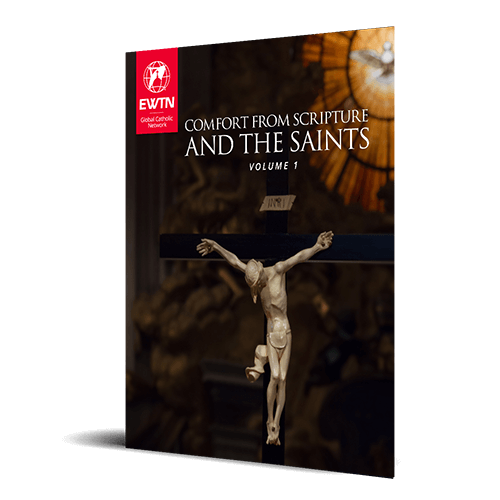
This eBook combines stunning photography from EWTN’s Vatican Bureau along with Bible passages and saints’ quotes that will calm your heart, give you hope, and remind you that God is with us always. Simply fill out the form below and we will send this to you!
Be inspired to follow in the footsteps of the saints. Subscribe to receive the Daily Saint, featuring a brief biography delivered to your inbox each day.
Start now and let the intercession and witness of the saints draw you closer to God.

As we deepen our relationship with the Eternal Word, Jesus Christ, we grow in grace and are transformed by His love and mercy.
STEP 1
We’re here to serve you. Let us help you complete your gift with confidence.

Send a message to Mission Advancement.

Guidance for DAFs, stock, IRA, and more.

Manage your gifts and preferences.