

Your Faith Journey with EWTN
As we deepen our relationship with the Eternal Word, Jesus Christ, we grow in grace and are transformed by His love and mercy.
c. 1268–April 20, 1317
Patron Saint of Montepulciano, religious sisters, children, those seeking purity and holiness

St. Agnes of Montepulciano was a remarkable woman whose holiness was evident from childhood. Born in the 13th century into a noble family in Tuscany, she demonstrated a profound faith and spent hours on her knees in prayer as a child. At age six, she asked her parents for permission to enter a monastery, but they refused.
At only nine years old, with her parents’ permission and a dispensation from the pope, St. Agnes entered an austere women’s community that wore habits made of sackcloth. Her spiritual maturity soon distinguished her among the sisters. At age 15, she was among several sisters sent to help establish a new monastery in Proceno, where she served as the community’s prioress.
In 1306, despite her poor health, the townspeople of Montepulciano called St. Agnes back to head a new monastery there. She built a church and, after experiencing a vision of St. Dominic, led her congregation to observe the Rule of St. Augustine and take the Dominican habit.
St. Agnes was known for her extraordinary devotion to the Eucharist and Christ’s Passion. Accounts of her life describe frequent ecstasies, visions, and miraculous healings attributed to her prayers. Despite these extraordinary gifts, she remained deeply humble, obedient to God, and a servant leader to her community.
St. Agnes’s health deteriorated in her later years. She died on April 20, 1317, surrounded by her sisters. When her tomb was later opened, her body was found to be incorrupt. She was canonized in 1726.
According to accounts, St. Agnes performed numerous miracles, including levitation during prayer, multiplying bread for her convent, and the healing of the sick. She experienced visions of the infant Jesus and the Virgin Mary. During a vision, she held the infant Jesus and, when the Virgin Mary took Him back, St. Agnes retained a small cross the child had been wearing. She healed the sick and brought a drowned child back to life. She was credited with multiplying loaves of bread to feed her convent. According to reports, on ten consecutive Sundays, an angel brought her a consecrated Host after she missed Mass due to being in deep ecstasy. After her death, her body was found to be incorrupt, and a sweet-smelling liquid flowed from her hands and feet.
The “age of reason” refers to the point in childhood when a person is considered capable of distinguishing right from wrong and making a deliberate, free-will choice to follow God. While the “age of reason” is traditionally considered to be seven years old, St. Agnes had already left childhood games behind by the age of four, spending hours in secluded prayer. Her desire to serve God in the religious life began when, at age six, she asked her parents to let her enter the convent. This demonstrated a level of spiritual clarity and intent usually reserved for older individuals. Her parents initially refused because she was too young, but they eventually allowed her to join the Sisters of the Sack in Montepulciano at nine years old. Although her parents consented, she still needed special permission from the pope because Church law required a higher age of entry. Early entry into her vocation set the stage for her remarkably rapid advancement; she was appointed abbess at 15, once again with special papal approval.
The body of St. Agnes of Montepulciano did not decompose. After her death, her limbs remained supple, and her body was found to be intact when moved years later. Her body emitted a pleasant, sweet aroma, and a mysterious, fragrant liquid was reported to flow from her hands and feet. While her body was temporarily moved to Orvieto in 1435, it was later returned to the convent she founded in Montepulciano. Incorruption has traditionally been viewed by the Church as a sign of purity and holiness, although not a requirement for sainthood. In St. Agnes’s case, the preservation of her body strengthened devotion to her and affirmed the testimony of those who witnessed her virtuous life and miraculous intercession. The incorrupt body of St. Agnes of Montepulciano is venerated in the Santuario di Sant’Agnesse (Church of St. Agnes) in Montepulciano, Italy, where it is preserved in a glass case above the high altar.
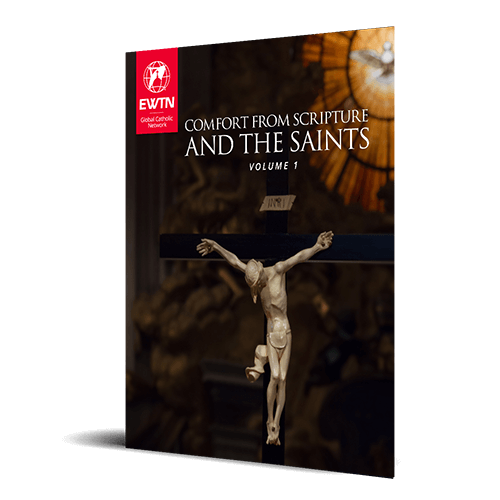
This eBook combines stunning photography from EWTN’s Vatican Bureau along with Bible passages and saints’ quotes that will calm your heart, give you hope, and remind you that God is with us always. Simply fill out the form below and we will send this to you!
Be inspired to follow in the footsteps of the saints. Subscribe to receive the Daily Saint, featuring a brief biography delivered to your inbox each day.
Start now and let the intercession and witness of the saints draw you closer to God.

As we deepen our relationship with the Eternal Word, Jesus Christ, we grow in grace and are transformed by His love and mercy.
STEP 1
We’re here to serve you. Let us help you complete your gift with confidence.

Send a message to Mission Advancement.

Guidance for DAFs, stock, IRA, and more.

Manage your gifts and preferences.