

Your Faith Journey with EWTN
As we deepen our relationship with the Eternal Word, Jesus Christ, we grow in grace and are transformed by His love and mercy.
March 25, 1347–April 29, 1380
Patron Saint of Europe, Italy, nurses, the sick, fire prevention, and miscarriages

St. Catherine of Siena was a mystic, peacemaker, and fearless advocate for reform. Born in 1347 during a time of political unrest, she was the 25th child of her family. From early childhood, she experienced mystical visions and developed a deep love for Christ.
At age 16, she joined the Third Order of St. Dominic, dedicating herself to prayer while remaining in her family home. However, this caused her great pain, as her family sought to see her married and tried to distract her from her spiritual devotions.
When she turned 18, she received the Dominican habit and lived in a cell connected to the convent, where she dedicated her life to serving God. During the devastating years of the Black Death plague, she cared for the sick and dying with heroic compassion. Gradually, her holiness drew clergy and laypeople who sought her spiritual counsel.
Despite having little formal education, St. Catherine dictated hundreds of letters to popes, bishops, and civic leaders. At the time, the papacy had been residing in Avignon for nearly 70 years. With humility yet bold conviction, she urged Pope Gregory XI to return to Rome to strengthen the Church. Her appeals bore fruit when he returned in 1377.
Her most famous work, The Dialogue, presents profound theological reflections on divine Providence, mercy, and the love of Christ crucified. This work came from dictation of her ecstasies, where she conversed with Christ. Her spiritual gifts included stigmata, visions, ecstasies, prophecies, and spiritual wisdom.
St. Catherine died in Rome in 1380 at the age of 33. Canonized in 1461 and declared a Doctor of the Church in 1970, she was later named co-patroness of Europe.
The Dialogue of Divine Providence, commonly called The Dialogue, is St. Catherine’s principal spiritual work. Dictated during mystical prayer, it presents a conversation between a soul and God the Father. The work explores themes such as divine mercy, the value of suffering, the importance of virtue, and the reform of the Church. It explores the path to divine union, the “bridge” that connects the soul to God, and the necessity of truth, humility, and love. The dialogue covers topics such as the soul’s journey to God, the importance of self-knowledge, the role of charity, and the necessity of suffering to grow in virtue. It is regarded as one of the most profound works on Christian mysticism and spirituality, providing a roadmap for developing an intimate relationship with God. Its theological depth and spiritual insight contributed significantly to her being named a Doctor of the Church.
During the 14th century, the popes resided in Avignon, France, rather than Rome. St. Catherine believed this absence weakened the Church’s unity. She played a pivotal role in ending the 70-year Avignon Papacy by urging Pope Gregory XI to return to Rome through persistent letters and personal, face-to-face visits in 1376. She challenged him to stop acting as a French agent, embrace his role as the Vicar of Christ, and restore peace and unity to the Church. Beyond personal conviction, she argued that the pope’s absence was devastating to Italy’s spiritual and political stability. She also worked to broker peace in Italian city-states to facilitate this move. Despite opposition from his cardinals and fears of assassination, she, through her bold yet respectful counsel, encouraged him to reestablish the papacy in Rome in 1377, an event that shaped Church history.
St. Catherine’s body is enshrined in the Basilica of Santa Maria sopra Minerva in Rome. Her head, however, is preserved in the Basilica of San Domenico in Siena, her hometown. These relics have long been places of pilgrimage. Her relics were divided between Rome and Siena, Italy. According to legend, in 1380, followers from Siena brought her head from Rome and returned it to her hometown. To avoid detection, they hid it in a bag. When stopped by guards, they prayed for her help, and the head miraculously appeared to the guards as rose petals.
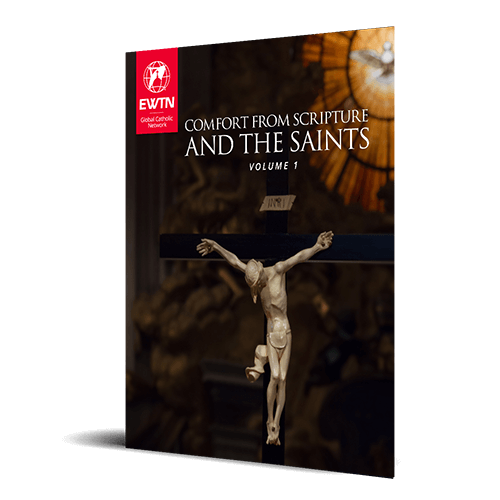
This eBook combines stunning photography from EWTN’s Vatican Bureau along with Bible passages and saints’ quotes that will calm your heart, give you hope, and remind you that God is with us always. Simply fill out the form below and we will send this to you!
Through reenactments and interviews with Church historians, Dr. Matthew Bunson brings the mystical works and prolific writing of St. Catherine of Siena to life.
Learn more about St. Catherine of Siena, as Richard Payne takes us through an interview with the saint and she answers questions from a modern-day audience.
Discover Catherine of Siena in her native Italy. Fr. Jacques Daley visits where St. Catherine tirelessly served God and the Church, and actress Mary McCown brings back to life this saint, considered a Doctor of the Church.
Be inspired to follow in the footsteps of the saints. Subscribe to receive the Daily Saint, featuring a brief biography delivered to your inbox each day.
Start now and let the intercession and witness of the saints draw you closer to God.

As we deepen our relationship with the Eternal Word, Jesus Christ, we grow in grace and are transformed by His love and mercy.
STEP 1
We’re here to serve you. Let us help you complete your gift with confidence.

Send a message to Mission Advancement.

Guidance for DAFs, stock, IRA, and more.

Manage your gifts and preferences.