

Your Faith Journey with EWTN
As we deepen our relationship with the Eternal Word, Jesus Christ, we grow in grace and are transformed by His love and mercy.
c. 560–April 4, 636
Patron Saint of the internet, computers, students, scholars, encyclopedists, educators

St. Isidore of Seville stands as a model scholar and leader whose dedication to knowledge guided the Church through a period of transition in the early Middle Ages.
Born around 560 in Cartagena, Spain, St. Isidore came from a remarkable Christian family. His brothers Leander and Fulgentius and his sister Florentina are all recognized as saints. Under his brother Leander’s guidance, St. Isidore received a strong religious education. Despite initially struggling with his studies, he later developed an extraordinary love for learning.
When St. Isidore became Bishop of Seville around 600, he dedicated himself to strengthening the Church in Spain through education, reform, and pastoral care. He convened councils, improved training for the clergy, and worked to unify the Visigothic kingdom in the Faith after centuries of division.
St. Isidore believed knowledge should serve truth and bring souls closer to God. His most famous work, the Etymologiae, gathered learning from classical and Christian sources into an organized reference, preserving theology, history, medicine, science, grammar, and philosophy when ancient knowledge risked being lost.
In addition to his scholarly achievements, St. Isidore was a devoted pastor. He preached with clarity and conviction and encouraged moral reform. He believed that studying the world and its knowledge helped to understand divine truths.
St. Isidore died peacefully on April 4, 636. In 1722, he was declared a Doctor of the Church. St. Isidore has been named the patron saint of the internet and computers, in recognition of his role in organizing and transmitting knowledge for the good of humanity.
St. Isidore was declared a Doctor of the Church because of the lasting importance of his writings and teaching. His works clarified Christian doctrine, preserved essential knowledge, and helped shape theological education for centuries. St. Isidore is recognized as the last of the early Western Church Fathers. He emphasized education for the clergy, requiring seminaries in every diocese and promoting the study of liberal arts, law, and theology. He also standardized liturgical practices and composed hymns for worship. As Archbishop of Seville, he played a critical role in converting the Visigoths from Arianism to Catholicism. He presided over pivotal councils that helped convert Arians to orthodox Catholicism, unifying the Church in Spain.
St. Isidore’s Etymologiae was one of the most influential books of the Middle Ages. Serving as an early encyclopedia, it gathered and organized knowledge from many fields at a time when access to learning was limited. This work was a monumental 20-volume encyclopedia that preserved the classical knowledge of the Middle Ages and integrated it with ancient learning on a variety of subjects, earning St. Isidore the title “Schoolmaster of the Middle Ages.” As Roman infrastructure collapsed, he recognized the need to compile a comprehensive summary of classical, theological, and scientific knowledge to preserve it for posterity, drawing on the knowledge of more than two hundred authors. The work covers diverse topics, including law, medicine, theology, mathematics, and natural history, using a method that explains the meaning of words to define the topics. This immense work enabled scholars, even when separated from the original source texts, to access the wisdom of the past, earning St. Isidore the title of Patron Saint of the Internet.
St. Leander of Seville, who died around 600, personally prepared his younger brother, St. Isidore, to succeed him as archbishop. He served as St. Isidore’s mentor, guardian, and teacher after their parents died. As an older brother, St. Leander, who was Archbishop of Seville, ensured St. Isidore received a thorough education in grammar, logic, rhetoric, and Scripture, laying the intellectual foundation for his future role. He also mentored St. Isidore in the Church’s crucial work of navigating and shaping the religious and political shifts in the Visigothic kingdom. St. Leander’s foundational training and spiritual guidance prepared St. Isidore for the pastoral challenges of leading the Church in Spain, enabling him to continue his brother’s work.
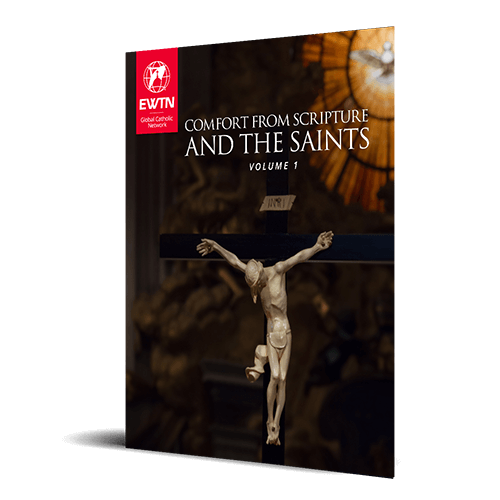
This eBook combines stunning photography from EWTN’s Vatican Bureau along with Bible passages and saints’ quotes that will calm your heart, give you hope, and remind you that God is with us always. Simply fill out the form below and we will send this to you!
Be inspired to follow in the footsteps of the saints. Subscribe to receive the Daily Saint, featuring a brief biography delivered to your inbox each day.
Start now and let the intercession and witness of the saints draw you closer to God.

As we deepen our relationship with the Eternal Word, Jesus Christ, we grow in grace and are transformed by His love and mercy.
STEP 1
We’re here to serve you. Let us help you complete your gift with confidence.

Send a message to Mission Advancement.

Guidance for DAFs, stock, IRA, and more.

Manage your gifts and preferences.