

Your Faith Journey with EWTN
As we deepen our relationship with the Eternal Word, Jesus Christ, we grow in grace and are transformed by His love and mercy.
3rd century–283 A.D.

St. Eutychian (also known as Eutychianus) served as Pope and Bishop of Rome for eight years, from 275 to 283 A.D.
Little is known about his early life or papacy beyond tradition. His epitaph was discovered in the Catacombs of Callixtus, confirming his existence and burial. He is known for having made a regulation allowing the blessing of grapes and beans on the altar.
Pope St. Eutychian is said to have buried more than three hundred martyrs with his own hands. Some accounts say St. Eutychian required martyrs to be buried in a red tunic called a dalmatic to signify their martyrdom; however, these accounts have not been verified.
He is called a martyr, but there is no record of how he died. Records of his reign may have been destroyed during an intense persecution of Christians by Emperor Diocletian following St. Eutychian’s death.
St. Eutychian was the last of the popes to be buried in the Catacombs of Callixtus. He was the 27th pope in the line of pontiffs to lead the Church. Though records are sparse, his legacy is one of pastoral care during a time when the Church still faced intermittent persecution and needed steady leadership to encourage the faithful.
Sources disagree on details: for example, the Liber Pontificalis, a book on the biographies of the popes, gives his reign as eight years and eleven months, from 275 to 283, while some other early historians, like Eusebius, suggest a much shorter period. Some of the information attributed to tradition lacks contemporary confirmation and may reflect later additions.
The blessing of produce, such as grapes and beans, reflects a longstanding Jewish and Christian practice. Offering the first fruits or seasonal harvests to God acknowledges His providence and expresses gratitude for His bounty. St. Hippolytus mentions prayers for blessing new fruits in the early third century. In the fourth century, prayers used for the blessing of fruits are found in the Apostolic Constitutions, a collection of early Christian writings on practices and worship.
The burial of martyrs was a significant act during the early Church period. Cremation was the standard practice for pagans in the Roman Empire, although some did bury their dead. Honoring the remains of the martyrs encouraged and strengthened the faithful. Shrines built over graves or relics of the martyrs became places of pilgrimage to honor their act of martyrdom.
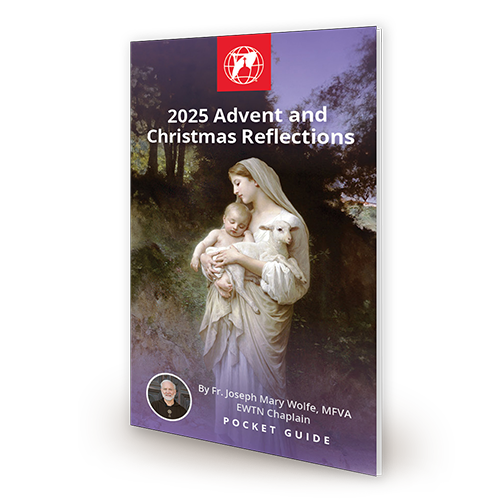
Sign up below for the free 2025 Advent and Christmas Reflections pocket guide, featuring meditations by Fr. Joseph Mary Wolfe, the EWTN Chaplain. His video series will also be sent to your email each Sunday of Advent and throughout the Christmas season. When you request the pocket guide by mail, we’ll also email you the eBook version. Or you may choose to receive just the eBook version and video series.
Send me the Physical Pocket Guide
Only available to homes in the U.S.A., while supplies last.
Send me the eBook
Be inspired to follow in the footsteps of the saints. Subscribe to receive the Daily Saint, featuring a brief biography delivered to your inbox each day.
Start now and let the intercession and witness of the saints draw you closer to God.

As we deepen our relationship with the Eternal Word, Jesus Christ, we grow in grace and are transformed by His love and mercy.
STEP 1
We’re here to serve you. Let us help you complete your gift with confidence.

Send a message to Mission Advancement.

Guidance for DAFs, stock, IRA, and more.

Manage your gifts and preferences.