

Your Faith Journey with EWTN
As we deepen our relationship with the Eternal Word, Jesus Christ, we grow in grace and are transformed by His love and mercy.
c. 284-285–December 31, 335
Patron Saint of Benedictine order, Sylvestrine order, Feroleto Antico, Italy, and Nonantola, Italy

Pope St. Sylvester I held the first full papal reign under the Edicts of Toleration, which ended the persecution of Christians and legalized Christianity in the Roman Empire.
Pope St. Sylvester I served as pope from 314 to 335, one of the longest pontificates in the early Church. Two edicts, called the Edicts of Toleration, were pivotal during his pontificate. The Edict of Serdica in 311 put a stop to Christian persecution, and the Edict of Milan in 313 legalized Christianity, giving Christians the freedom to practice their Christian faith openly.
During his papacy, Pope St. Sylvester I presided over a period of growth, with the construction of major Roman basilicas funded by the Emperor Constantine. Among them were the Lateran Basilica, which became the cathedral of Rome, and the original St. Peter’s Basilica.
When the Council of Nicaea convened in 325, Pope St. Sylvester I was advanced in years and unable to travel. He sent two legates who represented the Roman See. He stayed informed of the proceedings, and the legates gave his approval for the creation of the Nicene Creed, which he is also credited with helping to formulate with the term consubstantial.
This Council, one of the most pivotal in Church history, was attended by bishops from all over the empire. Attendees condemned the heresy of Arianism that denied Christ’s divinity and affirmed that Christ was fully God and fully man. The Council of Nicaea also approved the wording of the Nicene Creed and set the official date for the Solemnity of Easter.
Pope St. Sylvester I’s support gave the Council’s decisions weight in the Western Church. Being an ecumenical council representing the entire Church, the decisions made there were considered infallible in matters of faith and morals because those present spoke in one voice as the teaching office of the Church.
Pope St. Sylvester I died in 335 and was buried in the Catacomb of St. Priscilla on the Via Salaria in Rome. He steered the Church through a period of sweeping change, ensuring that the Faith remained firmly rooted in apostolic tradition.
By 325, Pope St. Sylvester I’s advanced age and health prevented him from traveling long distances. Although he was not present at the Council of Nicaea, he sent two priests as his legates. Their attendance confirmed the pope’s endorsement of the Council’s work. Because the Roman pontiff was recognized as head of the Church, his support of the Council’s efforts to defeat the Arian heresy and his approval of the wording in the Nicene Creed were critical. Although Eastern bishops dominated the Council, Pope St. Sylvester I provided the validation needed from the Roman See to secure the Western Church’s support.
Pope St. Sylvester I completed the Lateran Basilica in 324 A.D. Although rebuilt over time, it has continuously served as the pope’s seat of authority, or cathedra, for all the popes up to the present. The words, “Mother of all the Churches of Rome and of the world,” are inscribed in Latin on the basilica’s facade. It is called an archbasilica because it is the most important of the four major basilicas in Rome.
After the Emperor Constantine legalized the Faith, he gave several properties to Pope St. Sylvester I for Church use. One of those properties belonged to the Lateran family and was seized from them when the Roman authorities accused them of conspiracy against Rome. The property was in the hands of the Roman Empire for 250 years until the Emperor Constantine gifted it to the Church when Christianity was legalized. The pope built his cathedral and residence on the property.
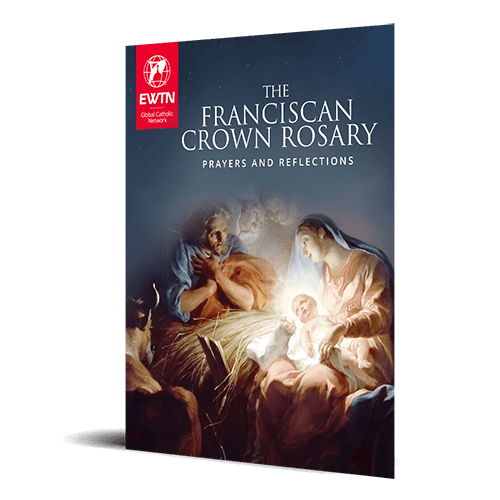
One unique devotion of the Franciscans is a seven-decade rosary known as the Franciscan Crown. While the traditional rosary consists of 5 decades which meditate on 15 mysteries, the 7-decade Franciscan Rosary, known as the Franciscan Crown, is a Rosary consisting of seven decades with each decade describing a particular joy from the life of the Blessed Virgin Mary. We hope that this special resource will help you meditate on each of the Seven Joys of Our Blessed Mother Mary.
Come explore the great stational churches of Rome on a Lenten Pilgrimage with Dr. Timothy O’Donnell. In this program, he explores the church of St. Martin and St. Sylvester on the Mountain.
Be inspired to follow in the footsteps of the saints. Subscribe to receive the Daily Saint, featuring a brief biography delivered to your inbox each day.
Start now and let the intercession and witness of the saints draw you closer to God.

As we deepen our relationship with the Eternal Word, Jesus Christ, we grow in grace and are transformed by His love and mercy.
STEP 1
We’re here to serve you. Let us help you complete your gift with confidence.

Send a message to Mission Advancement.

Guidance for DAFs, stock, IRA, and more.

Manage your gifts and preferences.