

Your Faith Journey with EWTN
As we deepen our relationship with the Eternal Word, Jesus Christ, we grow in grace and are transformed by His love and mercy.
Died in 652

St. Adalbald of Ostrevant (also known as Adalbert) was a seventh-century nobleman in northern France. He lived a virtuous life as a Christian during an era when Christianity continued to spread into rural pagan territories. Although much of his life is known through local tradition, St. Adalbald is remembered as a model layman whose faith guided his public and private life.
Born into a noble Frankish family, St. Adalbald inherited lands in Ostrevant, a region situated between modern-day Arras and Douai in northern France. Rather than using his position for privilege, he devoted himself to the service of the Church and the poor.
St. Adalbald was known for supporting monastic communities and offering hospitality to travelers and people in need. His life reflects the early medieval ideal of Christian nobles who took accountability for the welfare of the less fortunate with humility and charity.
In 652, St. Adalbald implemented religious reforms in Gascony. Threatened that he was usurping their power in the region, his in-laws murdered St. Adalbald. His wife, Rictrude, rejected her family’s demands to remarry. She lived out her life as the abbess of the monastery she and St. Adalbald built together and is recognized as a saint by the Catholic and Orthodox Churches. Their four children are also venerated as saints.
St. Adalbald lived his lay vocation fully by serving his family, strengthening the Church, and showing compassion for the most vulnerable. His example encourages each of us to pursue holiness in the daily responsibilities entrusted to us.
While St. Adalbald of Ostrevant is not listed in the Church’s official records as a martyr, he is venerated as such for several reasons. He was a holy Frankish nobleman killed by his in-laws in Gascony around 652 for his zealous Christian Faith, as he tried to make reforms in a largely pagan region. People in his community reported many miracles attributed to his tomb, leading to his veneration as a martyr and to his death being recognized as martyrdom for the Faith. He supported the Church and founded a monastery. St. Adalbald is honored for his generosity in charitable works, prayer, and dedication to God, even in death, making him a model of Christian virtue.
Christian nobles in the Middle Ages held a strong ideal, rooted in Church doctrine, that they were accountable for the welfare of the poor. They gave alms, provided hospitality, supported hospitals, and established monasteries as visible signs of faith and as part of a divinely ordained social structure in which the rich helped the poor. There were no government welfare programs at the time, so the nobles saw charitable works as a religious obligation and a Christian calling to care for those in need. Caring for the poor wasn’t just a good deed; it was a fundamental component of a noble’s Christian identity and directly tied to their spiritual destiny.
Marchiennes Abbey, founded around 630 by St. Adalbald of Ostrevant, was a major Benedictine monastery in France for centuries, influential for its illuminated manuscripts. The abbey reached its peak power, even supporting a college at Douai University, but suffered greatly in 1566 when iconoclasts destroyed much of its art. Bombarded during the Siege of Marchiennes (1712), the abbey was partially destroyed but later restored; however, it fell with the French Revolution. The impressive 1748 abbey gatehouse and some operational buildings (like the brewery) still stand. These remnants were designated national historical monuments in France in 1974, placing them under strict state oversight for protection and preservation.
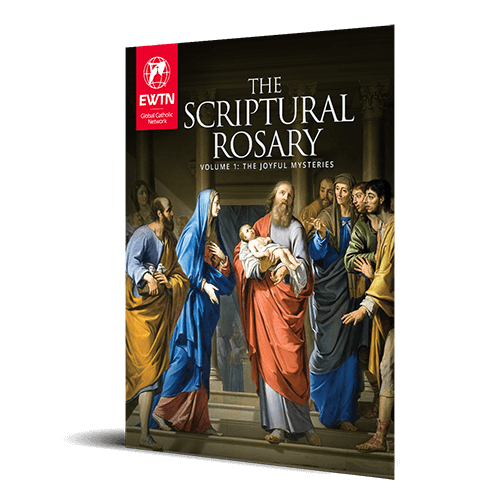
The Holy Rosary is an amazing prayer, encouraged by popes, loved by saints, and prayed by the faithful. At its heart, the Rosary is a meditation on Sacred Scripture, on the lives of Jesus and Mary.
Through this Scriptural Rosary, we hope that you will be able to better meditate on each Hail Mary and deepen your understanding of Sacred Scripture. Use the form below to get your free copy of The Scriptural Rosary.
Be inspired to follow in the footsteps of the saints. Subscribe to receive the Daily Saint, featuring a brief biography delivered to your inbox each day.
Start now and let the intercession and witness of the saints draw you closer to God.

As we deepen our relationship with the Eternal Word, Jesus Christ, we grow in grace and are transformed by His love and mercy.
STEP 1
We’re here to serve you. Let us help you complete your gift with confidence.

Send a message to Mission Advancement.

Guidance for DAFs, stock, IRA, and more.

Manage your gifts and preferences.